I am no expert photographer, preferring to capture the moment than get a perfectly composed shot. The pictures on my blog are either taken with a compact Canon, a Panasonic Lumix FZ150 or on my phone.


Sunday, 15 April 2012

Alicante, Spain - Butterflies - April 2011

After a long and exceptionally snowy winter we headed for the sun of southern Spain for a week. We rented an apartment in Torrevieja, which unfortunately didn't prove to be a particularly good location for butterflies.


These little Geranium Bronzes, Cacyreus marshalli, have spread along much of the Mediterranean after being introduced from Southern Africa on geranium plants. They were enjoying the pot plants at the apartment.


I've never had any luck photographing the upper side of the wings!

Most of the area around the apartment was quite built-up and the surrounding landscape was very flat. I had been recommended a walk along a river - the Rio Segura, where there may have been more butterflies. Unfortunately the day I was there it was quite windy, so there were very few butterflies about. Of course, I saw the ubiquitous Small White butterfly, Pieris rapae.

Part way along the river I spotted a track heading up towards a farm where there was a scrubby knoll that I thought looked promising. On one small sheltered, sunny spot I saw some blue butterflies amongst the wild flowers and herbs. They turned out to be Black-eyed Blues, Glaucopsyche melanops. They are stunning little butterflies. The the upper side of the males are two shades of blue with a black surround and narrow white edge. The females are mostly brown with a few blue flecks. The under-sides of the wings are grey with lovely black markings.


I spent some time just watching the small colony of these beautiful little creatures. I had a very brief view of these in Portugal a couple of years earlier, but it was fantastic being able to watch them so closely.

On the drive back to the apartment I saw a small white butterfly at the side of the road, so I stopped and tried to get a closer look. It turned out to be a Bath White, Pontia daplidice, but it wasn't keen on stopping for a picture. This was the best I could manage. I did see them later in the holiday in a couple of places, but never managed a picture.

Another day I headed for the distant hills, thinking that there may be more butterflies there. However, the hills seemed to be further away than I thought and I got a little lost and ended up by a reservoir. Initially there didn't seem to be many butterflies there, but after I had been there a while they started to appear. This is a Spanish Marbled White, Melanargia ines. There were a couple of them arguing over a sunny spot. I kept trying to follow them to take a photograph, but every time one settled the other would fly past and disturb it. I noticed that they always came back to the same point and so I just sat and waited with my camera ready and before long one flew into shot!

Other butterflies that I saw on the trip were:
Painted Lady, Vanessa cardui
Large White, Pieris brassicae
Swallowtail, Papilio machaon
Clouded Yellow, Colias crocea
Southern Swallowtail, Iphiclides feisthamelii
Speckled Wood, Pararge aegeria aegeria
Wall Brown, Lasiommata megera
Red Admiral, Vanessa atalanta
13 butterflies in total. I was expecting to see more, but I was thrilled to get good views of the Black-eyed Blues and Spanish Marbled Whites and I was particularly pleased to see the Bath Whites, a butterfly I hadn't seen before.

Thursday, 12 April 2012

Large White - Pieris brassicae

Two summers ago our kids occupied themselves one day by collecting caterpillars from some nasturtiums growing outside our neighbour's house and bringing them into our garden to eat our nasturtiums!


They turned out to be the caterpillars of Large White butterflies, Pieris brassicae. Over the next few days they grew bigger ...


... until our nasturtiums had almost all been eaten! Then one day I noticed a couple of caterpillars climbing up the walls of the house.


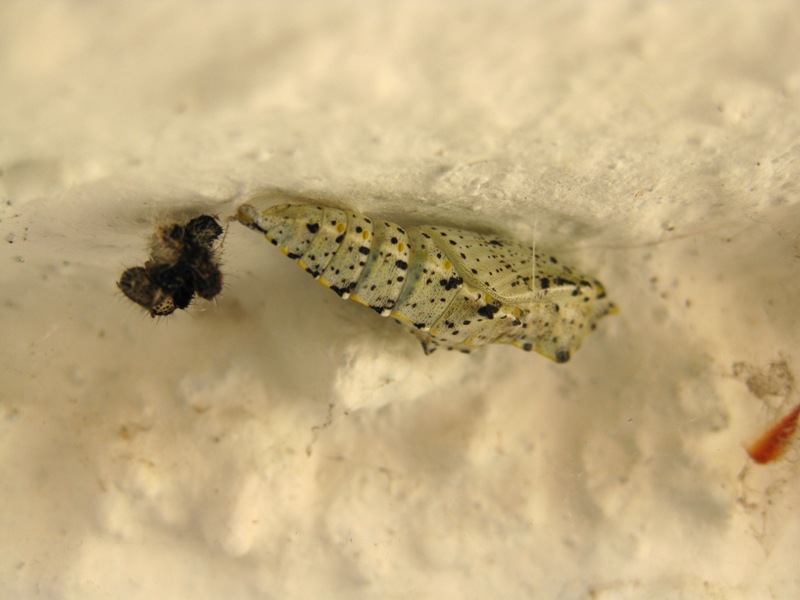
When they reached a sheltered spot they shed their skin and then started to fatten up. If you look carefully, there is a length of silk around the second segment from the right holding the caterpillar to the wall.


Within an hour or so, they were looking more like a chrysalis.


And this is what they looked like a couple of days later. This was the end of September and the chrysalises remained there all winter. One day the next spring I checked and discovered that the chrysalises had all emerged and I had missed the butterflies!


This is what the adult butterflies would have looked like.


Wednesday, 11 April 2012

Menorca eggs!

There were so many butterflies in the orchard of the villa we rented that on three occasions a butterfly landed close to me and laid an egg.

This one is a Clouded Yellow, Colias croceus, or at least I think it is. The butterfly that laid it was a pale form and possibly could have been a Berger's Clouded Yellow, Colias alfacariensis. The only way I know to tell the two apart is by the caterpillar, but unfortunately I never found it!

This one was laid by a Cleopatra, Gonepteryx cleopatra. A few days later I saw a little caterpillar on the same leaf, but I didn't see it again after that despite looking on several occasions.

This egg was laid by a Swallowtail, Papilio machaon. When it was laid it was white and it turned yellow the first day. Three days later a brown line appeared around the egg and the next day it hatched.

Here it is chewing on its egg shell. Unfortunately, this was the last day of our holiday so I didn't get to see it develop any further. They grow into spectacular-looking caterpillars.


Friday, 23 March 2012

Menorca - Butterflies - July 2010

Menorca is a small island in the Mediterranean Sea. There are about 25 species of butterflies occurring there with another five or so having been recorded as vagrants. We spent two weeks there in the summer of 2010, staying in an old farm house near the centre of the island. Attached to the house was an orchard, (where my daughter counted 19 different kinds of fruit trees) which turned out to be the perfect place for butterflies. I wasn't expecting to see too much, but I was to be pleasantly surprised.


We arrived in the evening just as the sun was going down, but there were still some Speckled Woods, Pararge aegeria aegeria, flying by the house. These proved to be very common flying anywhere with a bit of dappled shade.

Probably even more abundant than the Speckled Woods were Holly Blues, Celastrina argiolus. I was delighted to see so many of them living along the ivy-covered walls of the orchard.

Southern Brown Argus, Arica cramera, enjoyed the wild flowers in the orchard...

... along with a few Common Blue, Polyommatus icarus.

The Small Copper, Lycaena phlaeas, was less common, but still a lot more abundant than in Scotland.

I am used to seeing Small Heaths, Coenonympha pamphilus, on coastal grasslands and moors in Scotland. They seemed a bit out of place to me in the orchard. Back home they also tilt their wings towards the sun whenever they land in order to catch as much warmth as possible. In Menorca they always faced into the sun so as to catch as little sun as possible!

I was pleased to see a lot of Clouded Yellows, Colias croceus,  in the orchard. They seemed a lot less timid than those I had seen in Portugal.

The other yellow butterfly that occurs there is the Cleopatra, Gonepteryx cleopatra. These have a lovely flash of orange on their upper wing, but they always rest with their wings closed so it is only visible when they are flying. They also have an amazing ability to blend into the ivy when they roost at night.

As in most places in Europe, Large Whites, Pieris brassicae, were fairly common.

I saw one or two Small Whites, Pieris rapae, too.

A familiar sight in Scotland, but not so common on Menorca is the Meadow Brown, Maniola jurtina.


I spent ages following a Southern Gatekeeper, Pyronia cecilia, along the Alengdar Gorge, but it just wouldn't settle long enough for me to take a photo. This one appeared in the orchard and was much more obliging.

What I assume was the same Painted Lady, Vanessa cardui, always appeared in one particular area of the orchard.

Red Admirals, Vanessa atalanta, enjoyed the fallen fruit. They are amazingly well camouflaged when their wings are closed.

Having only just discovered Wall Browns, Lasiommata megera, back in Scotland it was funny also finding them in Menorca. As with most of the butterflies I saw there, they rested with their wings closed, whereas in cooler Scotland they tend to rest with their wings open absorbing the sun's rays.

This is the best picture I could manage of a Two-tailed Pasha, Charaxes jasius. These are amazing butterflies with a really powerful flight. It was great watching them gliding amongst the fruit trees.

On the last day of our holiday this Lang's Short-tailed Blue, Leptotes pirithous, visited a bush next to the swimming pool were it remained for most of the day.

The other three species that I saw, but wasn't able to take a picture of were a Long-tailed Blue, Lampides boeticus, a Swallowtail, Papilio machaon and a Geranium Bronze, Cacyreus marshalli, making 20 species for the trip. This was a lot better than I had expected. What Menorca lacks in variety of species is more than made up for by the number of butterflies in the air.

Wall Brown - Lasiommata megera

When I had been down in the Borders looking at the Small Blues I briefly saw a couple of Wall Brown butterflies, Lasiommata megera. It struck me that the area was very similar to a section of the coastal path in East Lothian and as I heard that Wall Browns had been extending their range northwards I thought I should have a look at an area near Bilsdean.
I was involved with the construction of this section of the coastal path, called the John Muir Way, so I knew it well and also knew that I had never seen Wall Browns there before.
In June 2010 I went to Bilsdean one lunch hour and walked along the path and very soon a small butterfly flew up and over my head. When it landed I was delighted to see it was a Wall Brown!


This is a female ...


... and this is a male.
I saw five that day and returned later in the year to find that they had obviously bred and produced a second generation. As far as I am aware, the only other record of a Wall Brown in East Lothian was one that was seen in 2005. These, though are breeding and established in East Lothian.


I returned in 2011 and was pleased to see good numbers and that they have moved slightly further up the coast. In fact I also saw one about 20 miles up the coast and heard a report that they had been seen in John Muir Country Park about 30 miles from the original site, so I think that they are well and truly established here now.

Small Blue - Cupido minimus

In late May 2010 I headed down to a small site on the Scottish Borders coast where I had heard that there is a small colony of Small Blue butterflies, Cupido minimus. This is the UK's smallest butterfly which occurs mostly on the south coast of England but also has a few scattered colonies around the Scottish coast.
I was blessed with good weather and after an hour's drive and half an hour's walk I was rewarded with my first view of this beautiful little butterfly.


They really are small, about 18mm wingspan. The upper side of the wings is brown and the males have a scattering of blue scales. The underside is a pale grey with black dots and blue scales towards the base.
The site I found them in is only about 30 feet by 30 feet on a steep scree slope. The colony seems so vulnerable there.


I have since head that another colony has been found not too far away from this one, so it would be nice to think that they are expanding their range.

I returned again in May 2012 to see these lovely little butterflies and they were there again in good numbers. Depending on the weather the adults occur during May and June.


The food plant is kidney vetch, Anthyllis vulneraria, which likes alkaline conditions and seems to do well on cliffs and scree slopes. I imagine that it is easily out-competed by grasses and shrubs, so isn't a particularly common plant.


Eggs are laid on the flower heads and the caterpillars feed on the flower. This flower head has an egg on it.


The eggs are very small - less than a millimetre across.


I was involved with a survey to look for kidney vetch along the coast of Northumberland and the Scottish Borders. I found a few areas, but sadly no more butterflies. I have been told of some areas of kidney vetch in East Lothian, which I will have to check out.

Wednesday, 7 March 2012

Portugal - Butterflies - April 2010

In April 2010 we returned to our friend's villa in the Algarve. This proved to be a very good time of year to be there for spotting butterflies and I found a small area where the land had been leveled in the past and which was now covered in wild flowers. Just next to this were areas of cork oak and grass offering a variety of habitats.

This was one of the first blues I saw, which I later identified as a Black-eyed Blue, Glaucopsyche melanops.

There were a few more Common Blues, Polyommatus icarus, around, but they were all rather worn out. I wonder if they were survivors from last year.

Back at the villa, Geranium Bronze, Cacyreus marshalli, were busy in the garden.

This Swallowtail, Papilio machaon, was in the abandoned orange grove next door.

Back at the wild flower patch, I was delighted to get some pictures of Clouded Yellows, Colias crocea.

I saw a Southern Brown Argus, Aricia cramera, in the same area several times. I suspect it was the same specimen that I saw each time.


This fuzzy picture was the best I could do of the pale form of the Clouded Yellow, Colias crocea.

Amongst the cork oaks were a few Green Hairstreaks, Callophrys rubi. These are beautiful little butterflies that I had never seen before.

Green-striped Whites, Euchloe belemia, were probably the most common butterflies in the area. I really love these striking little butterflies.

Western Dappled Whites, Euchloe crameri, were also fairly common. Another beautiful butterfly that reminded me of my favourite butterfly, the Orange Tip.

I briefly saw a Meadow Brown, Maniola jurtina, a common butterfly back home.
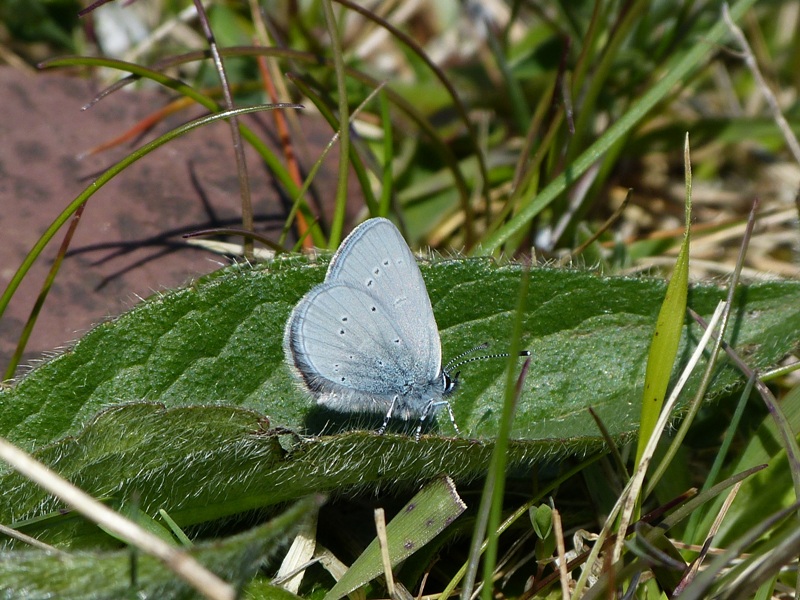
Another common butterfly back home is the Small Heath, Coenonympha pamphilus. We saw this one in a valley up in the mountains.

The moment I took this picture is one of those moments I will always remember. Just after I took the picture my wife came to find me to tell me that she had heard on the news that a volcano had erupted in Iceland and that all flights to the UK had been cancelled. The result of the chaos was that our 14 day holiday ended up as a 22 day holiday, but the last 8 days weren't all fun. We spent hours at internet cafes researching trains, buses and ferries across Portugal, Spain and France to see how we could get home. We also considered renting a car or even buying an old car to get home. After several visits and long queues at the airport our flight was re-scheduled. Anyway, this is a Red-underwing Skipper, Spialia sertotius.

This is a Small Copper, Lycaena phlaeas.

Small Whites, Pieris rapae, seem to occur in most countries I have visited, although they didn't seen to be very common in Portugal.

While I was walking along the road a Spanish Festoon, Zerynthia rumina, caught my eye behaving strangely. It turned out to be laying eggs on the underside of the leaves of some plants. Her is an egg.

And here is an adult Spanish Festoon.

I stalked this Spanish Marbled White, Melanargia ines, for ages, but just couldn't get close to it. This was the best picture I could manage!

In contrast the Speckled Woods, Pararge aegeria, were very obliging.

We had to move along the coast for the last few days of our holiday to a more rural area, but strangely to where there were fewer butterflies. However, the area seemed to be a hot spot for Marsh Fritillaries, Euphydryas aurinia.

During the holiday I also saw:
Wood Whites - Leptidea sinapis
Painted Ladies - Vanessa cardui
Large Tortoiseshell - Nymphalis polychloros
Long-tailed Blue - Lampides boeticus
Red Admiral - Vanessa atalanta
Large White - Pieris brassicae

A total of 24 species during the trip.

Followers