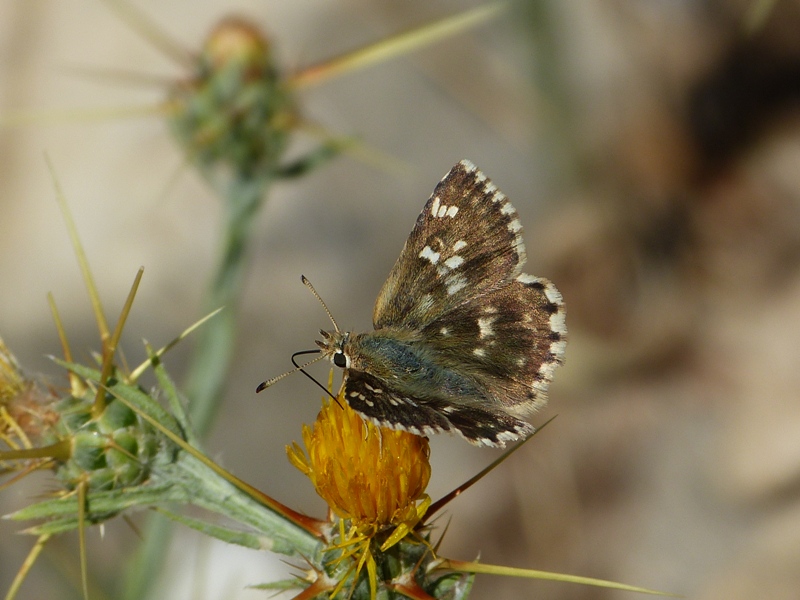
I am no expert photographer, preferring to capture the moment than get a perfectly composed shot. The pictures on my blog are either taken with a compact Canon, a Panasonic Lumix FZ150 or on my phone.


Showing posts with label Thymelicus acteon. Show all posts

Tuesday, 9 July 2024

Malaga Butterflies June 2024

We have just returned from a lovely holiday to the Malaga region of Spain. We were based in Alora, which is about 45 miles north west of Malaga. This was our sixth visit to the area. For our first four visits we were there in the first two weeks in July, two years ago we were there for the first two weeks in June and this year it was the last two weeks in June. It was interesting to compare what butterflies I saw this time with previous visits.

I normally only see Wall Browns high on the hills, but this year they were also along the track close to the villa.


Of course the weather can make a tremendous difference. This year the locals were concerned that there had been virtually no rain for about a year. Lemons and Oranges that should have been harvested last October/November were still hanging on the trees, because they were not good enough to harvest and the landscape looked very dry with hedges and trees dying because of the lack of water. There had been really heavy downpours in other areas of Spain causing flooding, but this area was particularly dry.


Interestingly, the dry weather didn’t appear to have had an impact on butterfly numbers. There were far more Small Whites flying everywhere than I have previously seen. I was really impressed with the flower beds in the centre of Malaga, which were all planted with either native plants, or plants that attracted bees and butterflies, particularly Small Whites.

Small Whites were by far the most common butterflies on this visit.

Unfortunately my usual walk from the villa we rent has been blocked by a new fence. It was a well-used path up the hill and living in Scotland where we have quite liberal access rights it seemed odd that a landowner could block a path like this.


However, I walked along the local tracks and found some new spots where there were plenty of butterflies.

The top of this unassuming hill proved to be a real hot spot for Swallowtails, Long-tailed Blues and Wall Browns. 

I also visited a few great places for butterflies that I have found on previous visits, including the Sierra Nevada mountains, a track near Antequera and a lovely village called Casarabonela, which always seems much greener and more lush than anywhere else around here. In total I managed to identify 51 species of butterflies this holiday and missed several other fly-by species which didn’t stop to let me see what they were.

It seems amazing that so far the dry weather doesn’t appear to have impacted on butterfly numbers. I am not sure if this will continue to be the case, if they don’t have rain soon, as surely the food plants for many species will be drying up.

The one species that I noticed wasn’t present was the African Grass Blue. They like damp grassy areas and I often see them down by the river. However, this year the grass there was dried up. They also like irrigated grass in parks and towns, but water restrictions mean that such areas are not being watered.


We visited the reservoirs at Guadalhorce, which supply much of the water for Malaga. They are currently at 20% of their capacity and are dramatically lower than they were two years ago when we last visited. This was another place where I have seen African Grass Blues in the past, but despite searching I didn’t find any. This year, though, there were a lot of Southern Blues in the same locations.


A nice surprise was to see Monarch butterflies drifting in and out of the lovely big park in the centre of Benalmadena. I wish I had had more time to go into the park to see what other butterflies there were there.

Having erienced a very wet few months in Scotland I don’t often wish it would rain, but I really hope that southern Spain gets some rain this coming winter to replenish the area. Here are a few of the butterflies I saw in the area.

Bath White.

Several Clouded Yellows were attracted to a clump of thistle-like flowers down by the river.


I used to find Dusky Heaths up the path that has been blocked off. Luckily this year there were some along the edge of the track by the villa.

There were two or three Geranium Bronzes flying around the villa garden and laying eggs on the Geraniums. In Alora each planter
down the main street had three or four Geranium Bronzes on the Aptenia cordifolia - a succulent plant with red flowers.

Long-tailed Blues could be found anywhere where Thyme was growing.

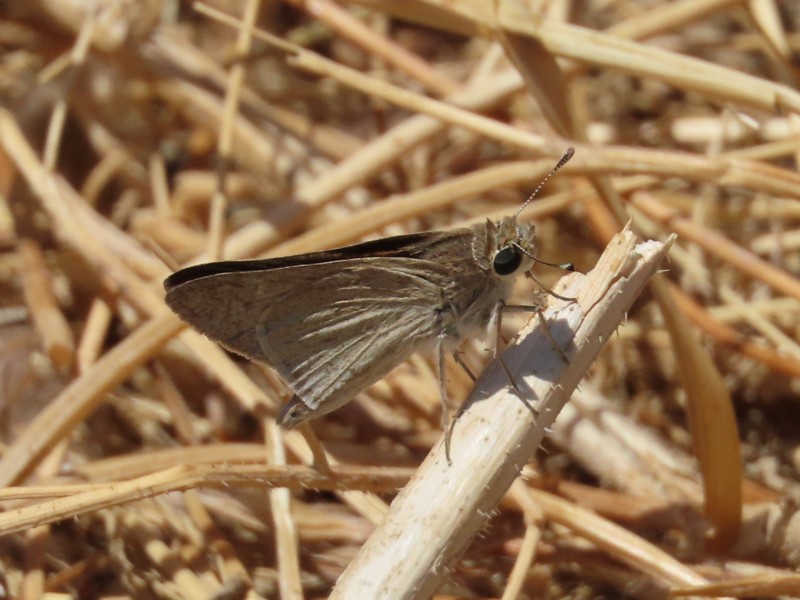
 A small patch of Thyme at the side of the track had Small Whites, Long-tailed Blues and this Lulworth Skipper on it. This was
the only one I saw this holiday.

Meadow Browns tended to hide away from the sun, preferring shade under the scrub.

Mediterranean Skippers were very plentiful. In the past I have only seen one or two in the area.

I only saw one Painted Lady close to the villa.

Sage Skippers were all along the tracks. They tended to fly up when disturbed and whiz around, returning to close to where they
had taken off.

I think I only saw this one Small Copper near the villa.

I love these beautiful Southern Brown Argus.

The Southern Gatekeeper is another butterfly that prefers to stay in the shade. Some years they can be really numerous.
This year there weren't so many.

I was delighted to see a Striped Grayling on the track near the villa. They can be quite common, but I have never seen them there before.

There were a couple of Swallowtails hill-topping on the small hill pictured earlier on in the post.


Sunday, 31 December 2017

Corfu Butterflies II - July 2017

On 1st July I decided to walk up the hill behind our villa. For the first one and a half kilometres I walked along a narrow road and then tracks through olive groves and past houses. I only saw a Meadow Brown and a Skipper while I was walking this section, which didn't bode well!

However, I then turned up a track past a tumbled down farm house and as I left the olive groves, I immediately started seeing great numbers of butterflies. First off, in the shade of some trees were what I think were some Southern Graylings, Hipparchia aristaeus.

In this same area there were also a couple of Meadow Browns, Maniola jurtina.

High up on a banking of brambles, there was a Silver Washed Fritillary, Argynnis paphia, and a Sage Skipper, Syrinthus proto.

As soon as I was back out into the light there were Wall Browns, Lasiommata megera, all along the track.

Among them were some Large Wall Browns, Lasiommata maera, which interestingly were smaller than the Wall Browns here.

The Wall Browns were out-numbered by Balkan Marbled Whites, Melanargia larissa, but here they seemed lighter in colour than those I had seen on the other side of Mount Pantokrator.

I was really thrilled to see a couple of Spotted Fritillaries, Melitaea didyma, on a sunny spot on the track. I spent some time watching them and they kindly stayed still for photographs feeding on yellow thistles.


A little further up the track I saw a Wood White, Leptidea sinapis. Unfortunately, it wouldn't come out into the sun, so it was impossible to get a picture of it without a shadow over the wings.

While I was watching them I photographed a little skipper, which I later identified as a Lulworth Skipper, Thymelicus acteon. There were also several more Sage Skippers higher up the track.

I walked as far as a saddle in the hill where I could see down to the coast on both sides of the island.

It was lovely being in amongst so many butterflies. The Wall Browns and Balkan Marbled Whites continued to be the most common, but there were plenty of other butterflies including Large Whites, Pieris brassicae, Brimstones, Gonepteryx rhamni, Scarce Swallowtails, Iphiclides podalirius, and Small Heaths, Coenonympha pamphilus.

A few days later I walked up there again, but towards the top of the hill I took a different track. This lead me into a wooded area, which was full of Eastern Rock Graylings, Hipparchia syriaca, and various other species, sheltering from the hot sunshine. I spotted a pair of Speckled Woods, Pararge aegeria, on a tree trunk and on the undersides of leaves there were Meadow Browns, Silver Washed Fritillaries and Purple Hairstreaks, Quercusia quercus.

Again, the most numerous butterflies were the Balkan Marbled Whites and Wall Browns. There were a lot more Spotted Fritillaries on this track, including this one with unusual markings.


There were also Sage Skippers, Common Blues, Polyommatus icarus, Long-tailed Blues, Lampides boeticusSmall Heaths and Meadow Browns and I was thrilled to see this Eastern Bath White, Pontia edusa.

Further down the track I saw some Southern White Admirals, Limenitis reducta. They were all quite active, flying from tree to tree, so didn't offer many chances to photograph them.

However, there were so many other butterflies flying around. Corfu has to be one of the best places I have been for butterflies.

I saw a total of 38 species, with 11 of them being species I hadn't seen before. It was very apparent that there were very few butterflies in the olive groves, but they were very abundant elsewhere.

Initially, I found it very difficult to find out anything about which butterflies occur on Corfu, but then I found the Corfu Butterflies and Moths Facebook page. This lists 86 species for the island, but some of those species have only been recorded once or twice.

There is also a book, Butterflies of Corfu, which I managed to obtain a copy of. I think that it is not generally available outside Greece. This book lists 69 species, which I think is closer to the number of butterflies that regularly are seen on Corfu.

So, yet another place I would love to go back to. The island itself is lovely, the people are just so friendly and of course there are plenty of butterflies!

Followers