I am no expert photographer, preferring to capture the moment than get a perfectly composed shot. The pictures on my blog are either taken with a compact Canon, a Panasonic Lumix FZ150 or on my phone.


Showing posts with label Satyrium spini. Show all posts

Tuesday, 13 November 2018

Sierra Nevada Viewpoint

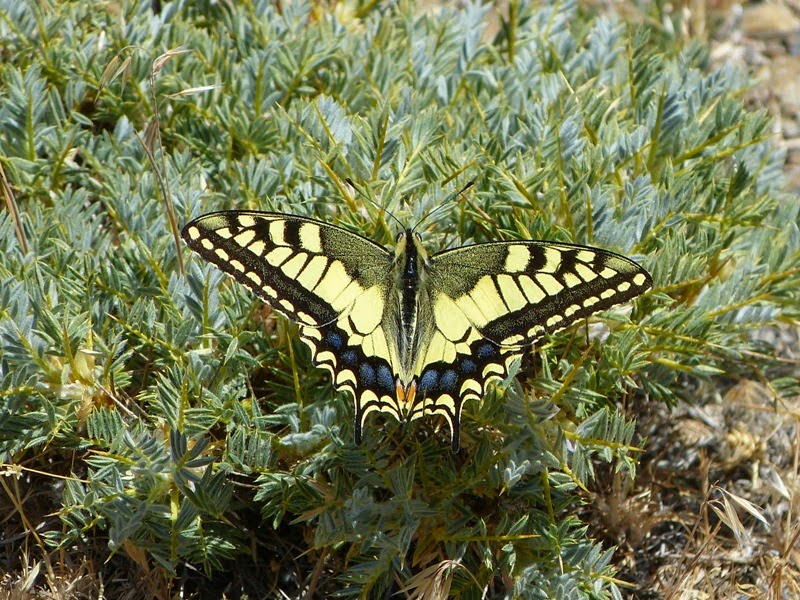
On my way back down the road, I called into a viewpoint that I have visited on previous occasions. Here, the subtly different habitat attracts some different butterflies. Most notable are the Swallowtails, Papilio machaon hispanicus, which I spotted almost as soon as I parked the car. They patrol this little hilltop, presumably looking for mates.

I also saw one Spanish Swallowtail, Iphiclides feisthamelii, feeding on the same little shrub that I have seen them on when I have visited previously.

In the past I have seen a lot of Wall Browns, Lasiommata megera, chasing each other around. This year I only saw one or two and I didn't see any Large Wall Browns, Lasiommata maera f. adrasta, that I normally see here.
I saw a couple of Common Blues, Polyommatus icarus, which I don't remember seeing in this spot before.

I spent some time watching these two Southern Marbled Skipper, Carcharodus baeticus, chasing around after each other and then locking horns! I have never seen behaviour like that before.

This Safflower Skipper, Pyrgus carthami nevadensis, was behaving a bit better!

I always see Blue-spot Hairstreaks, Satyrium spini, in this location.

Last year when I was reviewing my photos I realised that I had also taken a picture of a False Ilex Hairstreak, Satyrium esculi. So, this time I was looking out for them and once again spotted one.

There was also one Purple-shot Copper, Lycaena alciphron gordius, here. In previous years they had been quite numerous here.

It was interesting that many of the species found in each location that I visited in the Sierra Nevada were the same as I had seen on other visits. There are obvious locations, habits and food plants that will attract them. Some butterflies were in similar numbers and the same locations as in previous years.

Others were notable by their absence or low in numbers. For instance, it was worrying to see so few Zullich Blues and Apollos high in the mountains. Down by the stream this year I saw no Meadow Fritillaries, whereas two years ago I saw several. In fact there were very few butterflies there, but in previous years I have seen hundreds of butterflies enjoying the lush vegetation there.
Each year I visit, I see more species. This year I saw 3 species that I have never seen before and a total of 44 different species. The Sierra Nevada is still by far the best place for butterflies that I have ever visited.

Tuesday, 3 January 2017

Sierra Nevada Butterflies - July 2016 (4)

By now it was really time to be heading back to the villa, but I had three quick stops I wanted to make on my way back down the mountain. The first was at a viewpoint I had found two years ago. This is at about 2100 metres above sea level and the last time I was there I saw several Swallowtails hill topping.

I thought that the first butterfly I saw there was a very worn Blue-spot Hairstreak, but when I was looking at my pictures later I realised it was a False Ilex Hairstreak, Satyrium esculi.

When compared to the Blue-spot Hairstreaks, Satyrium spini, you can see the subtle difference in the white line on their wings.

In contrast to my last visit, I only saw one Swallowtail, Papilio machaon, this year and it was very ragged. There was also just the one Spanish Swallowtail, Iphiclides feisthamelii, in slightly better condition, but it had still lost its tails!

As with my previous visit there were a lot of Wall Browns squabbling over their territories, but I didn't spot any Large Wall Browns this year. I did see a Clouded Yellow, Colias crocea, which I haven't seen before in that location.

I jumped back in the car and drove down another 100 metres to the spot that Mike Prentice had suggested. There were a lot more butterflies there now than there had been at 9am.

I saw two Graylings, Hipparchia semele, one much lighter than the other. I spent ages checking my photographs to see if either of them were Nevada Graylings, but they both turned out to just be standard Graylings!

There were so many different butterflies flying amongst the vegetation there, including Long-tailed Blues, Spotted Fritillaries and Common Blues. They were very active in the afternoon heat, so many of them didn't stop for a picture! I managed to catch a shot of this Queen of Spain Fritillary, Issoria lathonia.

And I think this is a Large Grizzled Skipper, Pyrgus alveus. I have to admit that I find it very difficult to differentiate between many of the skippers.

Other butterflies there included Silver-studded Blues, Marbled Whites, Great Banded Grayling, Blue-spot Hairstreak and Southern Brown Argus. However, I didn't have long to watch them on my whistle-stop descent!

My final stop of the day was a little further down the mountain at about 1800 metres above sea level. This is a little scrubby area next to some Pine trees that I discovered two years ago. As then, I certainly wasn't disappointed with the butterflies I saw there.

Strangely, exactly as on my visit two years ago, the first butterfly I saw was a Marsh Fritillary, Euphydryas aurinia beckeri. Just the one next to where I parked the car.

The place was awash with butterflies, including Southern Brown Argus, Aricia cramera;

Essex Skippers, Thymelicus lineola hemmingi;

Silver-studded Blues, Plebejus argus hypochionus;

And I think this is a female Idas Blue, Plebejus idas nevadensis.

There were also Large Whites, Small Whites, Common Blues, Purple-shot Coppers, Cleopatras, a Rock Grayling and an Oriental Meadow Brown. Just like the last time, I saw one Black-veined White, Aporia crataegi, but this year it was kind enough to allow me to take a picture!

I spent some time following this Iberian Marbled White, Melanargia lachesis, to try to identify it. There are three different species found in the Sierra Nevada, but I have only seen the Iberian Marbled White there.


All too soon I had to drag myself back to the car. I had had an amazing few hours in the Sierra Nevada seeing 42 different species of butterflies, with several of them being species I hadn't seen before. It was certainly worth the three hour drive each way to get there.

Friday, 4 November 2016

Sierra Nevada Butterflies - July 2016 (1)

Two years ago I visited the Sierra Nevada for a day and saw a fantastic variety and number of butterflies. So, this year when we were on holiday near Malaga I took the opportunity for a return visit. There were three different locations that I had visited last year that I wanted to return to, but I had also been recommended another couple of spots to check out by Mike Prentice of Butterfly Conservation's European Interest Group.
It was a three hour drive from our rented villa to the first stop, which was on the road up to the ski resort at Hoya de la Mora at about 2,000 metres. This location had been recommended by Mike, who said I may find Spanish Chalkhill Blues, Polyommatus albicans, there. Unfortunately, I didn't see any, but I wasn't to be disappointed with the other butterflies I saw.

Initially I didn't see a lot there, but it was still before 9 in the morning, so a little early for butterflies There were a few Silver-studded Blues, Plebejus argus, flying amongst the scrub, though.

Other butterflies were less numerous there. There were a couple of Clouded Yellows, Colias crocea.

And a Wall Brown, Lasiommata megera, with a damaged wing.

I was really thrilled to see two Spotted Fritillaries, Melitaea didyma. They were very easily disturbed and quickly disappeared. Luckily I later saw another one that allowed me to get close enough to take a picture. This was one of the butterflies that I really wanted to see with its unusual markings.

I think this is a Thread-winged Lacewing of some kind. I had to follow it for ages before it stopped and I was able to get a better look at it. What an amazing creature!

On my way back to the car I saw another little blue butterfly that turned out to be a Lang's Short-tailed Blue, Leptotes pirithous. It somehow seemed out of place up in the mountains.

Not far away was this beautiful Blue-spot Hairstreak, Satyrium spini.

I had so many places I wanted to visit and so little time that I had to drag myself away to continue further up the mountain ...

Friday, 1 August 2014

Sierra Nevada, Spain - Butterflies - July 2014 (2) "Hilltopping"


On my way back down the mountain road I noticed a viewpoint, but it was impossible to drive the car into the parking area as there was a foot drop off the tarmac! I managed to find somewhere to park the car a little further down the road and walked back towards the viewpoint.

Initially, I was surprised not to see any butterflies, but as I walked up to the viewpoint I was amazed to see five Swallowtails, Papilio machaon hispanicus, flying backwards and forwards. I presume this is the "hill topping" activity that I have heard so much about.

The Swallowtails were being bombarded by Wall Browns, Lasiommata megera, every time they flew anywhere near them. It was a great sight to see!

Among them were some Large Wall Browns, Lasiommata maera.

I was delighted to see this Blue-spot Hairstreak, Satyrium spini. I had read about them before I went and I was disappointed to see that they occur in May and June in the Sierra Nevada. However, this one looked quite fresh. Later I saw some much more faded individuals.

As I crouched down to take a picture of the Blue-spot Hairstreak I noticed another butterfly out of the corner of my eye landing on the same plant. It was a Iberian Scarce Swallowtail, Iphiclides feisthamelii. What a dilemma - which to take a picture of?!! I ended up alternating between the two!

The Dusky Heaths, Coenonympha dorus, here were a lot fresher-looking than those back in Alora. There were quite a number here at about 2,100 metres, yet I had seen none 500 metres further up in the mountains.

There were also plenty of Purple-shot Coppers, Lycaena alciphron, in this area.

The Common Blues here were all rather faded, but this Idas Blue, Plebejus idas, was particularly nice. I had thought that this was another Silver-studded Blue, but after help from the UK Butterfly Forum and checking with the "Mariposas Diurnas de Sierra Nevada" book I now know it is an Idas Blue. These have a slightly darker background colour on the underside of their wings and more extensive blue spots.

I was amazed by how many butterflies there were in this small area. If you look carefully at the picture below you can see a dot above the left-hand interpretation board. It is one of the Swallowtails!


Followers