I am no expert photographer, preferring to capture the moment than get a perfectly composed shot. The pictures on my blog are either taken with a compact Canon, a Panasonic Lumix FZ150 or on my phone.


Showing posts with label Small Copper. Show all posts

Friday, 23 January 2026

East Lothian Butterflies 2025 part 1

I collect the butterfly records from the East Lothian Countryside Rangers and about 40 volunteers. At the end of the season I put together an annual round-up that I send to the volunteers to let them see how their records fit into the big picture. Below is an edited version.

2025 was pretty dry and sunny in East Lothian, but there was often an easterly wind keeping the temperatures down. The general lack of rain and the wind caused the vegetation to dry up, particularly in coastal areas.

We had a couple of very early records. Firstly, a Speckled Wood that was seen on 15th January in Butterdean Wood. I can only assume that it had crawled into a nearby greenhouse as a caterpillar last autumn and was tricked into thinking that spring had arrived.

The next butterfly was a Small Tortoiseshell, which was seen on 28th February. Maybe this wasn't such a surprise as they spend the winter hibernating as adult butterflies, so can make an appearance on a mild day.

There was then a flurry of Small Tortoiseshells and Peacocks on 6th March. Both species had a fairly average year, but at least Small Tortoiseshells bounced back from last year's low numbers.

There were a few Red Admirals seen in March, indicating that they may have survived the winter here. They went on to have an amazing year, with us recording about three times the average number.

The first Comma was seen on 15th March. They went on to have a great year, particularly later in the season, and I received the highest number of records since I started collating them in 2008.

A few days later a Painted Lady was spotted in North Berwick. They also had a good year, with 220 records - a big improvement on last year's 14! Their numbers can be really variable. I would suggest the normal annual average is under 100 records, but the figures are skewed by the 2019 invasion when I received 5395 records!

All four white species had an amazing year. For Orange Tips, Green-veined Whites and Large Whites it was by far the best year since I started recording the butterflies. 


Small Whites also had a fantastic year, way above average, but not quite as high a number as was seen in 2018.

Speckled Wood numbers picked up in April and they also had a very good year. I received records of 1608 of them, which is the second highest number since they reappeared in East Lothian in 2009.

Small Coppers had a fairly average year.

The same could be said for Wall Brown. Their numbers look fairly average, but when you look at when they were seen, they were almost exactly two weeks early and there was a small third generation towards the end of September, with the last one being seen on 7th November.

I will continue this on my next post.


Sunday, 19 August 2018

Small Copper, Lycaena phlaeas, aberration schmidtii

Our beautiful hot, dry summer came to an end a couple of weeks ago, but I have still been lucky enough to have been able to walk my weekly transect in reasonable weather. Last Wednesday was sunny, but very windy and cool. Despite that I still saw a reasonable number of butterflies including 36 Small Whites, 18 Green-veined Whites, 7 Large Whites, 4 Small Coppers, some Peacocks, Commas and Speckled Woods.

On my way back I took a different route and thought I would check out a sheltered corner where some mint grows in an old ditch. At first I didn't think there was much there, but I spotted a Peacock, which lead to me seeing a Small Copper, Lycaena Phlaeas. I then spotted a rather dull butterfly and thought it may have been a moth. But on closer inspection it turned out to also be a Small Copper. Instead of having lovely orange/copper markings, it was a cream colour. I believe this is an aberration known as schmidtii.

This is the second time this year that I have seen a special butterfly, when I didn't have my camera with me. Luckily I had my phone, but I wasn't able to get very close to the butterfly, so could only manage a distant shot.


As I followed this butterfly around the small patch of mint, trying to get a better picture, I spotted quite a few other butterflies. There turned out to be 7 Small Coppers there along with 2 Wall Browns, a Painted Lady, 2 Commas, 2 Peacocks and several whites. Here is a picture of a more conventional Small Copper.


I have returned to that spot a couple of times since, but the weather has been so poor there were no butterflies around. I will take my camera to work with me this week and if there is any good weather I will go and see if this special little butterfly is still there.

Nine days later and after three return visits I managed to see this butterfly again today. The weather was very dull and overcast and only 15 degrees. Despite that I saw five or six Small Coppers and then I noticed two squabbling in the air. One of them landed and I was delighted to see it was the schmidtii butterfly. I managed a couple of pictures and then it flew up and away, shortly before a very heavy shower.


Wednesday, 17 January 2018

East Lothian Butterflies 2017 - Part 1

2017 was a strange year for butterflies. It started off reasonably well, but the summer butterflies were rather disappointing. Luckily there was a late autumn resurgence of Speckled Woods and Red Admirals, which boosted the overall number of butterflies seen.
We had a good spring in 2017 after a mild winter with only one dusting of snow. From the end of March until mid-June we had decent weather, but then we had a period of very heavy rain. This seemed to impact on many species of butterflies (and I am told some species of birds). Certainly I saw a batch of Small Tortoiseshell caterpillars wiped out by the rain in June and also an enormous group of Peacock caterpillars perished after three days of continuous rain in July.
This year, we had more people than ever sending in records. This has given a bit of a false impression of the number of butterflies that there were around. One thing I noticed this year was that there were very few records of large numbers of butterflies being seen.
I have looked back over the last five years' worth of records and noticed a worrying trend in that the number of butterflies per sighting has been steadily reducing each year.
Below is a summary of how each species did in 2017.

Peacock, Aglais io
A really early sighting this year, the first Peacock record I received was on 16th January on an unusually warm and sunny day. They were recorded every month through to November, with numbers peaking towards the end of August. Peacocks did reasonably well this year, unlike the Small Tortoiseshell, which has a very similar life cycle.

Small Tortoiseshell, Aglais urticae
The first Small Tortoiseshell was spotted on 25th January. They had a very poor year this year and despite the record number of butterfly records sent in, we had our lowest number of Small Tortoiseshells recorded for five years. What I found interesting is that the first Small Tortoiseshell recorded hibernating was on 17 August, only a couple of weeks after it must have emerged. More hardy Small Tortoiseshells were seen flying until 14th September.

Red Admiral, Vanessa atalanta
The first Red Admiral recorded was on 9th March. I would speculate that this was an individual that had spent the winter here. They were seen every month after that right through to December, with numbers peaking in September. This was our most commonly recorded butterfly this year, and it did very well all over the UK. This is a butterfly that only a few years ago was considered as a migrant, but which has now firmly established itself here.

Comma, Polygonia c-album
The first record of a Comma this year was on 12th March. The Comma has never been a particularly common butterfly in East Lothian. Since first being recorded here in 2001 their numbers have picked up each year, peaking in 2015. For some reason 2016 was a terrible year for them and in 2017 there have been a few more seen, but still worryingly low numbers.

Green-veined White, Pieris napi
The first Green-veined White was recorded this year on 1st April. They seemed to have a fairly average year, but I think in reality numbers were lower than usual (given that we had more people recording butterflies). Certainly, the number recorded on the transects was lower than average.

Orange Tip, Anthocharis cardamines
The Orange Tip was first recorded on 6th April. The number recorded was a little higher than average, as expected. The adult stage of this butterfly usually flies between April and mid June, so they missed the terrible weather just after that.

Speckled Wood, Pararge aegeria
The first Speckled Wood was seen on 8th April. There are generally three peaks in population of adult Speckled Woods throughout the year. Possibly the first to appear had spent the winter as a chrysalis. The second peak, in June, could be those that spent the winter as caterpillars. This year the number of records received in June was much greater than in previous years, but the later generation was not so spectacular, although there were a great number of records received in late September, making this the second most numerous butterfly recorded in East Lothian in 2017.

Small White, Pieris rapae
The Small White was also first recorded on 8th April. I think that the Small White is generally a little unrecorded, as it is difficult to identify unless it lands. 2017 started off reasonably well for the Small White with normal numbers being seen in the spring. However, the summer generation was very reduced, presumably as a result of the heavy rain during June and July.

Large White, Pieris brassicae
The Large White would normally follow a similar pattern to the Small White. The first record for 2017 was on 8th April and thereafter the Large White had a fairly average year. More were recorded this year than the previous three years, but remember there were more people recording them. Why the Small White struggled and the Large White didn't appear to be affected by the weather is a mystery to me!

Wall Brown, Lasiommata megera
The Wall Brown was one of 2017's success stories. First recorded here in 2010 the Wall Brown has since been spreading westwards around the coast and to several inland sites. In 2017 the first record was on 20th April and the first generation continued to be seen until  3rd June. The second generation started on 5th August and it was recorded through to the 19th September in much greater numbers than in previous years.

Small Copper, Lycaena phlaeas
The Small Copper has been fairly consistent in East Lothian over the last five years. 2017 wasn't very different from the average. 
I will continue with the remaining 12 species in my next post.

Wednesday, 11 September 2013

Autumn

I have to admit that I do find this time of year a little depressing. The long Scottish summer evenings are noticeably shortening each day, the temperatures are dropping and the butterflies are decidedly tatty!
The Swallows have started to gather on the power lines, psyching themselves up for the long flight to Africa. I'm actually rather envious. I would love to spend some time in Africa in search of insects!


I had a surprise package arrive last week. My wife phoned me to say that an envelope had dropped through the door, which said "Live insects, handle with care"! She opened it to find a little container with four caterpillars in it! Four years ago I ordered some Small Copper, Lycaena phlaeas, eggs. They didn't arrive because of a lack of stock, and as they were part of a bigger order I wasn't to concerned. The following year I inquired about them, but heard nothing more and so I forgot about them. Now I have some little companions to keep an eye on over the winter! I rushed out and dug up some dock plants and put them in a pot and so far the caterpillars are doing well.


I also noticed that our neighbour has a row of Nasturtiums planted along the foot of her fence outside her garden. These have become more skeletal over the last few days as a result of the abundance of Large White butterflies, Pieris brassicae. They have obviously laid a lot of eggs and the Nasturtiums are covered in caterpillars. Amongst them are a few Small White, Pieris rapae, caterpillars.


Knowing that our neighbour is a very keen gardener, I am sure the Nasturtiums will soon be pulled up, so I took the opportunity to liberate a few of the caterpillars and put them on our Nasturtiums.
I even noticed that most of the Garlic Mustard plants around the fields are covered in Large White caterpillars. I hope the farmer doesn't plough too close to the edges and that these caterpillars make it through to adulthood.


During August there were more Large White butterflies here than I have ever seen before. Some years I only see about ten in total, but this year I have been getting used to seeing more than 20 a day. Hopefully a good proportion of the progeny of this year's butterflies will make it through to next year.


The adults are starting to look rather tattered now. There are also quite a few Peacocks, Aglais io, still flying.


I have allowed a patch of Pepper Mint to take over a corner of our garden as the flowers are proving to be very attractive to all sorts of insects. I would love to be able to identify the bumble bees that are all over it, but I find it really difficult to separate one from another.


The mint has even taken over much of the pond. The frogs don't seem to mind, though. Under all of that weed there are hundreds of tadpoles. I don't know why they haven't developed more quickly. Normally they would be little froglets by now.


It is a funny thought that although, in a month or so, I won't be seeing any more butterflies there will be eggs, caterpillars, chrysalises and adult butterflies hiding away waiting to emerge next spring. This year has been fantastic for butterflies. I really hope that next year will be as good!

Monday, 11 February 2013

Small Copper - Lycaena phlaeas

The Small Copper, Lycaena phlaeas, is a bright little butterfly that occurs over most of the UK and much of Europe. It also seems to occur in Asia, North Africa and North America where it is know as the American Copper. Here there are two generations a year, with the first butterflies being seen in May. This generation is seen until late June and then there is a bit of a lull until the second generation appears in late July/early August. The second generation seems to be far more numerous and Small Copper butterflies are still seen flying through until early October. 
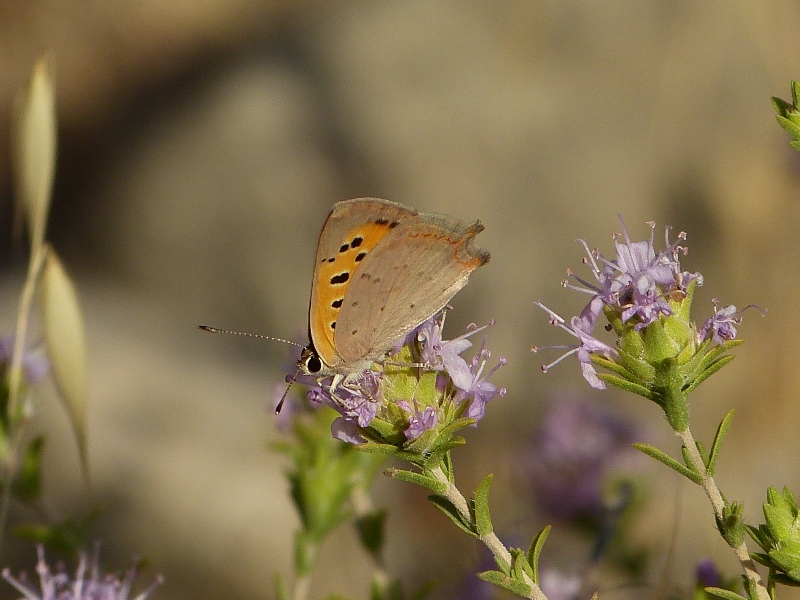

Small Coppers aren't seen here in great numbers. The males are very territorial and will fly up and chase off any other insect that dares to fly too close. They usually then return to their favoured sunny spot, making they quite easy to photograph! 


Quite a large proportion of the Small Coppers seen in East Lothian have a number of blue scales on their hind wings. This is referred to as the aberration caeruleopunctata. However, sometimes there can be as few as one blue scale on each wing and other times there can be five distinct blue spots. I am not convinced that this is so much an aberration as just a slight variation!


The two main food plants for Small Copper caterpillars here are Docken, Rumex obtusifolius, and Sorrel, Rumex acetosa. Here is a female I saw laying eggs on Docken a couple of years ago. 

Two years ago, at the end of August, I saw a female laying eggs on some Sorrel at a restored open-cast coal mine. I noticed that a number of the Sorrel plants had Small Copper eggs on them, so I dug one of them up and planted it in a pot in my garden. 

The egg was less than a millimetre across. A few days later the egg had clearly hatched, but it was a few days before I managed to find the caterpillar, which was larger than I expected (about 4mm long). Over the next few weeks, I was surprised to see that it appeared to be larger on some days than others. It was a while before it dawned on me that there were actually two caterpillars in the pot!!


I kept an eye on them for the next few weeks, but when the cold weather arrived in December they completely disappeared. Despite searching the plant thoroughly I couldn't find them and I thought that they may have become a snack for the garden birds.
However, in March I was pleased to find two large caterpillars and a smaller one in the pot!! They must have over-wintered just under the surface of the soil.


They munched their way through the sorrel until they reached about 10 or 12mm and then they disappeared again at the end of April. I presume that they formed chrysalises in the crown of the plant or in the soil, but I wasn't able to find them. Possibly they had wandered off to pupate in another part of the garden.

Sunday, 12 August 2012

Malaga, Spain - Butterflies - July 2012 (2)

As well as the Southern Gatekeepers, Dusky Heaths, Common Blues and the Skippers mentioned in my previous posts there were a few other butterflies that occasionally appeared on the track close to our rented villa. This is a Small Copper, Lycaena phlaeas. 

This is a female Meadow Brown, Maniola jurtina.

And this is a male Meadow Brown, Maniola jurtina.

This Clouded Yellow, Colias croceus, spent a long time feeding on thyme one evening allowing me to get very close.

Another day, I spent ages following this Bath White, Pontia daplidice, along the track before it stopped long enough for a quick picture.

The temperatures reached 40 degrees Celsius in the shade during the day, but early morning it would be about 25 degrees. I tended to get up at sunrise to make the most of the cooler weather. One day I walked up into the hills above Alora. This was a fairly steep climb and as soon as the sun came up, temperatures rose quickly. There were quite a number of Wall Browns, Lasiommata megera, defending territories on the path. 

I didn't see any females at all. Occasionally one of them would fly into another's territory and a short chase would ensue. I was amazed to see that one of the more aggressive Wall Browns was completely missing one of its rear wings. This didn't seem to hamper its ability to fly or defend it territory, though.


One morning I saw a small brown butterfly chasing after a small grey butterfly and trying to make passionate advances towards it. The grey one was intent on getting away from the brown one, so they weren't hanging around for a picture. I managed a couple of shots, which allowed me to identify them as a Southern Brown Argus, Aricia cramera, chasing an African Grass Blue, Zizeeria knysna. 


A few days later I decided to walk along the Guadalhorce River to see what butterflies there were there. The most common butterfly there was the African Grass Blue, which at least confirmed my identification of the grey butterfly above.

The river valley also proved to be popular with Small Whites, Clouded Yellows and Small Coppers, but surprisingly nothing that I hadn't seen closer to the house. I noticed that some of the Small Coppers by the river were the darker form.

I explored the pine forests near the Guadalhorce Lakes, but didn't see any butterflies there at all! I also explored the edge of a wooded area near Alora and the well irrigated orange groves in the valley, but didn't see any new species of butterflies in those locations.

Back at the track by the villa, I was beginning to think that I wouldn't see any new species, but one late afternoon a Long-tailed Blue, Lampides boeticus, briefly landed ahead of me. These are beautiful butterflies and I have only ever had a momentary view of one. 


On one of the last days of our holiday a small, orange butterfly landed in the garden as we were having lunch.   Luckily my camera was close by and I was able to take a picture of it before it flew off. Thanks to the zoom on my Lumix FZ150 I was able to identify the butterfly as a Small Heath, Coenonympha pamphilus, but this is the southern, second generation, which looks very different from the Small Heaths I see back in Scotland. 

I have to admit to being a little disappointed that I didn't see more butterflies during our holiday. I had hoped to see a lot of different species of blues that occur in that part of Spain. I was also surprised not to see any fritillaries, or even a Painted Lady or Swallotail flying past!
Judging by the dried up wild flowers I think I would have been a lot more successful in April or May and the area must look really beautiful then they are all in flower. We were told that Spain has experienced an exceptionally hot, dry spring and it was experiencing  a bit of a heat wave when we were there. Judging from what I saw in Gibraltar, I think that had I managed to find some cooler, damper areas I would have seen a lot more species of butterflies. 
However, after the horrible weather we have been experiencing in South East Scotland this year, it was fantastic to be somewhere hot and sunny where I could see butterflies every day! I saw 21 different species while we were there which is more species than occur in this part of Scotland. 


This is a beautiful part of Spain. I haven't mentioned the amazing villages built on steep hillsides, the castles, the friendly people, lovely food and the fantastic lifestyle. A great place for a holiday.


Followers