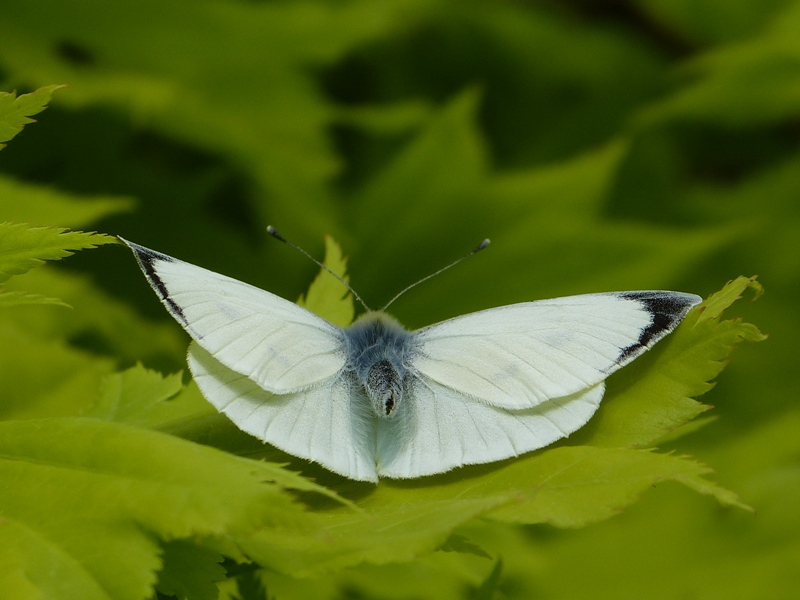
I am no expert photographer, preferring to capture the moment than get a perfectly composed shot. The pictures on my blog are either taken with a compact Canon, a Panasonic Lumix FZ150 or on my phone.


Showing posts with label Pieris napi. Show all posts

Sunday, 31 August 2025

Of Caterpillars and Chrysalises

So far this year has been amazing for butterflies, but not only in their adult form. I also seem to have come across quite a few eggs, caterpillars and chrysalises.

It is always fun searching for Orange Tip eggs and caterpillars on Garlic Mustard and Cuckoo Flowers. This year they seemed to be on just about every flower spike I saw. This is a group of freshly laid eggs on a Cuckoo Flower.

In a couple of days they turn bright orange. I followed one egg with interest, which had been laid on a Garlic Mustard near the house. This was the caterpillar a couple of days after it had hatched.

The egg hatched on 11 May and I watched it develop until the 17 June when it formed a chrysalis. This is another caterpillar preparing to form a chrysalis.

And another one that unusually is about to form a chrysalis head down.

This is the chrysalis of the caterpillar I reared. It seems strange that it will remain in this state until April next year. 

On 13th May I saw a Green-veined White laying eggs on the leaves of a Garlic Mustard plant.

The eggs hatched on the 21st May and the caterpillars developed until the 30th June when they formed chrysalises.


On the 9th July both chrysalises emerged.


I have found three batches of well developed Peacock caterpillars amongst the nettles here. I haven’t noted the dates of any of these, as I didn’t know when the eggs were laid, or when the caterpillars formed chrysalises. However, on 3rd July I was demolishing an old shed and discovered a mature Peacock caterpillar on a piece of wood I had ripped off. Luckily it wasn’t injured, so I put it into a mesh cage, where it crawled to the roof and hung in a “J” shape.

Two days later it was still hanging there, but I noticed a 3pm it had moulted and formed a lovely green chrysalis.

This changed colour over the next few days and on 22nd July it emerged.


Sadly, it didn’t stick around for an open-wing photograph!

On the 5th July I was walking up our drive when I noticed a Red Admiral caterpillar crossing in front of me. Of course I collected it up and put it in a cage, where it immediately went to a Garlic Mustard plant and started stitching together the edges of a leaf to form a tent. The next day I noticed it had formed a chrysalis. I wasn’t very hopeful of a positive outcome, as I thought it unusual to find the caterpillar out in the open like that, as they usually hide away inside leaf tents. However, on the 22nd July it emerged, the same day as the Peacock. 

It was a lot more cooperative and allowed me to take some pictures of it before it flew off!

I have seen a lot of Red Admiral caterpillars and chrysalises in the nettles in our garden. There are a lot of adults flying around so hopefully they will soon be joined by more.

Saturday, 2 November 2024

Scottish Borders garden butterflies 2024

We are lucky enough to live in 17 acres of woodland which we have been managing to improve for butterflies and other wildlife. I am developing a wild flower meadow, planted an area of native broadleaves that produce flowers and berries, put in hedges, taken out loads of invasive Rhododendron and planted up various areas with Rockrose and other wild flowers. Our triangle of land is quite a wildlife haven, which in itself causes more challenges. Everything needs to eat, either other creatures or precious plants that I have been nurturing!


It has generally been accepted that 2024 was a lousy year for butterflies in the UK. The Big Butterfly Count confirmed low numbers for most species with record-breaking reductions from 2023 for many species. I have yet to receive all of the record for East Lothian, but my own experience at home here in the Scottish Borders concurs with the national picture.


Although this is only the fifth year that we have been living here I had noticed a pattern developing and numbers of butterflies had been increasing year on year. I can't be sure why that was, but I would like to think it was partially because of the work I have done to manage the habitats here.


In previous years the first butterfly to appear has been the Small Tortoiseshell, which would venture out on a mild spring day to feed on whatever it could find flowering that early in the year. This year, however, I didn’t see any until August and I only saw a total of four all year. I didn’t find any caterpillars either this year, which is unusual. Often I find big clusters of caterpillars on nettles.


Peacocks and Commas are the other two butterflies that over-winter here. At least they both made an appearance this spring, but in surprisingly low numbers. This was particularly disappointing for Commas after I had such a bumper year for them last year. Towards the end of last summer I had been finding caterpillars and chrysalises everywhere, so I expected them to do well. However, this year I only recorded 26 compared to 122 last year.


Despite a poor spring showing the later summer generation of Peacocks did a lot better. The number I saw was only a little lower than average, which is encouraging. Again, I didn’t find any caterpillars, which is unusual.


Orange Tips had a fantastic year here. I recorded 101 of them this year, which is way up on the previous best number of 62. I also saw an unusually high proportion of female Orange Tips.


Despite finding so many caterpillars and chrysalises last year, the number of Small Whites this spring was lower than expected. I did see them throughout the year, though, and ended up seeing 26. This seems a low number compared with the 90s I have seen in previous years, but their numbers do seem to fluctuate considerably from year to year.


I saw seven Large Whites this year, which is about average for this species.


Although I had the impression that there were not many Green-veined Whites around this year, my records show that numbers were only slightly down on previous years. They were more numerous in the spring and the summer generation wasn't so good.


Red Admirals had the worst year by far here. I only recorded 38 in total compared to last year's 474!


Ringlets were here in about average numbers. Not as good as the previous two years, but better than the numbers I had seen before then. There is more suitable ground for them now that we have taken down a large area of Spruce woodland, which has now grassed over and thinned out the trees elsewhere. With the additional habitat it is a bit disappointing that the numbers weren't higher. Certainly higher up the valley where I often walk numbers were well down on previous years.


Last year was really good here for Meadow Browns. This year their numbers dropped back to what I had previously seen here. This was disappointing, as I had thought that Meadow Browns  were appreciating the new areas of grassland. However, numbers up the valley were also considerably down on previous years.


The first Speckled Wood I saw here this year was on 2nd July. Having seen them for the first time here last year I was delighted to see them return, although I had been hoping to see some in the spring indicating that they had bred here. I continued to see them for the rest of the year and ended up seeing 18 - 4 more than last year!


Small Skippers had the worst year since I first saw them here in 2021. They had been increasing in numbers since then, so it was disappointing that I only saw seven here this year. Similarly, in the valley above the house the numbers were lower than normal.


I often chance across a butterfly and think to myself if I had been there five minutes before, or five minutes after I would have missed it. I suppose, though, that there will be hundreds of butterflies I miss because I am not in the right place at the right time. So, this year's lucky spots included one Large Skipper in my meadow. I don't know why I only saw one, as there were a lot in the valley above our house.


As I do most years, I just saw one Small Heath in our meadow. It isn't best suited for these butterflies, so it is odd that most years I see one, just one!!


This year, again, I was delighted to see a Scotch Argus. I just happened to go out to check the Buddleia on a sunny afternoon and spotted a small, dark butterfly. I am still intrigued why I have seen one five out of the last six years here. I am sure there must be a colony close by, which I am yet to find.


Last year I saw my first Wall Brown here in the meadow. This year, I was sitting having lunch outside when a Wall Brown landed on some Marjoram in our patio. They have been slowly working their way in this direction over the last few years.


Disappointingly I only saw one Small Copper here this year. I don't understand why I don't see more as there are plenty of sorrel and dockens growing here for their caterpillars to feed on.


Sadly I didn't see any Northern Brown Argus, Dark Green Fritillaries, Small Pearl-bordered Fritillaries, or Painted Ladies here this year. I saw the first three species in the valley above the house, but in much smaller numbers than normal. This is the second year in a row that I haven't seen a Painted Lady anywhere in the UK!


It is difficult to know exactly why butterfly numbers were so low this year. I am sure it is a combination of factors. There has been much in the news recently about herbicides and loss of habitat impacting on insect populations. I am sure this is true, but I can't see that would explain this year's sudden reduction in butterfly numbers. Last year was really dry throughout spring and summer and I am sure this must have resulted in a reduction of food plants for caterpillars. I noticed how the wild flowers I had planted struggled. Then from September last year more or less until September this year we had so much rain. A damp winter and then limited sunshine later in the year must have had an impact.


It will be really interesting to see what next year brings. I really hope that butterfly numbers bounce back

Thursday, 29 February 2024

Scottish Borders Garden Butterflies 2023

We moved to this house in the Scottish Borders at the start of 2020 and since then I have been mostly working from home. During my lunch hours I tend to take the dogs for a walk around more or less the same route and I keep a note of the butterflies I see. I then keep a record of the highest number of each species I see each week. So, I now have four years' worth of butterfly records to compare.

Each year the weather has been quite different and that has had an impact on butterfly numbers. The weather was not great in 2023 with a lot of easterly winds. Spring started quite late but dry, but  from July onwards it was cloudy and wet.

Also, I have been spending a lot of time trying to improve habitats and plant different plants to attract butterflies. I would like to think that the effort is seeing rewards.


The main areas where I see butterflies is in the meadow I have been developing, on some Buddleia plants and, this year, in an area where I had some Spruce trees cut down, where I have replanted with native trees. The area is now quite grassy, with various other plants such a Fox Gloves and wild Raspberries.

The four species of white butterflies were interesting. Orange Tips generally had a good year. The first sighting was a week later than normal, but they were about in good numbers.


I saw more Small Whites than I have in previous years, but they were never seen in high numbers. I had found a number of chrysalises last year, which I kept in a cage over winter. 29 of them emerged over a period of a month in April and May. However, I never saw them in big numbers and, strangely, I didn't find any caterpillars on the Nasturtiums this year.


Conversely, Green-veined Whites didn't have such a good year for some reason.  I always associate Green-veined Whites with damper areas, so possibly last year's dry summer didn't agree with them.


Large Whites had a fairly average year. I had been expecting to see a lot of them, because there were a lot of caterpillars last year and there were several chrysalises on the house.  Again, this year, I didn't find any caterpillars on the Nasturtiums, which is unusual.


Last year was a really good year for Ringlets and this year wasn't quite as good. Overall, their numbers have gone up here over the last six years. I would like to think this is in part the result of some of the habitat work I have done.


2023 was a really great year for Meadow Browns here. I recorded 103 individuals, way up from the previous high of 21. As with the Ringlets, I would like to think that the Meadow Browns are enjoying the way I am managing the meadow. The high numbers of these two species may be a result of the weather the previous year, when eggs would have been laid and the caterpillars emerged. 2022 was a very dry summer. It will be interesting to see how they do this coming year after last year's wet summer.


I only saw 2 Small Coppers  here last year.  They had done really well the previous year, so I don't know why there were so few in 2023. There are plenty of food plants for them here, so I can only assume that it was the weather that didn't suit them.


I will continue this on the next post ...

Thursday, 18 February 2016

East Lothian Butterflies 2015

I will remember 2015 as being rather grey and cool. After a mild winter with only one dusting of snow, spring arrived in mid March with butterflies regularly being recorded from the 18th March.
Much of the summer was cloudy with only short spells of sunshine. While areas north and south of East Lothian enjoyed longer sunny periods, we seemed to miss any good weather. In fact when I was checking the Butterfly Transect results, I didn't come across one record sheet showing the temperature being above 20 degrees Celsius!
However, the weather in September and October was lovely and later in the year we avoided the heavy rain, which caused flooding elsewhere in the UK. The weather didn't really turn cold until 4th December.
Despite the weather I received a bumper number of records this year, which gave a really good picture of how the butterflies fared over the year.

Peacock, Aglais io
The first butterfly recorded in 2015 was a Peacock on 4th March. They were regularly seen with the last record of a worn specimen being seen on 30th June. On 16th July the first of the new generation was spotted and again they were seen in good numbers until 1 November.

Small Tortoiseshell, Aglais urticae
Small Tortoiseshells also did well this year with the first record being on 19th March. There was no clear division between the generations and they were recorded through to 8 December. That was our last butterfly record of the year.

Comma, Polygonia c-album
I think 2015 was the best year we have had for Commas here in East Lothian. The first record was on 23rd March and they were regularly spotted through April. I only received one record each month in May, June and July and then from the beginning of August they were seen in good numbers through to 26th October.

Small White, Pieris rapae
The number of Small Whites recorded in the spring was down on previous years, probably reflecting the poor weather we had late in the summer of 2014. The first record in 2015 was on 9th April and they were seen through to the 7th July. From 6th August the second generation appeared and they were seen in better numbers until 1 October.

Orange Tip, Anthocharis cardamines
Orange Tips did well this year. The first record was on 9th April and they were recorded through to 27 June. This was quite a prolonged flight period, maybe as a result of the cool weather.

Green-veined White, Pieris napi
Green-veined Whites always do well here. The first record for 2015 was on 9th April and they were seen in smaller than normal numbers until 16th July. On 6th August the second generation emerged and they were seen in good numbers until 14th October.

Red Admiral, Vanessa atalanta
The first Red Admiral record was on 10th April and I only received three more records until July when we were literally invaded by hundreds of them. On 1st July I saw six Red Admirals flying or blowing in from the sea on a cold grey day. Six other people reported similar sightings that day and I received several records of Red Admirals over the next few days. These butterflies went on to produce a further generation and high numbers of Red Admirals were seen until 11 November.

Large White, Pieris brassicae
Like the Small White, numbers of the spring population of Large Whites were quite low. They were first recorded on 15th April until 7th July. The second generation was seen between August 6th and October 26th in far greater numbers.

Speckled Wood, Pararge aegeria
The first Speckled Wood was recorded on 18 April. Their numbers seemed a little disappointing compared with last year, but they picked up later in the season. The last record was on 26th October. They didn't extend their range as they have in previous years, but considering the weather they continued to do well.

Small Copper, Lycaena phlaeas
Small Coppers did very well here in 2015. Because I received so many records there was a nice clear division between the two generations with the first generation being between 20th April and 8th July and the second generation being between the 12th August and 1st October.

Holly Blue, Celastrina argiolus
I only received one record of a Holly Blue in 2015 on 21st April. Whilst it is sad to only receive one, it gives me hope that there may be a hidden colony of Holly Blues somewhere in East Lothian. Records in recent years have all come from three neighbouring villages, so I intend to have a thorough search of the area this year!

Small Heath, Coenonympha pamphilus
Small Heaths were recorded from 4th May until 25th September. This is a longer season than I have seen here before, which is possibly a result of the cool summer we had.


I'll continue with the remaining species in my next post.

Followers