I am no expert photographer, preferring to capture the moment than get a perfectly composed shot. The pictures on my blog are either taken with a compact Canon, a Panasonic Lumix FZ150 or on my phone.


Showing posts with label Celastrina argiolus. Show all posts

Friday, 26 January 2024

East Lothian Butterflies 2023 Part 1

I have been collating the butterfly records from East Lothian for the last 11 years, so we now have good data to see how butterflies have been doing over this period. Of course we only record a very small fraction of the number of butterflies that occur in East Lothian, but it gives a pretty good picture.

2023 started off with a reasonably mild, but wet winter. However, there were a few colder spells and the frosts persisted into April. The year was punctuated with an unusually high number of easterly winds. There wasn't really a lot of sunshine until mid May, when we had a warm, sunny spell, but sadly that only lasted until half way through June! The remainder of the year was rather showery, with continuing east winds. This was only broken by a sunny week in early September and then back to cloud and rain! The first frost around the 12th October saw a sudden drop in the number of butterflies.

The weather can have an impact on the number of butterfly records received. This isn't necessarily because the butterflies aren't out and about when the weather is poor, but may be because recorders are less likely to be out looking for them. It is often the weather from the previous year that can have more of an impact, preventing the adults laying eggs, or heavy rain washing small caterpillars off their food plants.

Some species had a really poor year in 2023, but others did surprisingly well.

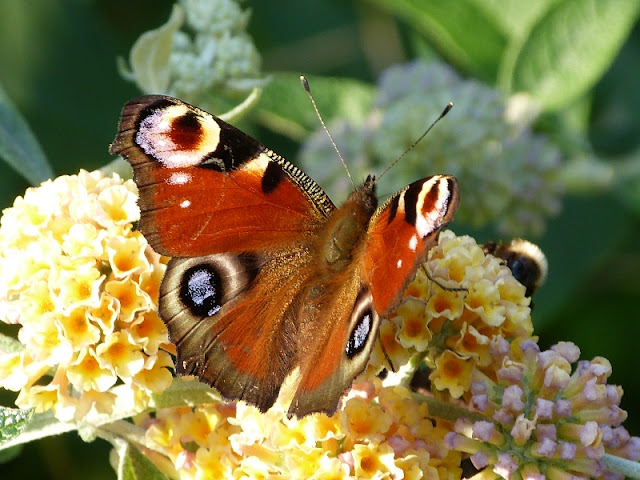
The first record I received was of 3 Peacocks seen on the 17th March and several more were seen over the next few days. They had a pretty good year, particularly later in the summer when the new generation appeared.

On 23rd March I received the first record of a Small Tortoiseshell. Nationally there is much concern about the reducing number of Small Tortoiseshells, yet here their numbers have been fluctuating, but not really showing a decline. The number of records in 2023 was just a little lower than the average of the previous ten years.

The third species that overwinters as an adult is the Comma and they had a particularly good year, being seen in high numbers later in the season. The first one was spotted on the 2nd April. It is interesting that these three species have similar life cycles, feeding on nettles as caterpillars and hibernating as adults, yet they each had different success rates in 2023.

The next butterfly to be seen was a Holly Blue on the 3rd April. This was the real success story of 2023, with them being spotted all over the county in good numbers. It seems funny to think that prior to 2019 they were rarely recorded in East Lothian. I received records of 377 Holly Blues last year.

Next were the whites with Small White, Large White and Orange Tips first being seen on the 3rd, 5th and 7th April. These three species all had a good year  with higher than average numbers being recorded. However, the Green-veined White didn't make an appearance until the 19th April and it had the worst year since I have been collating the butterfly records. It is difficult to understand why it did so poorly when the other white species did so well. My only suggestion is that I usually associate Green-veined Whites with river banks and damper areas. Possibly the dry springs that we have had the last two years haven't suited it. Hopefully the numbers may bounce back in the future.

The first Speckled Wood appeared on 7th April. They had a fantastic year in 2023 and were seen in particularly high numbers in early September. It is interesting to speculate why they did so well in a year when the weather wasn't what we wouldn't normally think of as ideal for butterflies.

The Wall Brown has slowly been increasing  in numbers over the last ten or twelve years in East Lothian. However, the number of records peaked in 2021 and since they have decreased again. Nationally there is concern about this species reducing in range and numbers and it had been thought that Wall Browns were spreading north in response to climate change. This year, we received the first record on 25th April with the summer generation being much more numerous than the spring generation.

Small Coppers are never really seen in big numbers. More often than not a male will take up territory on a sunny leaf and fly up when disturbed only to return to the same spot. The first record in 2023 was on 26th April and it wasn't a particularly good year for them, which I can only imagine was down to the weather.

Although Red Admirals appear to be able to survive our winters as eggs, caterpillars, chrysalises or adults, the vast majority of those we see in the early summer have flown up here from continental Europe. However, there are a few early records, which are likely individuals that have found somewhere sheltered to over-winter. Our first record last year was on the 4th May, so it is difficult to be sure where this individual spent the winter! 2023 proved to be a bumper year for Red Admirals with 1421 individuals being recorded. The highest figure since I started collating the records. There were an enormous number of records in the third week of June, pointing to a mass arrival from overseas.


I will continue this on the next post.

Sunday, 27 August 2023

Holly Blues, Celastrina argiolus, in East Lothian

I have mentioned the Holly Blue in many of my annual round-ups, but think it deserves a post of its own!

Since I started collating the butterfly records for East Lothian in 2007 there has been the odd record each year of a Holly Blue. When I was working as a Countryside Ranger in the late ‘90s there was an established colony of Holly Blues on the western boundary of East Lothian at Newhailes and Brunstane. They were more or less unheard of anywhere else in Scotland at the time and there was a bit of suspicion about how they had arrived there.


Despite the knowledge that they were regularly seen in the Newhailes/Brunstane area there are surprisingly few records for Holly Blues in that area.

Over the next few years I received records of one or two Holly Blues each year. These were mostly from coastal towns in the north of the county. In the spring of 2011 there was great excitement when I spotted three Holly Blues on a Holly bush in Aberlady. Unfortunately, there were no records of a second generation that summer, or any subsequent records from that site.


By 2013 the Newhailes colony appeared to have died out and I feared that two poor summers in a row had wiped out Holly Blues in East Lothian. However, I received one record in 2014, 2015 and 2016 from those towns in the north of the county, leading me to believe that somewhere in that area was a little colony, possibly in a large private garden.


Then in 2017 and 2018 I didn’t receive any records. But, in 2019 there was great excitement on Facebook, as someone had found a number of Holly Blues outside a garden on the edge of a golf course in Gullane. Later in the year they were also regularly spotted in two other locations in the village. That year I received 28 Holly Blue records.

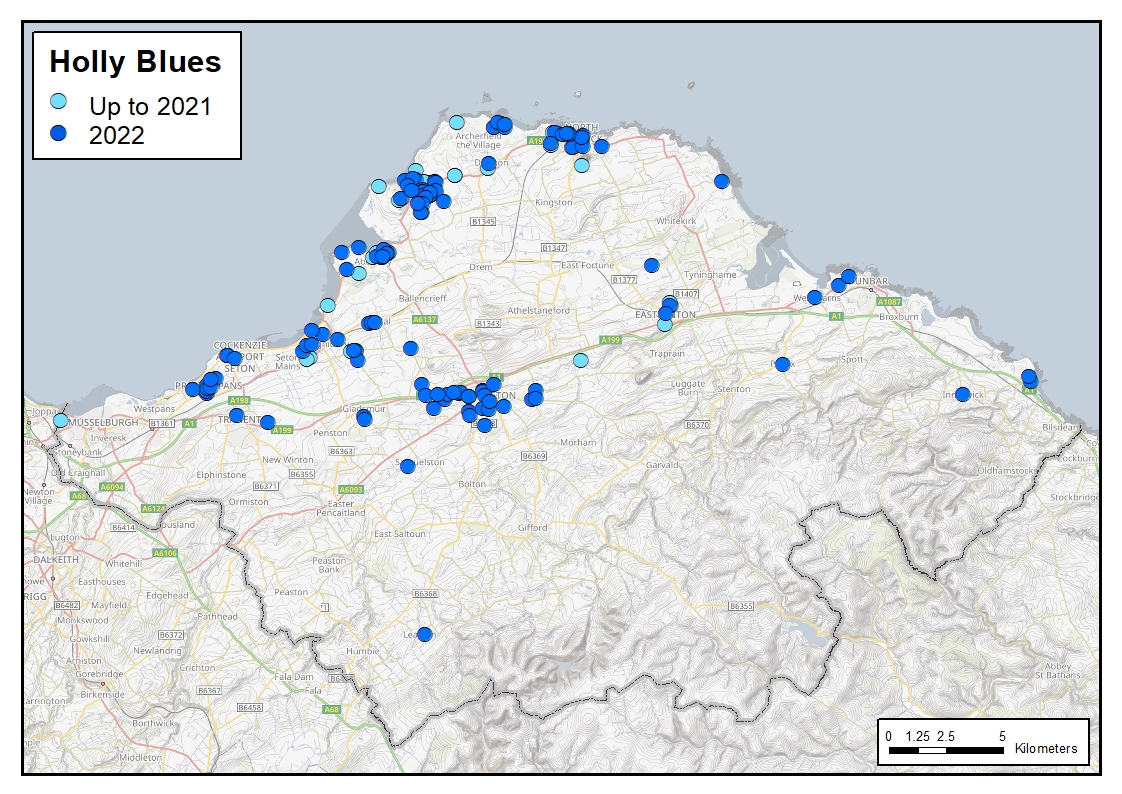
The excitement grew the following year when Holly Blues were spotted in various villages about 8 miles away from Gullane. By the end of 2020 I had received records of 90 Holly Blue being seen.


In 2021 the expansion of the range and population continued, with Holly Blues being quite regularly spotted and reported to me. Again they had advance by about 8 miles  following old railway walks and river valleys.  By the end of the year I had received records of 101 Holly Blues.

And in 2022 the trend continued with 288 Holly Blues being reported to me from much of the county. By this time they had spread to Edinburgh and there were some sightings in the Scottish Borders.


Already this year they have spread further across the county and a good number have been seen in the Borders, Edinburgh and Midlothian. I can't believe that this little butterfly has managed to colonise the entire county in just four years!

The Holly Blue has two generations a year. The first being seen in April and May and the summer generation flying in late July and August. We have also seen the odd Holly Blue in October and November, as a very small third generation. During their flight periods it is worth checking any sunny patches of ivy or holly for these little silvery-blue butterflies.


In England the populations of Holly Blues fluctuate considerably over a five year cycle. This is because of a parasitic wasp, Listrodomus nycthemerus, for which the Holly Blue is its only host. The population of Holly Blues can be decimated, but the following year the wasp has very few hosts causing a drop in its own numbers. As the Holly Blues continues to extend its range in Scotland it will eventually join up with the English population and, possibly, the parasitic wasp!


Sunday, 26 March 2023

East Lothian Butterflies 2022 - Part 1

Every year when I report on the butterflies that have been seen in East Lothian there is something exciting to report. I often wonder how long we can go on finding new species here and 2022 didn't let us down!

The weather wasn't the best for butterflies and it is interesting to speculate how temperature, wind, cloud cover or rain will impact on the number of butterflies seen not only in the current year, but also the impact the weather may have on next year's generations.


Last winter was reasonably mild, but very windy and it remained quite cloudy through till mid way through June. It then warmed up nicely and we had a very dry summer, but after mid September there was a lot of rain. There were one or two frosty days in October, but it wasn't until November that the cold weather arrived. The year continued wet with a very cold spell in mid December.

Many species of butterflies had a fairly normal year, so rather than reporting on each species, I thought I would concentrate on some of the more unusual sightings.


The first records I received were both on the 27th February, with a Peacock at Gullane and a Small Tortoiseshell in Dunbar. After that there were no more sightings until the 18th March when another Small Tortoiseshell was seen and then a Red Admiral on the 19th March. The next species was a Comma on the 23rd and then the exciting news that a Brimstone was seen on the 25th March.


There had been a few scattered sightings of Brimstones in 2021, so to have a sighting so early in the year suggested that it had over-wintered in East Lothian, rather than flown up from England. Over the next four weeks I received another six records of both males and females, all from a small area on the west side of Haddington.


The Brimstone is a very common butterfly over much of England, but it doesn't occur much north of Yorkshire. It lays its eggs on Alder Buckthorn and Purging Buckthorn, and these plants have a very similar distribution to the butterfly. We speculated that somewhere in Haddington was an Alder Buckthorn bush that had hosted a brood of caterpillars in the summer of 2021. The resulting butterflies would have over-wintered and then appeared in spring 2022. Sadly, though, there were no records of any Brimstones later in the year, so it looks as though the new colony didn't continue. Possibly the owners of the Alder Buckthorn saw all of the caterpillar damage and cut the plant down! It will certainly be worth keeping an eye open for large yellow butterflies over the coming years.


Large Whites, Green-veined Whites and Small Whites all have very similar life cycles, with a spring generation and a summer generation. However, the Large White is never seen in big numbers, with the other two species usually being very common. In 2022 the Small White did very well, but the Green-veined White struggled a bit. In fact it was the worst year for them since I started collating the records. I can only assume this was down to the weather. I tend to associate Green-veined Whites with damper areas, along the sides of rivers or in meadows, whereas Small Whites are more often spotted in gardens. Possibly the dry first half of the year didn’t suit the Green-veined White as much.


Holly Blues have continued to do well in East Lothian. They increased their range considerably, being seen as far east as Thorntonloch and along much of the coast into Edinburgh. They were also seen in good numbers in Haddington and into the foothills of the Lammermuirs. I can't believe how quickly they have expanded. We had no records of Holly Blues in 2017 or 2018. In 2019 there was great excitement when I received 28 records, mostly from around the Gullane area. In 2020 I received 90 records, in 2021 101 records and last year 288 Holly Blues were recorded.


There were two records of a very late Holly Blue spotted in Aberlady. I am not sure if it was the same butterfly that was seen by two people. The record I received was from 12th November. The second generation of Holly Blues usually only goes on until the end of August, so I think this must have been a third generation.


In order to keep this post to a reasonable length I will continue with the remaining species seen last year in my next post.

Saturday, 12 February 2022

East Lothian Butterflies 2021 Part 1

The number of East Lothian butterfly records was quite a bit lower in 2021 than in previous years. This was partially due to the additional work load that Covid 19 placed on the Countryside Rangers and, to some extent, because I am no longer living in East Lothian. I didn't receive so many records from volunteers this year, maybe because they were making the most of the reduced lockdown restrictions. However, it turned out to be a very interesting and exciting year for butterflies in East Lothian, possibly a record year!

It is a little odd reporting on East Lothian butterflies now that I am living in the Borders. I usually get an impression on how things are doing when I am out and about, but things can be very different here compared to East Lothian. I did keep a note of butterflies that I saw when I was in East Lothian on site visits, but frustratingly those dates often didn't coincide with decent weather!

So, in 2021 we received a total of 1,546 records totaling 7,996 butterflies. This is a higher number of butterflies than were recorded in 2020, but about half the number of previous years.

2021 started off very cold and frosty. Despite a warm spell at the beginning of April frosts continued into May. Thereafter the weather wasn't too bad, but the earlier cold spell appeared to impact on some butterfly species.

Despite the weather, the first butterfly to be recorded in 2021 was a Small Tortoiseshell seen at Aberlady on 17th February. This species did very well during the spring, but there weren't as many as usual later in the summer. This year I didn't find any Small Tortoiseshell caterpillars, despite looking in likely spots, which is unusual. I suspect that the late cold spells must have limited breeding opportunities for them.


The first Peacock was seen on 26th February sunning itself in a skip in Dunbar! Like the Tortoiseshells, they appeared to have a poor year, even taking account of the limited number of records received. This corresponded with how few I saw at home on my Buddleia later in the summer.


It wasn't until the 16th of March that we saw the first Comma of the year. Unfortunately, 2021 was one of the worst years I have known for them. They are not normally seen in large numbers, but this year we only recorded 24 individuals. On average over the last 8 years we have seen over 75 Commas each year.


The first Small White was recorded on 3rd April. They had a reasonably good year, but like the species above the summer generation wasn't as big as normal. It is interesting that the Green-veined White, that has a similar life cycle, did much better later in the year. The Green-vein is a species that I associate with damper areas, so possibly they are better able to cope with poor weather. The first Green-veined White was recorded on 17th April and they were seen through to 7th September.


It was exciting to see the Holly Blue doing well again in 2021. The first record was on 10th April and over the season I received records of 101 Holly Blues. They were seen in all of the locations where they were seen the previous year and don't appear to have expanded their range further. However, this is encouraging, given that many other species struggled in 2021.


The first Speckled Wood was seen on 11th April. Their numbers were lower than normal in the spring, but they more than made up for it with very high numbers seen in late August and September. It was good to see their numbers bounce back after a poor year in 2020.


Orange Tips
first appeared on 12th April. Unfortunately, they had a very poor year, probably because their flight period coincided with the cold weather. Of course the cold weather may also have meant that fewer people were out looking for butterflies, so hopefully things weren't as bad as they appeared and we will see them back in good numbers again this spring.


Large Whites
made an appearance from 21st April. They didn't do very well in the spring, but unlike its smaller cousin, the summer population was relatively high. It isn't a butterfly that is ever seen in large numbers, but 2021 was one of the best years we have had.


Red Admirals
had a particularly poor year. The first record of was on 22nd April and only one more was seen in May. June was better, but we didn't see the usual big influx of migrant butterflies. As a result the summer population was lower than we have seen for the last few years.


The first Wall Brown was recorded on 30 April and they went on to have a fantastic year. Over the last ten years, since they first arrived in East Lothian, they have increased in number year after year. 2021 was by far the best year yet with records of 663 butterflies reported.

Small Heaths had a very good year. In fact I received more records of them in 2021 than in any previous year. They had a short season, first being recorded on the 17th May and being seen until 5th September. It is said that in Scotland there is only one generation a year, but further south in England there are two generations a year. It is difficult to understand what is happening here with them being seen over such a long period and it is tempting to think we get two generations.


Common Blue
had a bit of a slow start to the season, with the first record being received on 30th May. However, their numbers soon picked up and they ended up having a very good year.


2021 wasn't a good year for Painted Ladies. The first record wasn't until 5th June, which is a lot later than usual and I only received records of 38 individuals. I suppose that when you think that these butterflies start off in Northern Africa and migrate over two or three generations before they arrive here that it isn't surprising that some years very few make it. They will need good weather and food sources throughout their journey to be successful.

I will continue this on the next post...

Friday, 30 April 2021

Holly Blues in East Lothian, Celastrina argiolus

This beautiful little butterfly is found extensively across England and Wales but there is only the odd record in Scotland. Most of those are from East Lothian, although they have been recorded in Fife and the Scottish Borders.

I was always aware of a colony on the western edge of East Lothian, but when I checked out Butterfly Conservation’s records for the area, I only found one record from 2013, although I know they had been seen there for many years before that. It just shows the importance of making sure that sightings of any butterflies are sent to the local recorder. Sadly, following a series of cold winters that colony appeared to die out.

For the last ten years, though, there have been single sightings each year from an area around three villages in the north of East Lothian. These have all been from Dirleton, North Berwick and Gullane and I suspect that there is a large private garden somewhere in that area containing Holly and Ivy where a colony of Holly Blues has secretly been living. Those individuals that were seen could all have flown from that one colony.

Despite the efforts of a few of us, we have never found where that colony may have been.

In 2011 there was great excitement, as three Holly Blues were seen on the outskirts of Aberlady. However, despite careful checking of the area since, they were not seen there again.


Then in 2019 some Holly Blues were seen feeding on Snowberry flowers on the outskirts of Gullane, right next to a popular path. I am sure that they would have been spotted in previous years if they had been there. I think the maximum count seen then was 7 butterflies.


A little later in the year a second colony was found a few hundred yards away and a couple of individuals were spotted on the outskirts of the village.


In 2020 we anticipated their return, but we were disappointed that no one saw any in these two locations during the spring. We wondered if these were yet more failed colonies that couldn’t cope with our winter weather. However, I started to receive records from other areas of East Lothian, up to 12 kilometres away. I think we had records of 38 Holly Blues that spring and later in the summer, when the second generation was flying, we had a further 52 records come in, including several from the two colonies in Gullane and from the site in Aberlady where they were seen in 2011.


I would love to find out more about Holly Blues. I get the impression that females must fly from the original colony for up to about 10 kilometres in search of somewhere to lay eggs. This would explain the individual sightings over the last few years and the new colonies that have sprung up around East Lothian. Many of these are in areas that have been regularly surveyed by enthusiasts, so any Holly Blues would have been spotted there in previous years.


Already this spring there have been quite a few records sent in from the areas we found them last year. It will be interesting to see if they expand their range further when the next generation appears in August.


I guess I will never know where the original colony was, but it is great that Holly Blues are now becoming a regular site in East Lothian.

Monday, 22 February 2021

East Lothian Butterflies 2020

For the last few years I have been coordinating the butterfly records from the Countryside Rangers and volunteers in East Lothian and then sending them in to Butterfly Conservation. 2020 was a very unusual year in more ways than one. The coronavirus, weather and my move to the Scottish Borders all impacted on butterfly recording.

After a reasonably mild, but wet winter the weather was wonderful from March until June. Coupled with the good summer of 2019 this resulted in a few early records, such as Small Coppers being seen on the coast near Dunbar on 7th April, the earliest record in Scotland.

Unfortunately in early June we had some very heavy showers and the wet and cloudy weather persisted for much of the rest of the year. I am sure the poor weather later in the summer impacted on the number of butterflies we saw.


The Covid-19 lockdown came into effect in March, meaning that we were not able to travel, other than for essential reasons. Luckily many of the East Lothian Countryside Volunteers took up the request to record the butterflies that they saw in their gardens or while they were taking their daily exercise.

The transects took a real hit, though, as it wasn't possible for people to travel in order to undertake these surveys. Only the John Muir Country Park transect was walked all season and two other transects were walked from July until September. There are normally nine transects regularly walked in East Lothian.

But, thanks to everyone's efforts we received 1,858 ad hoc records of butterflies in 2020, a bit down on the average of 2,200, but much better than it could have been. The number of butterflies recorded varies year on year, but has averaged about 13,000 over the last few years. In 2020 we only recorded 5007 butterflies. Undoubtedly the lack of transect records has contributed to this, but some species didn't appear to do very well last year, particularly those that we normally see in good numbers after June.


Because of all of the variability in 2020, it would be wrong to directly compare the figures with previous years, but there were still some very interesting results.

The spring populations of Large Whites and Small Whites, appeared to do well, but the summer generations were smaller than we are used to seeing. This appeared to correspond with the weather conditions during each generation. The ever-reliable Green-veined Whites, though, did well throughout the year.


After the bumper numbers of Painted Ladies we saw in 2019, it seemed odd that we had so few records last year. In 2019 we recorded 5,395 Painted Ladies, but in 2020 we only had 18 records. The number that arrive on our shores depends on how well they have done in North Africa and southern Europe earlier in the year, but it is interesting to see the dramatic difference there can be each year. You would imagine that with so many returning from the UK in the autumn of 2019 that there would have been a good stock to start the 2020 season with. Possibly there was limited food available in North Africa, maybe the weather in southern Europe wasn’t so good and, of course, we would normally expect to see large numbers appearing on our shores in July, when the weather was particularly rainy here.

The big story of 2020 was Holly Blues. For the last few years we have received one, or occasionally two, records of a Holly Blue in East Lothian. These records have usually been from a 5 kilometre stretch of the coast, leaving us to suspect that there was an undiscovered colony in a large garden or other secluded location in the area. Then in 2019 two colonies were discovered in the village of Gullane, right in the middle of that area.


In the spring of 2020 we we received records from that same general area, but also from further along the coast and from 5 miles inland. Then in July and August we had several more records from all these areas and a bit further afield. By the time we received the last record on September 6th, 90 Holly Blues had been recorded in East Lothian. It was an amazing expansion in their range and most of the sightings were from places which are regularly checked for butterflies so they would have definitely been seen in previous years if they had been there.


Two Large Skippers were spotted, one inland and one at the coast. I suspect that there are more of them around, but they tend to whizz from flower to flower and are often difficult to spot.


There was a mass arrival of Red Admirals at the end of June, but numbers were lower than expected later in the year. I guess the weather didn’t help, but I noticed that many of the caterpillars in my garden were attacked by parasitic wasps and perished. I wonder if the same happened in East Lothian?


However, Peacocks and Commas also seemed to do less well later in the year, suggesting that it may have been more to do with the weather.

In contrast, Small Tortoiseshells had a really good year, which is good to see. There is quite a lot of national concern because their numbers have been declining over the last few years. Let’s hope this is the start of a renaissance for the species.


I only received one Green Hairstreak record in 2020. The Covid restrictions meant that it wasn't possible to check most of the site where they have previously been recorded, which are all quite remote.

It was great seeing Wall Browns continuing to do well. It is ten years since they were first recorded in East Lothian and they can now be found almost anywhere in the county.


Meadow Browns and Small Heaths both appeared to do very well in 2020 and it was surprising to receive so many records, as they are not what you would consider to be garden butterflies.

I didn't receive any records of Northern Brown Argus in 2020. I am only aware of four colonies and three of those are not in places that people would have been able to visit during lockdown. There is a colony on a coastal golf course, where I only saw one Northern Brown Argus in 2019. I hope that they are still there and just weren't spotted by people walking past.

We had 23 species of butterflies recorded in 2020 in East Lothian, which is fantastic given the restrictions we were all under.


I am very grateful to everyone who contributed records last year. I hope it won't be too long before we are seeing butterflies again in the spring and I really hope that restrictions will have been lifted enough for us to be able to get out and see them.

Followers