A collection of observations about butterflies here in Scotland and notes of the butterflies I have seen when on family holidays.
Saturday, 29 November 2025
Some more Borders Butterflies
Tuesday, 11 February 2025
East Lothian Butterflies 2024 - Part 2
Continued from my previous post.
The number of Small Skippers recorded took a dip after they have been increasing since they were first recorded in East Lothian in 2011.
Large Skippers are now found all across East Lothian, but we only receive a few records. I think it is quite a difficult butterfly to spot and identify as it zips about between flowers.
Ringlet numbers were a little lower than average, but nothing significant.
However, Meadow Brown numbers were down to about 75% of the average.
Holly Blue numbers crashed. After the odd sighting for many years their numbers have increased since 2019. They started off very well in the spring of 2024, but the summer generation was very much lower than expected. Across England the annual population fluctuates in response to a parasitic wasp. This wasp was discovered in 2024 by a local enthusiast who had reared some Holly Blues, only for some to fail with wasps appearing from the chrysalises.
There are a number of small, isolated colonies of Northern Brown Argus across East Lothian. They are found north of Traprain, east of Dunbar and in the Lammermuirs. Some of the known colonies may have died out and there are likely more undiscovered locations. Because of their remote locations we struggle to monitor how they are doing. In 20224 the Countryside Rangers received funding to plant Rockrose at a coastal site and they worked with Bear Scotland to plant up a south-facing road verge. Once these are established they will hopefully these will provide stepping stones between the existing colonies.
Grayling butterflies continue to be found at three semi-urban sites. Sadly two of these locations are being developed, so I suspect we may lose those colonies. The exciting new was that there was a Grayling photographed on North Berwick Law last summer and they were also seen in the Lammermuirs.
The Small Pearl-bordered Fritillary is a rare butterfly in East Lothian, but they are found in a couple of locations in the Lammermuir Hills. They were seen in one of the Lammermuir valleys last summer.
And finally, hairstreaks! We have long been aware of a few small colonies of Green Hairstreaks around East Lothian. They are mostly in quite remote locations in the Lammermuirs, so I don't often receive records of them. There was a colony in Saltoun Big Wood, but there have been no Green Hairstreaks recorded there in the last few years, since there was a fire in the small area of woodland where they were found.
Having found adult Purple Hairstreaks in 2022 at Woodhall and Dunglass, two enthusiasts returned to East Lothian to search for eggs last winter. They did a very thorough job collecting carrier bags full of terminal buds from fallen Oak twigs and branches and searching them with a magnifying glass to look for eggs. Amazingly they were successful in finding eggs in six woodland across East Lothian. The adult butterfly rarely leave the top of mature Oak trees, where they can be seen flying in the late afternoon and early evening. Despite a lot of effort searching these woods in the past Purple Hairstreaks haven't previously been recorded in these locations.
Probably the most exciting news of 2024 was the sighting of a White-letter Hairstreak in a garden in Haddington. This is the first sighting of this species in East Lothian. They have made their way out of Northumberland and into the Scottish Borders over the last few years, mostly along the Tweed Valley. So, this is a big jump for the species. However, one was also recorded in Edinburgh and another in Dundee. It is fascinating to consider how these butterflies have spread so far, or if they have been there for a while. It will be interesting to see how they do over the next few years.
It certainly wasn't a great year for butterflies, but I think East Lothian probably did better than the UK as a whole, with one or two species actually appearing in good numbers. Some of the species such as Meadow Brown, Comma and Red Admiral did amazingly well in 2023, so the lower numbers in 2024 are almost to be expected.
Certainly I noticed that numbers where I live in the Borders were pretty similar to East Lothian. Given the wet summer that we had it isn't really surprising that numbers were a bit down. The next few years will give a better idea of how things are going. Let's hope for some decent weather!!
As always, thank you very much to everyone who took part in a transect or who sent in records. I am always delighted to receive them.
Sunday, 29 January 2023
Three year garden butterflies
It has been almost three years since we moved to our house in the Scottish Borders. We have actually owned the house since 2016, but only popped down at weekends while we were having building work done. We finally moved in two days before lockdown for the Covid pandemic, which means I have been mostly working from home, allowing me pop out at lunchtime to look for butterflies.
I have a set lunchtime dog walk, past all the best butterfly spots and around a little path through my meadow and each day I walk the route I keep a note of the butterflies I have seen.
I have just had a look at all of my sightings over the last three years to see if there are any increases in butterfly numbers, which may be a result of the work I have done to try to enhance the place for butterflies.
I have seen 19 different species of butterflies here, which I am very pleased about. The numbers of some of the more common species seem to fluctuate quite a bit, so don't really show anything. Each year I have seen good numbers of Orange Tips and 2022 was a particularly good year for Green-veined Whites. Small White had a really poor year in 2020, a great year in 2021 and an average year last year! Large Whites tend to be seen in much smaller numbers than the other whites, but they had a particularly good year in 2021. I am expecting to see a good number this year, as I planted nasturtiums last year and the house is currently covered in Large White chrysalises!
Ringlet and Meadow Brown numbers have increased year on year. Possibly these grassland species are benefiting from the management of the meadow area and I have seen them in the area that had been a spruce plantation, so they are certainly benefiting from the grass that is growing amongst the young broad leaves there.
The other grassland species, the Small Heath, hasn't done so well. Each year I have only seen one or two here. It seems strange, as they are really common in the valley above the house and I would have thought the habitats here are perfect for them.
The number of Small Tortoiseshells has gone up and down. 2021 was particularly good, but numbers dropped back down last year. I think the cool and cloudy spring didn't help them this year. In the past I have found several groups of caterpillars on nettles, but I didn't find any this spring.
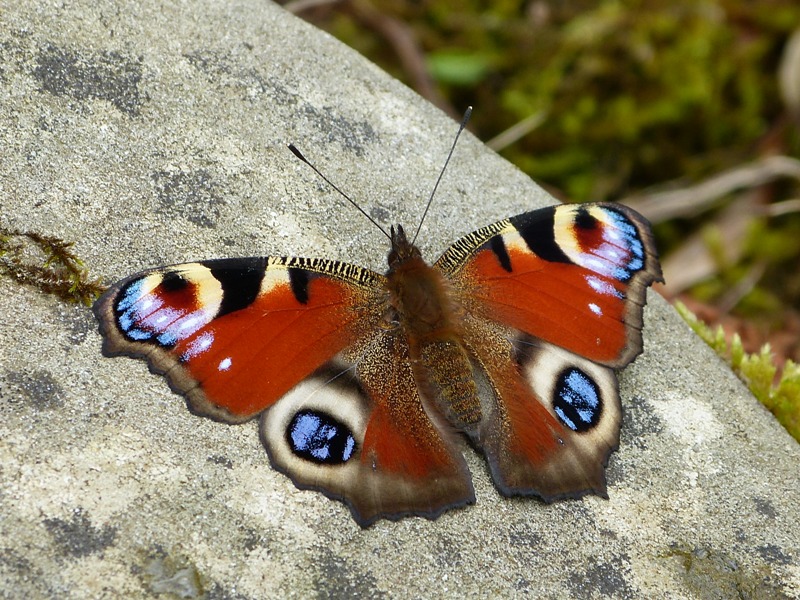
However, the Peacock, which has a similar life cycle to the Small Tortoiseshell did really well in both 2021 and 2022. I did find a couple of groups of caterpillars, so they were possibly more successful breeding. In 2019 I recorded 48 Peacocks, in 2020 99 Peacocks, 2021 I saw 196 and last year I recorded 192 Peacocks. Maybe the numbers reflect how my Buddleia bushes have grown over the last four years.
Red Admirals have been remarkably consistent and I have seen almost the same number each of the last three years. In late summer the Buddleia bushes are covered with them and they remain here long after the first frosts.
Commas are not considered a common butterfly in Southern Scotland, but their numbers have increased year on year here. Since 2018 the numbers I have seen each year were 9, 20, 25, 38 and 58. It is lovely to see them doing so well and I hope their numbers continue to increase.
The number of Painted Ladies varies considerably, as it does all over the country. Last year was the best year I have seen here, with 11 sightings, but in 2021 I didn't see any at all.
In 2020 I was happy to see 13 Dark Green Fritillaries feeding on thistles in my meadow. I thought that my new cutting regime was really paying off, but in 2021 I only saw 3 and last year only 5, despite there being really good numbers on the hill above the house.
I was really excited in 2020 to see a Small Pearl-bordered Fritillary in the meadow. Unfortunately, I didn't see any here in 2021, but last year I saw another here for a few days. There are good numbers in the valley above our house and we have a lot of violets growing in our woodland, so I am hopeful I may continue to see them here in future years.
I am really pleased that the number of Small Coppers I have seen has increased over the last three years. In 2020 I only saw 1, in 2021 I saw 8 and last year I saw 17. I don't really understand why I don't see more as the place is covered in Common Sorrel and Dock Leaf. Maybe their numbers will continue to increase.
I saw one Large Skipper zipping around the meadow in 2020 and another in 2022. I have seen them in the valley above the house, but only one or two.
I didn't see any Small Skippers in 2020, but I was excited to see 7 in 2021 and 17 last year. I am hoping that they will like the way I am managing the meadow, but I am always a bit worried that I may be destroying their eggs when I cut the vegetation in the autumn. There are areas that I leave uncut in the hope that it will help.
I have been amazed that every year since 2019 I have seen a Scotch Argus on our land. A couple of years I have recorded 2, but I can't be sure they were different individuals. Strangely, we don't have any Purple Moor Grass here, but I have seen one egg laying on another species of grass. The other strange thing is that there are no records of any Scotch Argus anywhere near. I can only assume that there is a colony somewhere nearby that hasn't been recorded.
The other really exciting record has been Northern Brown Argus. I saw one in 2020 and another here in 2022. There is a good colony in the valley about 800 metres above the house, but I have always understood that Northern Brown Argus don't travel any distance. Even more exciting last year was that I found Northern Brown Argus eggs on the Rockrose that I have planted on a little bank near the house. I am really looking forward to seeing if I now have my own little colony here and I am already planning to extend the area of Rockrose.
There are two species of butterfly that I watched arrive and spread across East Lothian when we lived there. Speckled Woods arrived in 2010 and are now a really common site across the county. Wall Browns arrived in 2011 and they have also spread right along the coast and along river valleys and are now seen regularly. It has always seemed odd not having either species here, but being further from the coast, we have a shorter season, so they haven't made their way here yet. However, last year Speckled Woods were recorded about three miles from here and there was a Wall Brown seen in the village less than a mile from here. So, both species are spreading in this direction and I live in hope that I may see them later in 2023.
There has also been a lot of excitement here in the Borders with more and more sightings of White-letter Hairstreaks and Purple Hairstreaks, particularly in the east of the county. White-letter Hairstreaks are heading along the river valleys in this direction and there used to be a colony of Purple Hairstreaks just the other side of the valley from here. So, there is much to look forward to.
Wednesday, 29 December 2021
Scottish Borders Butterflies 2021
Due to Covid travel restrictions our planned holiday to Spain was cancelled for the second year in a row. I always look forward to a trip abroad and the opportunity to see different butterflies. On previous trips to Spain I have managed to see about 40 species of butterflies, so for the second year in a row my tally was going to be particularly low.
I am lucky that we have some land where we have done much to encourage butterflies and just a few hundred metres above our house there is an amazing valley where there are a lot of interesting species. There are a few interesting species that occur a few miles away, so I decided this year to see how many species I could find in the Scottish Borders.
The year started off well with a couple of Small Tortoiseshells, Aglais urticae, visiting the garden in March and in April Peacocks, Aglais io, and Commas, Polygonia c-album, joined them. Despite the good start to the season the weather was cold and wet later in the spring and I didn't find any caterpillars of these species, which is unusual. However, they obviously did manage to breed as there were more adults later in the summer, but not in as good numbers as normal.
In early June I drove over to Burnmouth to look for Small Blues, Cupido mimimus. Although there was a cool breeze coming in off the sea I still saw quite a few, along with Small Heaths, Coenonympha pamphilus, Small Coppers, Lycaena phlaeas, and Wall Browns, Lasiommata megera.
Towards the end of July I went to Kelso to look for White-letter Hairstreaks, Satyrium w-album. Iain Cowe, the Borders butterfly recorder, had previously shown me how to find eggs on Elm trees, so I headed to the same spot. Within a few minutes I spotted some butterflies high in the trees and a little later one kindly flew down and landed on a branch next to me.