I am no expert photographer, preferring to capture the moment than get a perfectly composed shot. The pictures on my blog are either taken with a compact Canon, a Panasonic Lumix FZ150 or on my phone.


Showing posts with label Green-veined White. Show all posts

Friday, 23 January 2026

East Lothian Butterflies 2025 part 1

I collect the butterfly records from the East Lothian Countryside Rangers and about 40 volunteers. At the end of the season I put together an annual round-up that I send to the volunteers to let them see how their records fit into the big picture. Below is an edited version.

2025 was pretty dry and sunny in East Lothian, but there was often an easterly wind keeping the temperatures down. The general lack of rain and the wind caused the vegetation to dry up, particularly in coastal areas.

We had a couple of very early records. Firstly, a Speckled Wood that was seen on 15th January in Butterdean Wood. I can only assume that it had crawled into a nearby greenhouse as a caterpillar last autumn and was tricked into thinking that spring had arrived.

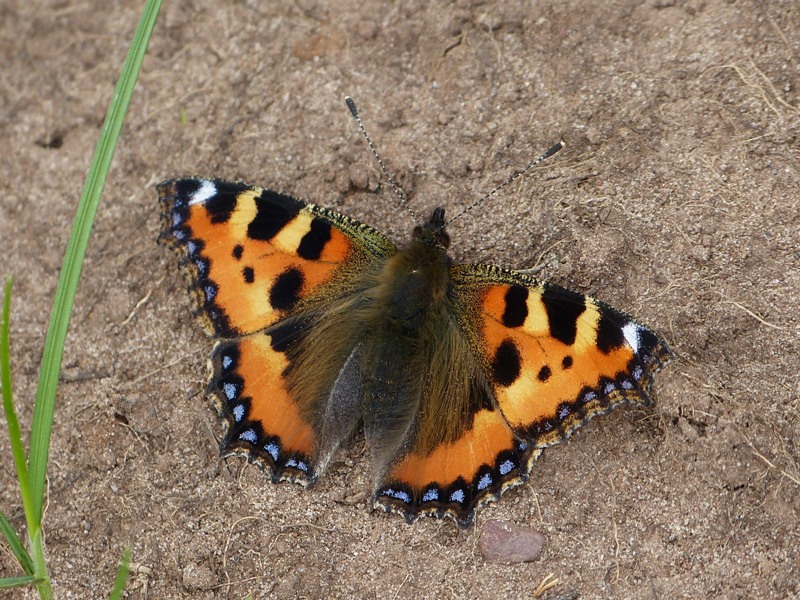
The next butterfly was a Small Tortoiseshell, which was seen on 28th February. Maybe this wasn't such a surprise as they spend the winter hibernating as adult butterflies, so can make an appearance on a mild day.

There was then a flurry of Small Tortoiseshells and Peacocks on 6th March. Both species had a fairly average year, but at least Small Tortoiseshells bounced back from last year's low numbers.

There were a few Red Admirals seen in March, indicating that they may have survived the winter here. They went on to have an amazing year, with us recording about three times the average number.

The first Comma was seen on 15th March. They went on to have a great year, particularly later in the season, and I received the highest number of records since I started collating them in 2008.

A few days later a Painted Lady was spotted in North Berwick. They also had a good year, with 220 records - a big improvement on last year's 14! Their numbers can be really variable. I would suggest the normal annual average is under 100 records, but the figures are skewed by the 2019 invasion when I received 5395 records!

All four white species had an amazing year. For Orange Tips, Green-veined Whites and Large Whites it was by far the best year since I started recording the butterflies. 


Small Whites also had a fantastic year, way above average, but not quite as high a number as was seen in 2018.

Speckled Wood numbers picked up in April and they also had a very good year. I received records of 1608 of them, which is the second highest number since they reappeared in East Lothian in 2009.

Small Coppers had a fairly average year.

The same could be said for Wall Brown. Their numbers look fairly average, but when you look at when they were seen, they were almost exactly two weeks early and there was a small third generation towards the end of September, with the last one being seen on 7th November.

I will continue this on my next post.


Sunday, 31 August 2025

Of Caterpillars and Chrysalises

So far this year has been amazing for butterflies, but not only in their adult form. I also seem to have come across quite a few eggs, caterpillars and chrysalises.

It is always fun searching for Orange Tip eggs and caterpillars on Garlic Mustard and Cuckoo Flowers. This year they seemed to be on just about every flower spike I saw. This is a group of freshly laid eggs on a Cuckoo Flower.

In a couple of days they turn bright orange. I followed one egg with interest, which had been laid on a Garlic Mustard near the house. This was the caterpillar a couple of days after it had hatched.

The egg hatched on 11 May and I watched it develop until the 17 June when it formed a chrysalis. This is another caterpillar preparing to form a chrysalis.

And another one that unusually is about to form a chrysalis head down.

This is the chrysalis of the caterpillar I reared. It seems strange that it will remain in this state until April next year. 

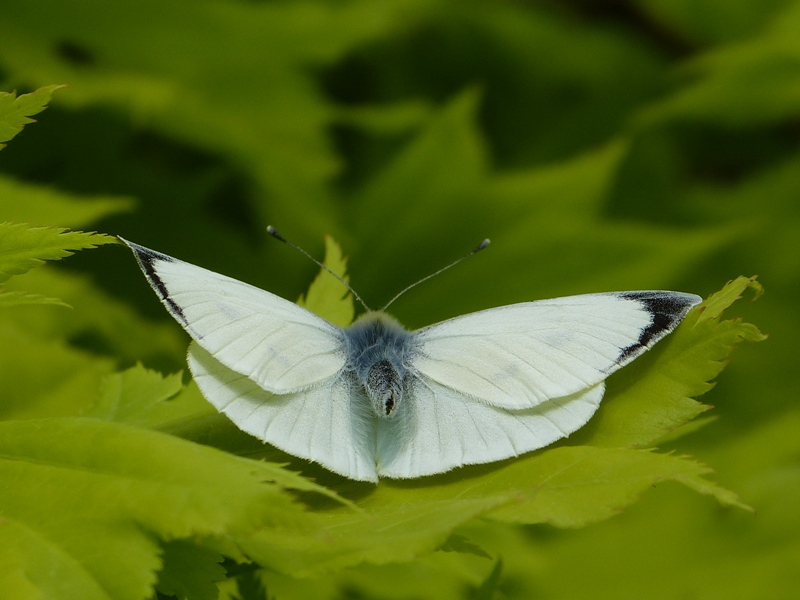
On 13th May I saw a Green-veined White laying eggs on the leaves of a Garlic Mustard plant.

The eggs hatched on the 21st May and the caterpillars developed until the 30th June when they formed chrysalises.


On the 9th July both chrysalises emerged.


I have found three batches of well developed Peacock caterpillars amongst the nettles here. I haven’t noted the dates of any of these, as I didn’t know when the eggs were laid, or when the caterpillars formed chrysalises. However, on 3rd July I was demolishing an old shed and discovered a mature Peacock caterpillar on a piece of wood I had ripped off. Luckily it wasn’t injured, so I put it into a mesh cage, where it crawled to the roof and hung in a “J” shape.

Two days later it was still hanging there, but I noticed a 3pm it had moulted and formed a lovely green chrysalis.

This changed colour over the next few days and on 22nd July it emerged.


Sadly, it didn’t stick around for an open-wing photograph!

On the 5th July I was walking up our drive when I noticed a Red Admiral caterpillar crossing in front of me. Of course I collected it up and put it in a cage, where it immediately went to a Garlic Mustard plant and started stitching together the edges of a leaf to form a tent. The next day I noticed it had formed a chrysalis. I wasn’t very hopeful of a positive outcome, as I thought it unusual to find the caterpillar out in the open like that, as they usually hide away inside leaf tents. However, on the 22nd July it emerged, the same day as the Peacock. 

It was a lot more cooperative and allowed me to take some pictures of it before it flew off!

I have seen a lot of Red Admiral caterpillars and chrysalises in the nettles in our garden. There are a lot of adults flying around so hopefully they will soon be joined by more.

Thursday, 29 February 2024

Scottish Borders Garden Butterflies 2023

We moved to this house in the Scottish Borders at the start of 2020 and since then I have been mostly working from home. During my lunch hours I tend to take the dogs for a walk around more or less the same route and I keep a note of the butterflies I see. I then keep a record of the highest number of each species I see each week. So, I now have four years' worth of butterfly records to compare.

Each year the weather has been quite different and that has had an impact on butterfly numbers. The weather was not great in 2023 with a lot of easterly winds. Spring started quite late but dry, but  from July onwards it was cloudy and wet.

Also, I have been spending a lot of time trying to improve habitats and plant different plants to attract butterflies. I would like to think that the effort is seeing rewards.


The main areas where I see butterflies is in the meadow I have been developing, on some Buddleia plants and, this year, in an area where I had some Spruce trees cut down, where I have replanted with native trees. The area is now quite grassy, with various other plants such a Fox Gloves and wild Raspberries.

The four species of white butterflies were interesting. Orange Tips generally had a good year. The first sighting was a week later than normal, but they were about in good numbers.


I saw more Small Whites than I have in previous years, but they were never seen in high numbers. I had found a number of chrysalises last year, which I kept in a cage over winter. 29 of them emerged over a period of a month in April and May. However, I never saw them in big numbers and, strangely, I didn't find any caterpillars on the Nasturtiums this year.


Conversely, Green-veined Whites didn't have such a good year for some reason.  I always associate Green-veined Whites with damper areas, so possibly last year's dry summer didn't agree with them.


Large Whites had a fairly average year. I had been expecting to see a lot of them, because there were a lot of caterpillars last year and there were several chrysalises on the house.  Again, this year, I didn't find any caterpillars on the Nasturtiums, which is unusual.


Last year was a really good year for Ringlets and this year wasn't quite as good. Overall, their numbers have gone up here over the last six years. I would like to think this is in part the result of some of the habitat work I have done.


2023 was a really great year for Meadow Browns here. I recorded 103 individuals, way up from the previous high of 21. As with the Ringlets, I would like to think that the Meadow Browns are enjoying the way I am managing the meadow. The high numbers of these two species may be a result of the weather the previous year, when eggs would have been laid and the caterpillars emerged. 2022 was a very dry summer. It will be interesting to see how they do this coming year after last year's wet summer.


I only saw 2 Small Coppers  here last year.  They had done really well the previous year, so I don't know why there were so few in 2023. There are plenty of food plants for them here, so I can only assume that it was the weather that didn't suit them.


I will continue this on the next post ...

Saturday, 3 March 2018

5-Year Comparisons


I have mentioned in my previous couple of posts how things have changed for Speckled Woods and Wall Browns over the last five years in East Lothian. These two species have both extended their range northwards and only arrived in the county within the last ten years.


I have been comparing 2017 figures with the previous four years for all of the species occurring here and it is apparent that some species have done very much better than others. I had my own perceptions of how well each species had done, but it is interesting to see the combined records from all of the volunteers.

The problem with doing a comparison like this is that each year I have had more people send in their records  to me, so you would expect to see more records for each species. However, this hasn't been the case with many of them.


For instance, when looking at the Large White, Small White and Green-veined White, there is a marked difference in how they did in 2017. These three species that share very similar life cycles, with a spring generation and a summer generation. It is odd that the Small White apparently had a poor second generation, but the other two species did as well as ever.

In the graphs below the red line shows the 2017 records. The blue line is the average figure for the last five years.


I had thought that there had been fewer than normal  Peacocks around in 2017, but when I looked at the records received they appeared to have done better than normal.


This is in contrast with the Small Tortoiseshell, which seemed to have a very poor year. I was surprised to see that there were more records than I expected.


2017 was an amazing year for Red Admirals. They have been increasing in numbers over the last few years and it is thought this is because they are now able to survive the winter in the UK. Whether this is because the temperatures are warmer than in previous years, or if they have adapted to our climate is unknown. It will be interesting to see how the very cold winter we are experiencing just now will impact on their numbers later this year.


What I find most interesting is that the species, such as the Wall Brown, Speckled Wood and Small Skipper, which have all moved into East Lothian in the last nine or ten years, have continued to increase in numbers, while some long-established species have been declining.


Most people who submit butterfly records to me it was felt that 2017 was a poor year for butterflies. As I mentioned previously we may be showing a falsely rosy picture of how the butterflies did, as we had more people sending in records. However, the differences between the species is valid. 

It will be interesting to see what happens in the years to come.


Followers