I am no expert photographer, preferring to capture the moment than get a perfectly composed shot. The pictures on my blog are either taken with a compact Canon, a Panasonic Lumix FZ150 or on my phone.


Showing posts with label Purple-shot Copper. Show all posts

Wednesday, 17 August 2022

Sierra Nevada Butterflies - June 2022

No visit to the villa in Alora would be complete without a visit to the Sierra Nevada. This year I visited on the 3rd of June, almost exactly a month earlier than normal. It is a three-hour drive to get there, but well worth it for the range of butterflies that occur there. There are three different locations that I normally visit, each with its own selection of butterflies.


Initially I drove up to the Hoya de la Mora carpark, which is as high as you can drive. From there I walked down into a valley with a lovely clear stream running through it. Normally, there is quite a variety of butterflies down there, but I started to worry after a few hundred metres and I had seen no butterflies.

Eventually, as I reached the stream I saw a Small Tortoiseshell. A little further along I saw a Small Copper. I was starting to get a bit fed up, as I had traveled all this way to see two butterflies, both of which I had seen in my garden before I left Scotland!


However, I soon cheered up when a Provence Orange Tip flew past me. Frustratingly, I saw at least two of them, but neither settled at all. Eventually, I just fired off my camera in their general direction and managed to get a picture of a little yellow and orange dot, a few pixels wide, just to prove I had seen them!

At least it now seemed worthwhile struggling down into the valley. On the way back up towards the carpark I saw a couple of Clouded Yellows and Queen of Spain Fritillaries.


So, just five species. Usually, in July I will see about 15 species on this same walk.

I then walked up to the small area where Zullich’s Blues are found. I anticipated I would be too early to see any, but thought it worth checking as I was there. I have sat on a rock up there in the past, eating my lunch, watching Zullich’s Blues sparing with Spanish Argus with the occasional enormous Apollo gliding past. Sadly this year, none of those species were flying yet.


On my way back down to the carpark I did see some Painted Ladies and quite a few Small Tortoiseshells. Also some Wall Browns and a Bath White.


Driving back down the mountain road, I stopped at the viewpoint I have visited in the past. This is a very reliable site and as usual, there were Swallowtails and Iberian Scarce Swallowtails hill-topping there. Also a lot of Wall Browns amongst the scrub. This year there were also quite a few whites flying. Those that stopped allowed me to identify them as Small Whites and Western Dappled Whites.


I was really excited to see a little Panoptes Blue flying there along with two Purple-shot Coppers.


There was also a mystery Skipper that didn’t land for long enough for me to photograph it and a large orange Fritillary whizzing around, which I had no chance to identify! Next I drove down to my favourite spot - a scrubby meadow. 

I will continue this in my next post.

Tuesday, 13 November 2018

Sierra Nevada Viewpoint

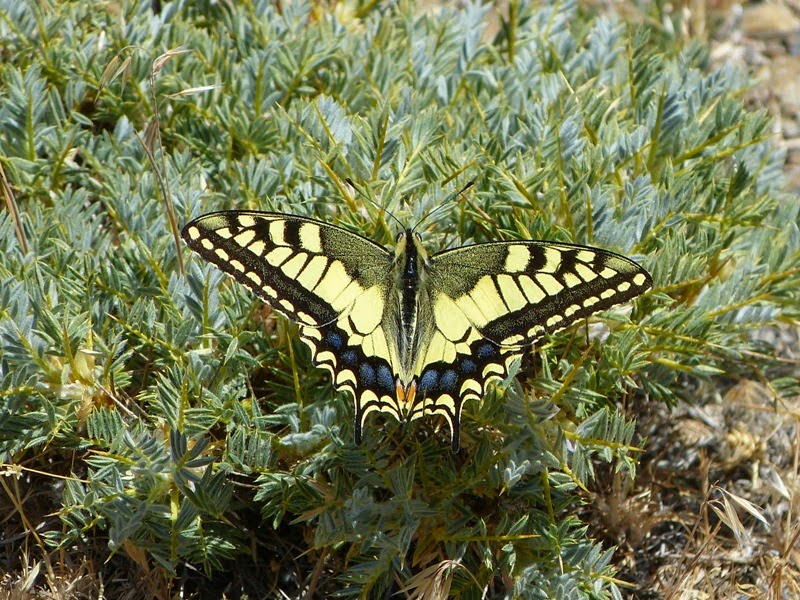
On my way back down the road, I called into a viewpoint that I have visited on previous occasions. Here, the subtly different habitat attracts some different butterflies. Most notable are the Swallowtails, Papilio machaon hispanicus, which I spotted almost as soon as I parked the car. They patrol this little hilltop, presumably looking for mates.

I also saw one Spanish Swallowtail, Iphiclides feisthamelii, feeding on the same little shrub that I have seen them on when I have visited previously.

In the past I have seen a lot of Wall Browns, Lasiommata megera, chasing each other around. This year I only saw one or two and I didn't see any Large Wall Browns, Lasiommata maera f. adrasta, that I normally see here.
I saw a couple of Common Blues, Polyommatus icarus, which I don't remember seeing in this spot before.

I spent some time watching these two Southern Marbled Skipper, Carcharodus baeticus, chasing around after each other and then locking horns! I have never seen behaviour like that before.

This Safflower Skipper, Pyrgus carthami nevadensis, was behaving a bit better!

I always see Blue-spot Hairstreaks, Satyrium spini, in this location.

Last year when I was reviewing my photos I realised that I had also taken a picture of a False Ilex Hairstreak, Satyrium esculi. So, this time I was looking out for them and once again spotted one.

There was also one Purple-shot Copper, Lycaena alciphron gordius, here. In previous years they had been quite numerous here.

It was interesting that many of the species found in each location that I visited in the Sierra Nevada were the same as I had seen on other visits. There are obvious locations, habits and food plants that will attract them. Some butterflies were in similar numbers and the same locations as in previous years.

Others were notable by their absence or low in numbers. For instance, it was worrying to see so few Zullich Blues and Apollos high in the mountains. Down by the stream this year I saw no Meadow Fritillaries, whereas two years ago I saw several. In fact there were very few butterflies there, but in previous years I have seen hundreds of butterflies enjoying the lush vegetation there.
Each year I visit, I see more species. This year I saw 3 species that I have never seen before and a total of 44 different species. The Sierra Nevada is still by far the best place for butterflies that I have ever visited.

Friday, 1 August 2014

Sierra Nevada, Spain - Butterflies - July 2014 (2) "Hilltopping"


On my way back down the mountain road I noticed a viewpoint, but it was impossible to drive the car into the parking area as there was a foot drop off the tarmac! I managed to find somewhere to park the car a little further down the road and walked back towards the viewpoint.

Initially, I was surprised not to see any butterflies, but as I walked up to the viewpoint I was amazed to see five Swallowtails, Papilio machaon hispanicus, flying backwards and forwards. I presume this is the "hill topping" activity that I have heard so much about.

The Swallowtails were being bombarded by Wall Browns, Lasiommata megera, every time they flew anywhere near them. It was a great sight to see!

Among them were some Large Wall Browns, Lasiommata maera.

I was delighted to see this Blue-spot Hairstreak, Satyrium spini. I had read about them before I went and I was disappointed to see that they occur in May and June in the Sierra Nevada. However, this one looked quite fresh. Later I saw some much more faded individuals.

As I crouched down to take a picture of the Blue-spot Hairstreak I noticed another butterfly out of the corner of my eye landing on the same plant. It was a Iberian Scarce Swallowtail, Iphiclides feisthamelii. What a dilemma - which to take a picture of?!! I ended up alternating between the two!

The Dusky Heaths, Coenonympha dorus, here were a lot fresher-looking than those back in Alora. There were quite a number here at about 2,100 metres, yet I had seen none 500 metres further up in the mountains.

There were also plenty of Purple-shot Coppers, Lycaena alciphron, in this area.

The Common Blues here were all rather faded, but this Idas Blue, Plebejus idas, was particularly nice. I had thought that this was another Silver-studded Blue, but after help from the UK Butterfly Forum and checking with the "Mariposas Diurnas de Sierra Nevada" book I now know it is an Idas Blue. These have a slightly darker background colour on the underside of their wings and more extensive blue spots.

I was amazed by how many butterflies there were in this small area. If you look carefully at the picture below you can see a dot above the left-hand interpretation board. It is one of the Swallowtails!


Followers