On Monday 29th April I went on my planned trip to El
Torcal de Antequera. This is an area of amazing limestone formations and the
pictures I had seen of the Natural Park looked very promising, with valleys of
wild flowers and weathered rock formations. I decided to leave early as the
forecast promised sun in the morning, until about 11am and then it was to cloud
over before rain later in the afternoon.
Before any such visit I normally spend some time looking at
Google Earth and Streetview to see if I can spot any promising locations. My
first planned destination was on the south side of the mountains, but when I
arrived at the track I was intending to walk along it was completely cloudy, 9
degrees and there was a strong wind blowing. There was some blue sky around, so
I decided to press on regardless. I was very pleased to have a cheap fleece
top, that we had each bought on arrival in the village! As I walked, I grew
more frustrated at the weather. I thought that even if the sun did come out,
the cold wind would still mean that butterflies were unlikely to fly. After a
while, it dawned on me that the clouds were being formed over the mountains and
just sitting there. As one area of clouds blew away more rolled in behind. I
therefore decided to give up on this site, thinking that maybe I could try
again in the afternoon when the sun would have swung round away from the
mountains.

So I drove to the El Torcal Natural Park. My intention had been
to park at the bottom of the entrance road and then walk up to the visitor
centre, but the weather was so miserable that I just drove up to the main car
park, which was surprisingly busy. Everyone else was dressed as if they were
going on an arctic expedition and I felt quite self conscious in my thin
fleece. It was 7 degrees up at the car park, still cloudy and windy.
I decided to walk the Yellow Route, which promised panoramic
views and I noticed that there appeared to be more sun on the north side of the
mountains. So, after my 2.5 kilometre loop of very interesting rock formations,
mostly dotted with people climbing up them, I jumped back in the car and drove
around to the north. It did appear that the mountains were holding the clouds,
and as I rounded a corner the sun came out.
I stopped at a likely looking area, and started to follow a
track that appeared to head west, parallel with the mountains. It was
interesting to see that there was a fence running next to the path and goats
were grazing the lower slopes of the mountain. Luckily they were not on my side
of the fence and I was treated to a fantastic display of wild flowers.
Initially, not many butterflies, though.
The track turned a corner that then went through some fields of
wheat. I was beginning to wonder if this wasn't going to be such a good spot,
after all, but I saw a distant white butterfly so decided to continue. I caught
up with it and saw that it was a Small White, Pieris rapae. At least it meant that it was warm enough for
butterflies, though.
The track then went back into another lovely area of wild flowers
and scrub and I was delighted to see a Spanish Marbled White, Melanargia ines, which I watched for
some time.
It wasn't until I had returned to Scotland, and I was looking at my photographs, that I discovered that I had also taken pictures of a Western Marbled White, Melanargia occitanica. It has subtly different markings on its wings.
A couple of Clouded Yellows, Colias
crocea, and more Small Whites appeared in this section.
Continuing further along the track the vegetation became shorter
and then it followed the edge of some arable fields. When the track joined
another track I decided that I really needed to turn around in order to get
back to my wife when I said I would.
I followed a little butterfly and saw that it was a Small Heath,
Coenonympha pamphilus, then this
Dappled White, which I am still not 100% sure if it is Western or Portuguese.
The Small Whites and Clouded Yellows were out in force now and I
saw the occasional unidentified white or blue butterfly. The sun kindly went
behind a cloud for a while, which was enough for one of the smaller whites to
stop flying. It turned out to be a Green-striped White, Euchloe belemia, - one of my favourites.
I was now off-piste, so I looped back to join the track,
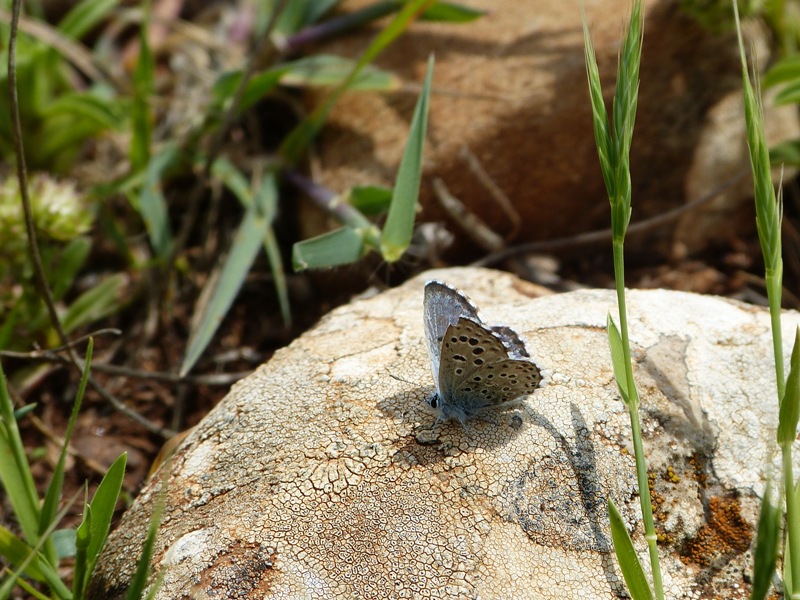
spotting a small blue butterfly in the process. After much following, it
stopped for long enough for a picture and an ID of Southern Blue, Polyommatus celina.
I was now very off-piste and struggling to locate the track. As
I pushed through some Lavender bushes a small insect flew away, which, when it
landed I saw was a little blue butterfly - Panoptes Blue, Pseudophilotes panoptes. I found myself saying, "Oh yes,
brilliant!" out loud and then hoped there was no one anywhere near!
The first I saw was a male and then it magically turned into a
female as I tried to follow this diminutive little butterfly. They were both
very obliging, staying in one spot for long enough for me to manage to
photograph them. This was the first time I have ever seen this species and it
is a butterfly that I have long wanted to see.
What a difference from a few hours ago when I was cursing the
weather! I managed to relocate the track and started to walk back towards the
car. However, it was as if someone had switched on the butterfly switch and
they were everywhere. Mostly more Small Whites, Clouded Yellows and Spanish
Marbled Whites. But then the occasional blue, some Black-eyed Blues, Glaucopsyche melanops.
And then another really small blue, which turned out to
Lorquin's Blue, Cupido lorquinii.
As I was photographing them I thought that I saw a couple of
large moths flying nearby, but they turned out to be quite faded Spanish
Festoons, Zerynthia rumina!
I dragged myself away from this magical spot and back through
the wheat fields towards the car, only to discover that the area of short
vegetation around the car was attractive to more Panoptes Blues. I saw at least
six there, along with some Small Coppers and Southern Brown Argus, Aricia cramera.
I returned to the apartment feeling very satisfied with my day
out looking for butterflies. When I arrived back in Alora, I parked in the main
car park and walked past a very overgrown rose bed. And there was an African
Grass Blue, Zizeeria knysna, flitting
about. As I was running a little late, I decided not to photograph it, but to
leave it for another day. Sadly that was the last sunny day of our holiday, so
I didn't get a chance. Never mind, my wife has just booked the apartment again
for September!!