I am no expert photographer, preferring to capture the moment than get a perfectly composed shot. The pictures on my blog are either taken with a compact Canon, a Panasonic Lumix FZ150 or on my phone.


Showing posts with label Melitaea didyma. Show all posts

Tuesday, 25 September 2018

Sierra Nevada Fritillaries


I walked a little further down the dry stream bed to where it opened out into a rocky area. There were several fritillaries flying around fighting over this prized territory. It was so nice having time to observe them and take pictures of the upper and underside of the wings. I realised that they usually returned to the same spot after a bout of aerial combat, so I was able to wait for them to return for a photograph!


There were at least two Knapweed Fritillaries, Melitaea phoebe.


They seemed to be continually chasing off some Niobe Fritillaries, Argynnis niobe altonevadensis.


A Spotted Fritillary, Melitaea didyma, seemed to be at the bottom of the pecking order and was quickly seen off.


But a Marsh Fritillary, Euphydryas aurinia beckeri, was more persistent, constantly returning to its favourite rose bush.


Occasionally a larger Fritillary would fly past, but it would soon be chased off before it had even landed. I suspect they were High Brown Fritillaries, Argynnis adippe, as that is the largest fritillary occurring in the Sierra Nevada.

There were also a few Queen of Spain Fritillaries, Issoria lathonia. They seemed to be the top dogs in the area.


I returned to the car to have a drink of water and while I was there I noticed two fritillaries on a yellow flower below me. I cautiously approached them and saw that they were Cardinal Fritillaries, Argynnis pandora.


Despite a disappointing start to my day, I ended up seeing 33 species. It was so nice being able to spend some time watching the butterflies in this little meadow.

Sunday, 31 December 2017

Corfu Butterflies II - July 2017

On 1st July I decided to walk up the hill behind our villa. For the first one and a half kilometres I walked along a narrow road and then tracks through olive groves and past houses. I only saw a Meadow Brown and a Skipper while I was walking this section, which didn't bode well!

However, I then turned up a track past a tumbled down farm house and as I left the olive groves, I immediately started seeing great numbers of butterflies. First off, in the shade of some trees were what I think were some Southern Graylings, Hipparchia aristaeus.

In this same area there were also a couple of Meadow Browns, Maniola jurtina.

High up on a banking of brambles, there was a Silver Washed Fritillary, Argynnis paphia, and a Sage Skipper, Syrinthus proto.

As soon as I was back out into the light there were Wall Browns, Lasiommata megera, all along the track.

Among them were some Large Wall Browns, Lasiommata maera, which interestingly were smaller than the Wall Browns here.

The Wall Browns were out-numbered by Balkan Marbled Whites, Melanargia larissa, but here they seemed lighter in colour than those I had seen on the other side of Mount Pantokrator.

I was really thrilled to see a couple of Spotted Fritillaries, Melitaea didyma, on a sunny spot on the track. I spent some time watching them and they kindly stayed still for photographs feeding on yellow thistles.


A little further up the track I saw a Wood White, Leptidea sinapis. Unfortunately, it wouldn't come out into the sun, so it was impossible to get a picture of it without a shadow over the wings.

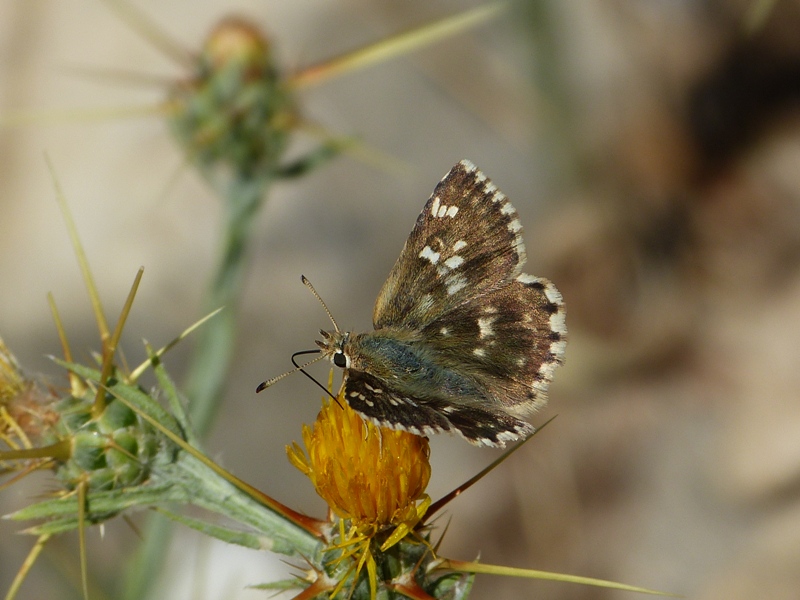
While I was watching them I photographed a little skipper, which I later identified as a Lulworth Skipper, Thymelicus acteon. There were also several more Sage Skippers higher up the track.

I walked as far as a saddle in the hill where I could see down to the coast on both sides of the island.

It was lovely being in amongst so many butterflies. The Wall Browns and Balkan Marbled Whites continued to be the most common, but there were plenty of other butterflies including Large Whites, Pieris brassicae, Brimstones, Gonepteryx rhamni, Scarce Swallowtails, Iphiclides podalirius, and Small Heaths, Coenonympha pamphilus.

A few days later I walked up there again, but towards the top of the hill I took a different track. This lead me into a wooded area, which was full of Eastern Rock Graylings, Hipparchia syriaca, and various other species, sheltering from the hot sunshine. I spotted a pair of Speckled Woods, Pararge aegeria, on a tree trunk and on the undersides of leaves there were Meadow Browns, Silver Washed Fritillaries and Purple Hairstreaks, Quercusia quercus.

Again, the most numerous butterflies were the Balkan Marbled Whites and Wall Browns. There were a lot more Spotted Fritillaries on this track, including this one with unusual markings.


There were also Sage Skippers, Common Blues, Polyommatus icarus, Long-tailed Blues, Lampides boeticusSmall Heaths and Meadow Browns and I was thrilled to see this Eastern Bath White, Pontia edusa.

Further down the track I saw some Southern White Admirals, Limenitis reducta. They were all quite active, flying from tree to tree, so didn't offer many chances to photograph them.

However, there were so many other butterflies flying around. Corfu has to be one of the best places I have been for butterflies.

I saw a total of 38 species, with 11 of them being species I hadn't seen before. It was very apparent that there were very few butterflies in the olive groves, but they were very abundant elsewhere.

Initially, I found it very difficult to find out anything about which butterflies occur on Corfu, but then I found the Corfu Butterflies and Moths Facebook page. This lists 86 species for the island, but some of those species have only been recorded once or twice.

There is also a book, Butterflies of Corfu, which I managed to obtain a copy of. I think that it is not generally available outside Greece. This book lists 69 species, which I think is closer to the number of butterflies that regularly are seen on Corfu.

So, yet another place I would love to go back to. The island itself is lovely, the people are just so friendly and of course there are plenty of butterflies!

Sunday, 1 October 2017

Corfu Butterflies - June 2017

This year's family summer holiday was to the Greek island of Corfu. A fantastic place for a holiday with lovely scenery, warm sea and the most friendly, generous people I have ever met. My parents holidayed there in the 1970s and came back with stories about how lovely the people were there and it seems they still are!!

We rented a villa in an olive grove at the north east of the island, above Nisaki. It was built on a steep slope, so there were two stories with the swimming pool build into the hillside at roof level. I thought this would provide a great vantage point for seeing butterflies, but compared with other areas on the island there were not that many there.

I am not quite sure where to start with the butterflies, so here is a summary of what I saw at the villa and in the surrounding area.

We arrived at our villa at about 6pm and I was delighted to see a number of butterflies flying around a small cherry tree by the front door. There was a pair of Large Wall Browns, Lasiommata maera ...

... four or five Great Banded Graylings, Brintesia circe ...

... two Speckled Woods, Pararge aegeria ...

... a Lattice Brown, Kirinia roxelana ...

... and about ten Eastern Rock Graylings, Hipparchia syriaca.

The following day these butterflies were still there, feeding on the over-ripe and fallen fruit and flying up in a cloud each time we walked past. Over the course of the day I also saw a Small White, Pieris rapae, Cleopatra, Gonepteryx cleopatra, Swallowtail, Papilio machaon, Scarce Swallowtail, Iphiclides podalirius, Balkan Marbled White, Melanargia larissa, and a Silver-washed Fritillary, Argynnis paphia, flying past the villa, but none of them stopped.

There was a wisteria plant growing at the front of the villa and this attracted Mallow Skippers, Carcharodus alceae, Long-tailed Blues, Lampides boeticus, and a Lang's Short-tailed Blue, Leptotes pirithous.

However, by the fourth day the usual five species disappeared from around the cherry tree. I suspect that the housekeeper had sprayed around the tree to kill the ants, as there was still plenty of fruit around.

The butterflies continued to fly past the villa, but rarely settled. Half way through our holiday I was thrilled to see a Spotted Fritillary, Melitaea didyma, fly past the villa and land briefly on a bay tree. I was frustrated that it didn't stay long enough for a photo, though! However, on our last day a Spotted Fritillary landed near the villa and started laying eggs on a dried up plantain plant.

I had read that the olive groves in Corfu are sprayed against disease, which has had a bad impact on wildlife that would otherwise occur there. I guess that the olive trees around the villa had been sprayed. Elsewhere on the island there were loads of butterflies, which I will write about in my next posts.


Friday, 4 November 2016

Sierra Nevada Butterflies - July 2016 (1)

Two years ago I visited the Sierra Nevada for a day and saw a fantastic variety and number of butterflies. So, this year when we were on holiday near Malaga I took the opportunity for a return visit. There were three different locations that I had visited last year that I wanted to return to, but I had also been recommended another couple of spots to check out by Mike Prentice of Butterfly Conservation's European Interest Group.
It was a three hour drive from our rented villa to the first stop, which was on the road up to the ski resort at Hoya de la Mora at about 2,000 metres. This location had been recommended by Mike, who said I may find Spanish Chalkhill Blues, Polyommatus albicans, there. Unfortunately, I didn't see any, but I wasn't to be disappointed with the other butterflies I saw.

Initially I didn't see a lot there, but it was still before 9 in the morning, so a little early for butterflies There were a few Silver-studded Blues, Plebejus argus, flying amongst the scrub, though.

Other butterflies were less numerous there. There were a couple of Clouded Yellows, Colias crocea.

And a Wall Brown, Lasiommata megera, with a damaged wing.

I was really thrilled to see two Spotted Fritillaries, Melitaea didyma. They were very easily disturbed and quickly disappeared. Luckily I later saw another one that allowed me to get close enough to take a picture. This was one of the butterflies that I really wanted to see with its unusual markings.

I think this is a Thread-winged Lacewing of some kind. I had to follow it for ages before it stopped and I was able to get a better look at it. What an amazing creature!

On my way back to the car I saw another little blue butterfly that turned out to be a Lang's Short-tailed Blue, Leptotes pirithous. It somehow seemed out of place up in the mountains.

Not far away was this beautiful Blue-spot Hairstreak, Satyrium spini.

I had so many places I wanted to visit and so little time that I had to drag myself away to continue further up the mountain ...

Followers