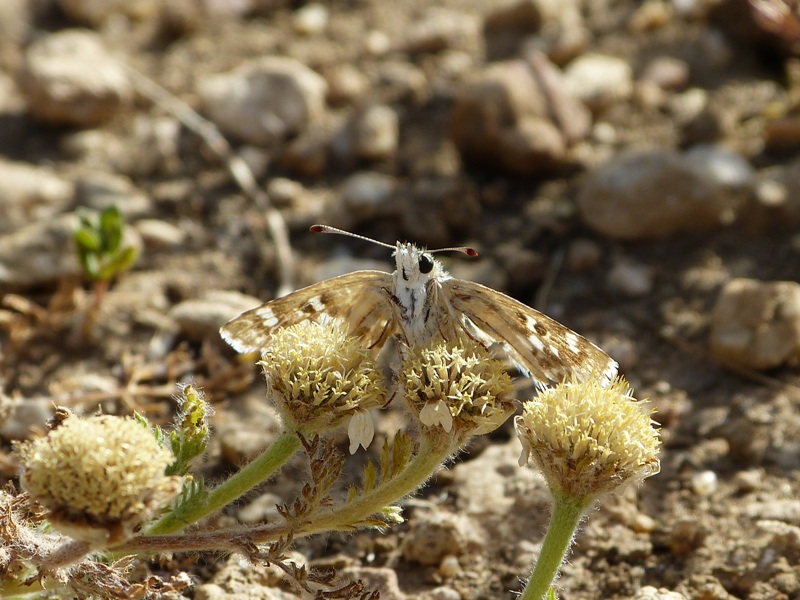
I am no expert photographer, preferring to capture the moment than get a perfectly composed shot. The pictures on my blog are either taken with a compact Canon, a Panasonic Lumix FZ150 or on my phone.


Showing posts with label Pyronia bathseba. Show all posts

Wednesday, 21 September 2022

Antequera Butterflies June 2022

Two days before the end of our holiday, on 11th June, I decided to drive up to Antequera to walk along an amazing little track I found in 2019 when we were last in Spain. This track runs along the north side of El Torcal de Antiquera, which is an amazing area of limestone rock. In April 2019 I had seen an amazing variety of spring butterflies and when I returned in September that year there were still a lot of butterflies there, despite the local goat herd having grazed all of the flowers down.


I had great hopes for this year, but noticed as I drove up that the wind was getting stronger and stronger. When I arrived it was incredibly windy, but as I was there it would have been silly not to have gone for a walk. The gusts of wind whipped up sand from the track and bent the vegetation. Despite this, there were still a few hardy butterflies hanging on! They were mostly species I had seen elsewhere on our holiday, such as Bath Whites, Clouded Yellows and Sage Skippers.

There were one or two Spanish Gatekeepers and Southern Gatekeepers sheltering amongst the vegetation.


I was really pleased to see an Iberian Marbled White.

There were also Small Whites, Large Whites, Painted Ladies, Meadow Browns and Mallow Skippers. I didn’t want to pursue any of them for pictures, as when they took off they were immediately taken by the wind and I was concerned they would be blown into some scrub and sustain damage.


I was amazed to see a Swallowtail doing some acrobatics, trying to feed on a flower that was blowing violently in the wind.

The last butterfly I saw was a Red-underwing Skipper. Normally I see a lot of these, but this was the only one I saw this holiday.


Despite the wind I saw 15 species. I couldn’t manage a decent picture of any of them, as they were being battered by the wind and so was I! I can only imagine how many more butterflies there would have been had it not been windy.

Monday, 20 May 2019

Malaga Butterflies - April 2019

Since 2012 we have spent four summer holidays in a villa near Alora, 45 kilometres north west of Malaga. Each time we have been there it has been early July and very hot! The roads were lined with dried up wild flowers and grasses and everything was brown, other than the orange groves and a few private gardens. We would often say that it would be interesting to see the area in the spring, when everything would be green.

So, this year my wife and I found ourselves able to go away by ourselves now that the children have moved out and we decided to return to Alora in April. This time we stayed in an apartment in the village, so it wasn't quite so easy to pop out and look for butterflies.

Unfortunately, we didn't choose the best week to go away. Firstly, the village was the middle of incredible Easter celebrations, meaning most businesses were closed and it was almost impossible to move at times. Also, while the UK was basking in unseasonably hot weather, southern Spain was suffering from unseasonable cloud and showers!

When we arrived the village was in complete gridlock, so it was a good excuse for me to take a quick trip to my old butterfly spot near the villa we used to rent. This was an area where I saw numerous Southern Gatekeepers and Dusky Heaths in the summer months, but I was too early for them this year. Interestingly, Spanish Gatekeepers, Pyronia bathseba, took the place of the Southern Gatekeepers and I wondered why I had not seen them on my four previous visits to this spot.


Although it was relatively cool and there were only occasional sunny spells there were still a reasonable number of butterflies flying, including Small Whites, Pieris rapae, Southern Blues, Polyommatus celina, Meadow Browns, Maniola jurtina


and Clouded Yellows, Colias croceus.


As in previous visits I saw a few Geranium Bronzes, Cacyreus marshalli, which seemed a little out of place in this natural environment.


There was also a faded Long-tailed Blue, a Small Copper, a Southern Brown Argus and a Large White. Not bad for an hour on a cloudy day.

In the summer this area is full of flowering Thyme, Lavender and Rosemary, but in April there were a lot of annual flowering plants but the more woody herbs were not yet in flower.

The following day I decided to check out my other favourite spot down by the Rio de Guadalhorce. In the summer there is a great patch of mint in flower, which attracts a lot of butterflies. Of course it wasn't yet in flower, but there were plenty of other wild flowers there.


I was frustrated that it clouded over before I arrived and there was quite a strong wind blowing. After about 15 minutes there was a bit of a break in the clouds and a Painted Lady was the first butterfly to brave the conditions. It didn't hang about, but at least it proved that it was warm enough for butterflies.

Not long afterwards I spotted a lovely Long-tailed Blue, Lampides boeticus, in some grass and it slowly opened its wings to absorb a few of the sun’s rays.


As I watched it a Small Copper, Lycaena phlaeas, landed on a stem close by.


I walked further down stream and found a Southern Brown Argus, Aricia cramera.


While I was watching it, I disturbed a Bath White, Pontia daplidice, which landed on the ground and once warmed up a bit flew to a flower for a feed.


Although it was frustrating that there was so much cloud, at least the cooler weather meant that the butterflies were easier to photograph.

I had specifically gone to this area, as I have always found African Grass Blues here in the summer, but despite extensive searching I didn’t see any on this visit. However, the sun came out and after a while the place was alive with butterflies. Mostly Small Coppers, which looked beautiful glinting in the sun.


There were also a number of Southern Brown Argus flying with them and by far the most numerous, Clouded Yellows were everywhere I looked. There were the occasional Wall Brown and Meadow Brown, some more Bath Whites, a few small whites and one Southern Blue, Polyommatus celina.


And then, as if they had had too much sun they all appeared to disappear!

The following day I decided to walk up a track above the cemetery. This ran between olive groves and what appeared to be fallow fields.


There were plenty of wild flowers and a number of butterflies flitting from flower to flower. They were all white or yellow, being Small Whites, Large Whites, Clouded Yellows


... and what I assumed were more Bath Whites. However, when I examined my photographs back at the apartment I saw that they were all Western Dappled Whites, Euchloe crameri.


I found it interesting that there were no Bath Whites amongst them. Presumably, just a little change in habitat meant that this area was more favourable to Dappled Whites and the flowers down by the river suited Bath Whites.

I had been keeping an eye on the forecast, which had been pretty accurate. Monday looked like it was going to be sunny in the morning and so I planned to go to a area of limestone mountains about 30 miles north. I will report on what I saw there next. Sadly, however, that was to be the only other day with sufficient sun for me to look for butterflies. Typically, the weather improved considerably from the day we left!

The day before we left I drove past the area near the river where I had seen so many butterflies to discover that it had been completely grazed to the ground by a large herd of goats. Although this was rather frustrating, I was pleased that I had been able to visit the area before this had happened. I did wonder where all of the butterflies would go, though!

Friday, 7 September 2018

Sierra Nevada Butterflies - July 2018


We have visited the same holiday villa north west of Malaga every second year since 2012 and more by chance than design I have driven the three hour trip to the Sierra Nevada on the 4th of July each time. It has been interesting to see the differences in butterflies each time.

This year I drove straight up to the Hoya de la Mora ski resort, arriving just before 9 o'clock, with the intention of heading straight up to look for Zullich's Blues, Agriades zullichii. However, as soon as I stepped out of the car I discovered that it was really windy up there.


Having driven so far, I thought that I may as well walk up the mountain to have a look anyway, hoping that the wind may die down. However, I didn't see any butterflies at all.

I then decided to walk down to the stream that I have visited in the past thinking that it would be more sheltered there. However, the wind seemed to be blowing straight down the valley, so all I saw all morning were two Common Blues, a Painted Lady, two Clouded Yellows and a Small Tortoiseshell, all sheltering from the wind.


Rather disheartened, I gave up and headed back to the car. I drove back down the mountain and thought that I may as well have a look in a little meadow where I have seen a lot of butterflies in the past. Normally, I only spend a few minutes here having spent most of my time in the high mountains, but this year I had about two and a half hours wondering around an area no bigger than a football pitch. Luckily this area was completely sheltered and I was able to see hundreds of butterflies.


The grassy area of the meadow had all sorts of small butterflies, such as Common Blues. Both Polyommatus icarus and Polyommatus celina occur in Sierra Nevada...


Silver-studded Blues, Plebejus argus hypochionus...


Idas Blues, Plebejus idas nevadensis...


Southern Brown Argus, Aricia cramera...


and Small Skippers, Thymelicus sylvestris.


On previous visits I have seen the almost identical Essex Skipper, Thymelicus lineola hemmingi. I think this is one that I saw this year.


In amongst the shrubs were various white butterflies, most of which wouldn't stop for a picture this year. There were Large Whites, Pieris brassicae, Iberian Marbled Whites, Melanargia lachesis, Black-veined Whites, Aporia crataegi, Cleopatras, Gonepteryx cleopatra mauretanica, and Small Whites, Pieris rapae.


I spotted one rather faded Long-tailed Blue, Lampides boeticus...


And only one Small Copper, Lycaena phlaeas lusitanicus. I am always surprised that they aren't seen in greater numbers in the Sierra Nevada.


There were also Oriental Meadow Browns, Hyponephele lupinnus, Wall Browns, Lasiommata megera, and Rock Graylings, Hipparchia alcyone enjoying a bit of shade. I was delighted to see a Spanish Gatekeeper, Pyronia bathseba. It was very difficult to approach, but I did manage a couple of distant pictures.


While I was stalking it, I saw a Nettle Tree Butterfly, Libythea celtis, the first time I have managed to see this species. Sadly it flew off before I could take its picture.

But I did manage to get a picture of this Bath White, Pontia daplidice.


There were a few Dusky Heaths, Coenonympha dorus.


In the more open spaces Clouded Yellows, Colias crocea, regularly flew past. Most were the regular yellow colour, but there were one or two of the pale helice form.


There were a few damp areas in an otherwise dry stream bed, which were attracting butterflies. Here are three Silver-studded Blues and an Idas Blue.


There were also some Small Tortoiseshells, Aglais urticae, enjoying the minerals.


I started to follow the stream bed down the hill and I was thrilled to see a Mother-of-pearl Blue, Plebicula nivescens. This was the first time I have seen this beautiful butterfly.


Further down the stream I noticed some fritillaries flying around. I think I had better talk about them in my next post.

Followers