I am no expert photographer, preferring to capture the moment than get a perfectly composed shot. The pictures on my blog are either taken with a compact Canon, a Panasonic Lumix FZ150 or on my phone.


Showing posts with label Cleopatra. Show all posts

Tuesday, 1 October 2024

Casarabonela butterflies June 2024

A couple of days before we left Spain I decided to visit Casarabonela, which is a beautiful village about 20 minutes drive from where we were staying. I have visited a couple of times before and always noted how much greener it is there. Even this time during the extreme dry spell there was still water running in a stream there and I could hear water running in a deep ravine in the middle of the village.


Looking at Google Maps I chose a car park on the northern edge of the village, high on the hill. I was a little disappointed when I arrived, as it was a dry dusty area below a Pine woodland. However, I spotted a couple of butterflies in the car park - a very ragged Geranium Bronze and a Southern Brown Argus.


As I set off on a marked trail up the mountain I spotted an area of Thyme growing above the car park, so I scrambled up to it and I was delighted it was covered in butterflies.

These included Southern Marbled Skippers, Sage Skippers, Small Whites, Dusky Heaths and Southern Blues.


I was also distracted by the arrival of an Iberian Scarce Swallowtail.


I continued up the trail and saw an extremely worn Blue-spot Hairstreak and the odd Dusky Heath on my way.


After a while I came across another area of Thyme. This time there were Small Coppers, Spanish Gatekeepers and Clouded Yellows as well as numerous Dusky Heaths.


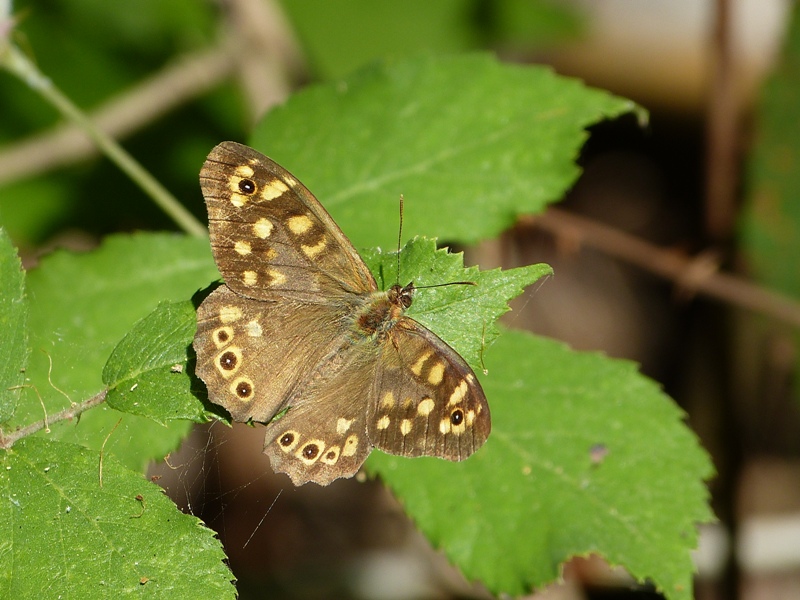
Along the path there was the occasional Wall Brown and Speckled Wood.


And then a little further up the path I saw two large Lavender bushes. There were two Cleopatras continually flying around them, briefly stopping for less than a second on a flower before doing another couple of laps.


They were occasionally joined by a Clouded Yellow and more Dusky Heaths!


I noticed that the Thyme close by was covered with butterflies and this area appeared to be a real magnet for them. There was a Striped Grayling, Southern Brown Argus and loads of Dusky Heaths.


There were also some Large Whites, as well as more Wall Browns and Meadow Browns. It really had been worth the climb!


Before I left Casarobonela I decided to check out a ravine in the centre of the village. This had housing and a street above one side with olive and citrus trees growing down the other. In the bottom of the ravine were fig trees and small areas of vegetables. I could only view this area from above, but as on my previous visit I saw a number of Holly Blues flying amongst the fig trees, as well as some Large Whites.


It had been a fantastic two-week holiday to Spain. I now have various favourite spots to visit to look for butterflies when I am there. All together I saw 50 species on this trip, which was primarily a family holiday! It was great to see that butterflies appear to be doing well despite the extremely dry year they have experienced in Spain.


Friday, 13 October 2017

Cape Drastis, Corfu - Butterflies

On 27th June I drove up to the north west of Corfu to Cape Drastis. I had been recommended a walk there by a fellow butterfly enthusiast. There are amazing lime stone cliffs there and the walk ran through old olive groves, woodland and small areas of vegetables.

I arrived at 8.30am and stayed for three hours. There were hundreds of Wall Browns, Lasiommata megera, all the way along the track along with some Meadow Browns, Maniola jurtina.

The Meadow Browns there are interesting, having two or three dots on the underside of their wings. However, they are thought to be the same species that occurs in the UK.

There was a small area that I had been recommended to visit. It consisted of a turning area and a clearing in the olive grove where some onions had been planted. There were plenty of wild flowers growing there, a grassy slope and some small trees offering a variety of habitats.

Initially I didn't think there was much in the way of butterflies there, but I spotted a Painted Lady, Vanessa cardui, and realised that there were three of them in a patch of wild flowers.

While I was photographing it, I was delighted to spot a Silver Washed Fritillary, Argynnis paphia, the other side of an olive tree. This was the first time I had seen a Silver Washed Fritillary, so I spent some time taking pictures of it.

There were a few Common Blues, Polyommatus icarus, flying there along with Large Whites, Pieris brassicae, and more Wall Browns.


While I was trying to get pictures of the Fritillary a small white butterfly flew past, and I was delighted to see that it was a Wood White, Leptidea sinapis. I have seen these briefly a couple of times before, but I have never managed to photograph them, so I watched it and carefully followed it until it eventually settled. I was so pleased to manage to get a picture of it.

A little further along the track I came across another area where the grass had been strimmed below some olive trees. There was also a small patch where vegetables were growing edged by some wild flowers where a beautiful Clouded Yellow, Colias crocea, was feeding.

I continued along the track and searched a variety of habitats on either side. A grassy slope had nothing flying on it, but a shady track had Speckled Woods, Pararge aegeria, enjoying the shade.

There were a couple of beautiful Scarce Swallowtails, Iphiclides podalirius, at the side of the track along with some Long-tailed Blues, Lampides boeticus.


On the way back I returned to the first area I had searched and the number of butterflies had really picked up. I found a Small Copper, Lycaena phlaeas, and saw a distant Brimstone and Cleopatra.

A little further along the track I notice a Scarce Swallowtail in an area below the track and went down to photograph it. This turned out to be a magical spot, with several Scarce Swallowtails, Brimstones, Gonepteryx rhamni, Cleopatras, Gonepteryx cleopatra, Large Whites and Silver Washed Fritillaries feeding on the flowers there.


I was also delighted to find a Brown Argus, Aricia agestis. I have seen Northern Brown Argus and Southern Brown Argus, but never before just a Brown Argus! I spent a while there watching all of the butterflies.

Eventually I had to drag myself away. Just a little further along the track, I couldn't believe my eyes, as I saw a Southern White Admiral, Limenitis reducta, flying down a track leading downhill. I followed it, but unfortunately lost it before I could take a picture. I was delighted to see one for the first time, but was disappointed that I hadn't managed to photograph it. However, it had been a great morning seeing so many butterflies, three species I hadn't seen before and another two species that I hadn't managed to photograph previously.


On my way back I drove down to Sidari Beach and walked up the river. There weren't many butterflies there, other than a few female Common Blues and a Small White, Pieris rapae. Then I saw a little brown insect, which turned out to be a Pigmy Skipper, Gegenes pumilio - the only one I saw all holiday.

What an amazing 3 hours! Lovely scenery, such a variety of butterflies and more kind local people. I called into a shop to buy a bottle of water on my way, but the shop had no change, so just gave me the bottle. On my way back I called into the shop and bought some food for lunch and paid the lady the extra Euro for the water she had given me. She told me I was very kind!! 

Wednesday, 11 April 2012

Menorca eggs!

There were so many butterflies in the orchard of the villa we rented that on three occasions a butterfly landed close to me and laid an egg.

This one is a Clouded Yellow, Colias croceus, or at least I think it is. The butterfly that laid it was a pale form and possibly could have been a Berger's Clouded Yellow, Colias alfacariensis. The only way I know to tell the two apart is by the caterpillar, but unfortunately I never found it!

This one was laid by a Cleopatra, Gonepteryx cleopatra. A few days later I saw a little caterpillar on the same leaf, but I didn't see it again after that despite looking on several occasions.

This egg was laid by a Swallowtail, Papilio machaon. When it was laid it was white and it turned yellow the first day. Three days later a brown line appeared around the egg and the next day it hatched.

Here it is chewing on its egg shell. Unfortunately, this was the last day of our holiday so I didn't get to see it develop any further. They grow into spectacular-looking caterpillars.


Followers