I am no expert photographer, preferring to capture the moment than get a perfectly composed shot. The pictures on my blog are either taken with a compact Canon, a Panasonic Lumix FZ150 or on my phone.


Showing posts with label Safflower Skipper. Show all posts

Tuesday, 30 July 2024

Sierra Nevada Butterflies - June 2024 Part 1

On 17th June I went on my traditional butterfly pilgrimage to the Sierra Nevada. It is a 200 kilometre drive in both directions from the villa we were staying in, but well worth the effort. There are four places I always visit there, which I know offer a great variety of butterflies. Initially I drive right up to the main ski resort at Hoya de la Mora and leave the car in the car park before the road barrier. From here I take the path down to the San Juan stream.


This is mostly quite rocky and barren, but there are a lot of little Alpine-type plants between the rocks.


Down by the stream there are a few areas of damp grassland, where amazing Gentian grow along with Tirana, which has sticky leaves for catching insects.


Almost as soon as I started walking I saw a Painted Lady drinking from a damp area below a patch of snow. I saw a few more of them on my walk down the hill.


A little further on and a blue butterfly landed ahead of me, which turned out to be a male Escher’s Blue. And further down the slope I saw a couple more, but those were the only Escher’s Blue I saw. Quite different from my visits in early July when they are quite common.


Small Tortoiseshells were dotted along the route and I saw about ten of them.


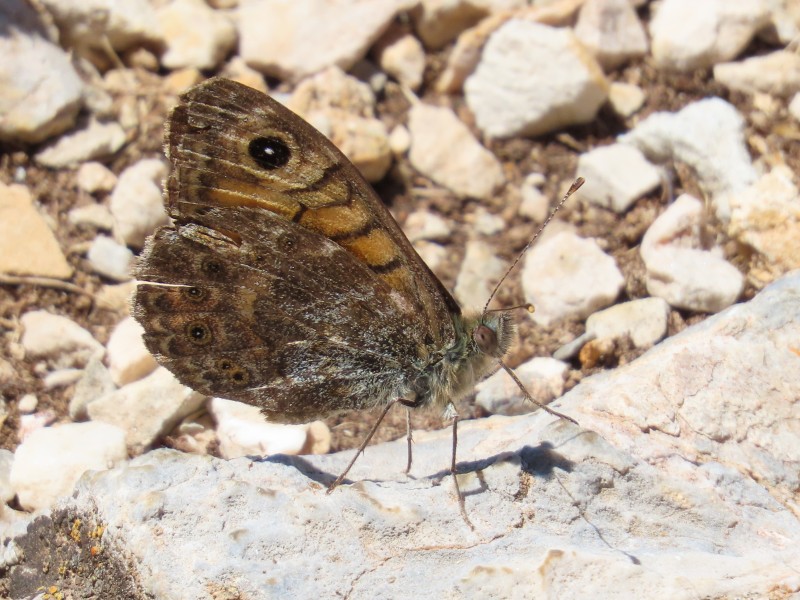
More numerous were Wall Browns which flew rapidly among the rocks and seemed to disappear when they landed!

As with everywhere else on my trip Small Whites were very numerous. It is always worth checking each white butterfly, as two of them turned out to be Bath Whites!


I saw this one, beautifully marked, Safflower Skipper.


As the ground became a little damper and more vegetated there were a few Nevada Blues about. I was very pleased to see these as I didn’t expect that they would be flying until July.


There were about five Clouded Yellows on this walk. Most of those I saw were the pale form, helice.


I returned to the car park and continued up the closed road beyond the barrier. My intention was to see if any Zullich’s Blues were flying yet. I met a group of about ten butterfly enthusiasts with big lenses who were patrolling the area. They told me that there had been a Zullich’s Blue photographed there the day before. Sadly, none of us saw one that day. However, I did see a Spanish Argus.


There were also a few Nevada Blues flying there and Queen of Spain Fritillaries.


I could have spent so much longer walking these areas, but I had quite a tight itinerary and two more exciting locations to visit.

Tuesday, 13 November 2018

Sierra Nevada Viewpoint

On my way back down the road, I called into a viewpoint that I have visited on previous occasions. Here, the subtly different habitat attracts some different butterflies. Most notable are the Swallowtails, Papilio machaon hispanicus, which I spotted almost as soon as I parked the car. They patrol this little hilltop, presumably looking for mates.

I also saw one Spanish Swallowtail, Iphiclides feisthamelii, feeding on the same little shrub that I have seen them on when I have visited previously.

In the past I have seen a lot of Wall Browns, Lasiommata megera, chasing each other around. This year I only saw one or two and I didn't see any Large Wall Browns, Lasiommata maera f. adrasta, that I normally see here.
I saw a couple of Common Blues, Polyommatus icarus, which I don't remember seeing in this spot before.

I spent some time watching these two Southern Marbled Skipper, Carcharodus baeticus, chasing around after each other and then locking horns! I have never seen behaviour like that before.

This Safflower Skipper, Pyrgus carthami nevadensis, was behaving a bit better!

I always see Blue-spot Hairstreaks, Satyrium spini, in this location.

Last year when I was reviewing my photos I realised that I had also taken a picture of a False Ilex Hairstreak, Satyrium esculi. So, this time I was looking out for them and once again spotted one.

There was also one Purple-shot Copper, Lycaena alciphron gordius, here. In previous years they had been quite numerous here.

It was interesting that many of the species found in each location that I visited in the Sierra Nevada were the same as I had seen on other visits. There are obvious locations, habits and food plants that will attract them. Some butterflies were in similar numbers and the same locations as in previous years.

Others were notable by their absence or low in numbers. For instance, it was worrying to see so few Zullich Blues and Apollos high in the mountains. Down by the stream this year I saw no Meadow Fritillaries, whereas two years ago I saw several. In fact there were very few butterflies there, but in previous years I have seen hundreds of butterflies enjoying the lush vegetation there.
Each year I visit, I see more species. This year I saw 3 species that I have never seen before and a total of 44 different species. The Sierra Nevada is still by far the best place for butterflies that I have ever visited.

Sunday, 11 December 2016

Sierra Nevada Butterflies - July 2016 (3)

I retraced my steps towards the car park, but took a shortcut below the observatory as I wanted to head towards a stream in the valley below. I noticed that a small cloud had developed above the valley and it appeared to be stuck there. As I entered into its shade I saw a lovely female Escher's Blue, Agrodiaetus escheri, waiting for the sun to come out again. I decided to wait with it to see if I could get a photo of the upper side of its wings.

Thankfully, when the sun came back out it opened up its wings. I have taken many pictures of female Lycaenidae, which I find almost impossible to identify from the upper wing shots. I hope that this picture may help me to identify other female Esher's Blues.

As I walked down the feint path in the mountain side I came across several Spanish Brassy Ringlets, Erebia hispania. They were quite obliging as they sat against the rocks warming up once the cloud had passed.

It is difficult to say which blue butterfly was the most common on the way down to the stream. There were probably equal numbers of Escher's Blues, Common Blues, Polyommatus celina, and Nevada Blues, Plebicula golgus. With almost every step another would fly into view.
Common Blue
Nevada Blue

The cloud also slowed the Apollos, Parnassius apollo nevadensis,  down a bit. I remember on my previous visit watching them for ages drifting up and down the mountain side without stopping. On my descent they were all on the ground, only flying when they were disturbed.

On the short grass by a spring I saw this lovely Safflower Skipper, Pyrgus carthami nevadensis.

This beautiful female Knapweed Fritillary, Melitaea phoebe, briefly stopped next to the path. This is the first time I have seen this butterfly.

When I reached the grassy area next to the stream I saw a few larger fritillaries. They all turned out to be Dark Green Fritillaries, Argynnis aglaja. A butterfly that I haven't seen in the Sierra Nevada before.

There were also about 20 or so smaller fritillaries. These were Meadow Fritillaries, Melitaea parthenoides, another butterfly that I haven't seen before. It is strange that they were so common this year, but two years ago I didn't see any in exactly the same location.

I spent some time down at the stream, enjoying the beautiful clear water cascading through the rocks and the many insects that live alongside it.

I was thrilled to see this cow pat, which was attracting various male blue butterflies. In this picture there are Common, Escher and Nevada Blues.

Every so often I would see a Purple-shot Copper, Lycaena alciphron gordius. I love the purple edging to their wings.

Other butterflies seen there, but not photographed were Clouded Yellows, Colias crocea, Cardinal Fritillaries, Argynnis pandora seitzi, Small Tortoiseshells, Aglais urticae, Bath Whites, Pontia daplidice and Wall Browns, Lasiommata megera.
On my way back up the mountain I saw this lovely Heath Fritillary, Melitaea athalia celadussa.

It was fantastic seeing so many butterflies and such a variety, but I had to drag myself away as I still had a couple of other places I wanted to check out.

Sunday, 3 August 2014

Sierra Nevada, Spain - Butterflies - July 2014 (3)

Further down the mountains at about 1,800 metres above sea level, the road entered an area of Cedar and Pine trees. I pulled over and walked into an area of scrub and meadow. There were plenty of different butterflies everywhere I looked here and I am very grateful to Mikhail and Guy Padfield from the UK Butterflies Forum for their help with some of the identifications!

This Iberian Marbled White, Melanargia galathea, was flying at the side of the road. There were several other Marbled Whites flying amongst the scrub, but I can't be sure they were the same species. The Spanish Marbled White and the Western Marbled White both also occur in the Sierra Nevada.

I spent some time watching this butterfly until it gave me a chance to photograph it. It turned out to be a Grayling, Hipparchia semele, although it is a little different from those I see in Scotland. There are several other species of grayling occurring in the Sierra Nevada, but the others proved elusive for me!

I think this is a Safflower Skipper, Pyrgus carthami. There were a lot of similar skippers in that area, but they were mostly whizzing about and they rarely settled.

After much indecisiveness, I have come to the conclusion that this is an Oriental Meadow Brown, Hyponephele lupinnus. The undulations on the rear wings being the deciding feature.

When I saw this little skipper I thought it was a Small Skipper, but closer examination of the pictures showed it to be an Essex Skipper, Thymelicus lineola hemmingi. There were quite a number of them flying around in this little area.

There were a lot of these little blues flying there. I assumed they were Silver-studded Blues, but again thanks to Mikhail, we now think they are Idas Blues, Plebejus idas nevadensis. In the Sierra Nevada the Silver-studded Blues tend to have lighter undersides to their wings (as per my earlier post). The Idas Blues have a grey background to the underside of their wings with a lighter postdiscal area. (Thanks also to "Las Mariposas de Sierra Nevada" and Google Translate!).


Given that all the males in this area were Idas Blues, I am assuming that this female is also an Idas Blue.

The other blues flying there were Common Blues, Polyommatus celina.


This Marsh Fritillary, Euphydryas aurinia beckeri, was the only fritillary there that I was able to photograph. Several others, large and small, flew past me!

After taking pictures of so many female blues, assuming that some of them were going to be an argus, it turns out that the last butterfly I photographed was the only argus I saw all day. It is a Mountain Argus, Aricia montensis.

Up on the top of the mountains the temperature was 10 degrees, but down here it was 18 degrees, and I think that is why the butterflies were so much more active. However, this was a lot cooler than Granada a few miles further down the road where it was 36 degrees when I drove past!
There were so many butterflies in this area that I wouldn't be surprised if there were twice the number of species that I managed to identify there. I also saw my first ever Black-veined White, Aporia crataegi. It was much bigger than I expected! There were also Cleopatras, Gonepteryx cleopatra mauretanica, Large Whites, Pieris brassicae vazquezi and Small Whites, Pieris rapae, flying there along with a lot more butterflies that I couldn't identify. I was only there for about 15 minutes, but I would have loved to have pitched a tent and spent several days there!
Sadly I couldn't spend more time there as I had a three-hour drive ahead of me to get back to the villa. All the driving was well worth it, though. In the five hours I had spent in the Sierra Nevada I had seen 33 different species, with 17 of them being species I had never seen before. Definitely my best ever day looking for butterflies!

Followers