I am no expert photographer, preferring to capture the moment than get a perfectly composed shot. The pictures on my blog are either taken with a compact Canon, a Panasonic Lumix FZ150 or on my phone.


Showing posts with label Gonepteryx cleopatra. Show all posts

Friday, 13 October 2017

Cape Drastis, Corfu - Butterflies

On 27th June I drove up to the north west of Corfu to Cape Drastis. I had been recommended a walk there by a fellow butterfly enthusiast. There are amazing lime stone cliffs there and the walk ran through old olive groves, woodland and small areas of vegetables.

I arrived at 8.30am and stayed for three hours. There were hundreds of Wall Browns, Lasiommata megera, all the way along the track along with some Meadow Browns, Maniola jurtina.

The Meadow Browns there are interesting, having two or three dots on the underside of their wings. However, they are thought to be the same species that occurs in the UK.

There was a small area that I had been recommended to visit. It consisted of a turning area and a clearing in the olive grove where some onions had been planted. There were plenty of wild flowers growing there, a grassy slope and some small trees offering a variety of habitats.

Initially I didn't think there was much in the way of butterflies there, but I spotted a Painted Lady, Vanessa cardui, and realised that there were three of them in a patch of wild flowers.

While I was photographing it, I was delighted to spot a Silver Washed Fritillary, Argynnis paphia, the other side of an olive tree. This was the first time I had seen a Silver Washed Fritillary, so I spent some time taking pictures of it.

There were a few Common Blues, Polyommatus icarus, flying there along with Large Whites, Pieris brassicae, and more Wall Browns.


While I was trying to get pictures of the Fritillary a small white butterfly flew past, and I was delighted to see that it was a Wood White, Leptidea sinapis. I have seen these briefly a couple of times before, but I have never managed to photograph them, so I watched it and carefully followed it until it eventually settled. I was so pleased to manage to get a picture of it.

A little further along the track I came across another area where the grass had been strimmed below some olive trees. There was also a small patch where vegetables were growing edged by some wild flowers where a beautiful Clouded Yellow, Colias crocea, was feeding.

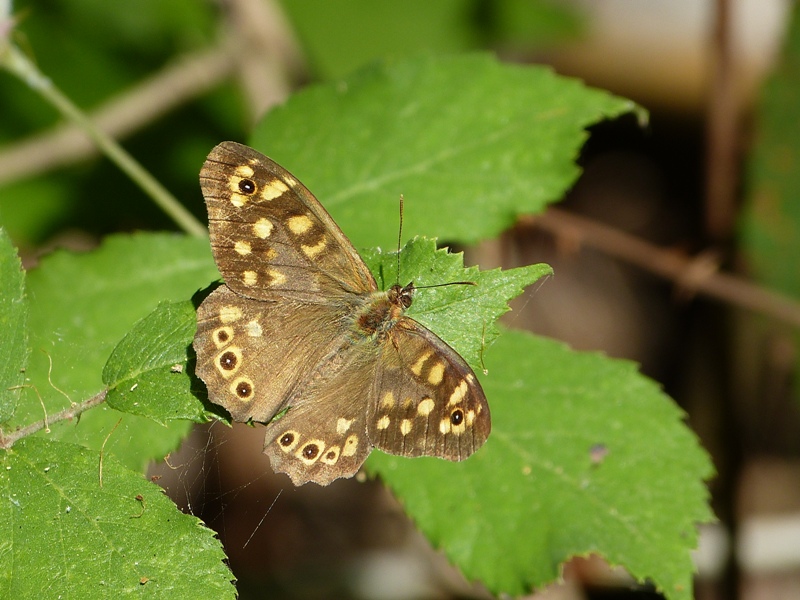
I continued along the track and searched a variety of habitats on either side. A grassy slope had nothing flying on it, but a shady track had Speckled Woods, Pararge aegeria, enjoying the shade.
There were a couple of beautiful Scarce Swallowtails, Iphiclides podalirius, at the side of the track along with some Long-tailed Blues, Lampides boeticus.


On the way back I returned to the first area I had searched and the number of butterflies had really picked up. I found a Small Copper, Lycaena phlaeas, and saw a distant Brimstone and Cleopatra.

A little further along the track I notice a Scarce Swallowtail in an area below the track and went down to photograph it. This turned out to be a magical spot, with several Scarce Swallowtails, Brimstones, Gonepteryx rhamni, Cleopatras, Gonepteryx cleopatra, Large Whites and Silver Washed Fritillaries feeding on the flowers there.


I was also delighted to find a Brown Argus, Aricia agestis. I have seen Northern Brown Argus and Southern Brown Argus, but never before just a Brown Argus! I spent a while there watching all of the butterflies.

Eventually I had to drag myself away. Just a little further along the track, I couldn't believe my eyes, as I saw a Southern White Admiral, Limenitis reducta, flying down a track leading downhill. I followed it, but unfortunately lost it before I could take a picture. I was delighted to see one for the first time, but was disappointed that I hadn't managed to photograph it. However, it had been a great morning seeing so many butterflies, three species I hadn't seen before and another two species that I hadn't managed to photograph previously.


On my way back I drove down to Sidari Beach and walked up the river. There weren't many butterflies there, other than a few female Common Blues and a Small White, Pieris rapae. Then I saw a little brown insect, which turned out to be a Pigmy Skipper, Gegenes pumilio - the only one I saw all holiday.

What an amazing 3 hours! Lovely scenery, such a variety of butterflies and more kind local people. I called into a shop to buy a bottle of water on my way, but the shop had no change, so just gave me the bottle. On my way back I called into the shop and bought some food for lunch and paid the lady the extra Euro for the water she had given me. She told me I was very kind!! 

Wednesday, 11 April 2012

Menorca eggs!

There were so many butterflies in the orchard of the villa we rented that on three occasions a butterfly landed close to me and laid an egg.

This one is a Clouded Yellow, Colias croceus, or at least I think it is. The butterfly that laid it was a pale form and possibly could have been a Berger's Clouded Yellow, Colias alfacariensis. The only way I know to tell the two apart is by the caterpillar, but unfortunately I never found it!

This one was laid by a Cleopatra, Gonepteryx cleopatra. A few days later I saw a little caterpillar on the same leaf, but I didn't see it again after that despite looking on several occasions.

This egg was laid by a Swallowtail, Papilio machaon. When it was laid it was white and it turned yellow the first day. Three days later a brown line appeared around the egg and the next day it hatched.

Here it is chewing on its egg shell. Unfortunately, this was the last day of our holiday so I didn't get to see it develop any further. They grow into spectacular-looking caterpillars.


Friday, 23 March 2012

Menorca - Butterflies - July 2010

Menorca is a small island in the Mediterranean Sea. There are about 25 species of butterflies occurring there with another five or so having been recorded as vagrants. We spent two weeks there in the summer of 2010, staying in an old farm house near the centre of the island. Attached to the house was an orchard, (where my daughter counted 19 different kinds of fruit trees) which turned out to be the perfect place for butterflies. I wasn't expecting to see too much, but I was to be pleasantly surprised.


We arrived in the evening just as the sun was going down, but there were still some Speckled Woods, Pararge aegeria aegeria, flying by the house. These proved to be very common flying anywhere with a bit of dappled shade.

Probably even more abundant than the Speckled Woods were Holly Blues, Celastrina argiolus. I was delighted to see so many of them living along the ivy-covered walls of the orchard.

Southern Brown Argus, Arica cramera, enjoyed the wild flowers in the orchard...

... along with a few Common Blue, Polyommatus icarus.

The Small Copper, Lycaena phlaeas, was less common, but still a lot more abundant than in Scotland.

I am used to seeing Small Heaths, Coenonympha pamphilus, on coastal grasslands and moors in Scotland. They seemed a bit out of place to me in the orchard. Back home they also tilt their wings towards the sun whenever they land in order to catch as much warmth as possible. In Menorca they always faced into the sun so as to catch as little sun as possible!

I was pleased to see a lot of Clouded Yellows, Colias croceus,  in the orchard. They seemed a lot less timid than those I had seen in Portugal.

The other yellow butterfly that occurs there is the Cleopatra, Gonepteryx cleopatra. These have a lovely flash of orange on their upper wing, but they always rest with their wings closed so it is only visible when they are flying. They also have an amazing ability to blend into the ivy when they roost at night.

As in most places in Europe, Large Whites, Pieris brassicae, were fairly common.

I saw one or two Small Whites, Pieris rapae, too.

A familiar sight in Scotland, but not so common on Menorca is the Meadow Brown, Maniola jurtina.


I spent ages following a Southern Gatekeeper, Pyronia cecilia, along the Alengdar Gorge, but it just wouldn't settle long enough for me to take a photo. This one appeared in the orchard and was much more obliging.

What I assume was the same Painted Lady, Vanessa cardui, always appeared in one particular area of the orchard.

Red Admirals, Vanessa atalanta, enjoyed the fallen fruit. They are amazingly well camouflaged when their wings are closed.

Having only just discovered Wall Browns, Lasiommata megera, back in Scotland it was funny also finding them in Menorca. As with most of the butterflies I saw there, they rested with their wings closed, whereas in cooler Scotland they tend to rest with their wings open absorbing the sun's rays.

This is the best picture I could manage of a Two-tailed Pasha, Charaxes jasius. These are amazing butterflies with a really powerful flight. It was great watching them gliding amongst the fruit trees.

On the last day of our holiday this Lang's Short-tailed Blue, Leptotes pirithous, visited a bush next to the swimming pool were it remained for most of the day.

The other three species that I saw, but wasn't able to take a picture of were a Long-tailed Blue, Lampides boeticus, a Swallowtail, Papilio machaon and a Geranium Bronze, Cacyreus marshalli, making 20 species for the trip. This was a lot better than I had expected. What Menorca lacks in variety of species is more than made up for by the number of butterflies in the air.

Followers