I am no expert photographer, preferring to capture the moment than get a perfectly composed shot. The pictures on my blog are either taken with a compact Canon, a Panasonic Lumix FZ150 or on my phone.


Showing posts with label Erebia hispania. Show all posts

Sunday, 11 December 2016

Sierra Nevada Butterflies - July 2016 (3)

I retraced my steps towards the car park, but took a shortcut below the observatory as I wanted to head towards a stream in the valley below. I noticed that a small cloud had developed above the valley and it appeared to be stuck there. As I entered into its shade I saw a lovely female Escher's Blue, Agrodiaetus escheri, waiting for the sun to come out again. I decided to wait with it to see if I could get a photo of the upper side of its wings.

Thankfully, when the sun came back out it opened up its wings. I have taken many pictures of female Lycaenidae, which I find almost impossible to identify from the upper wing shots. I hope that this picture may help me to identify other female Esher's Blues.

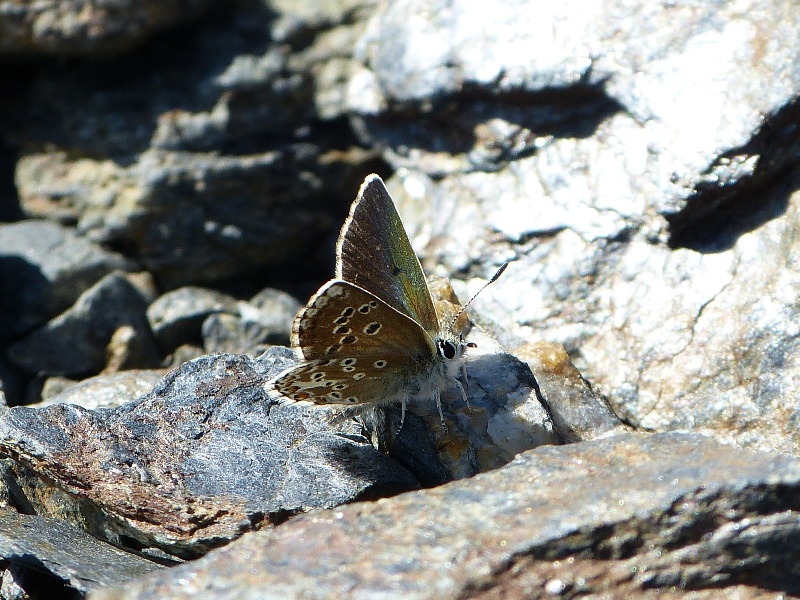
As I walked down the feint path in the mountain side I came across several Spanish Brassy Ringlets, Erebia hispania. They were quite obliging as they sat against the rocks warming up once the cloud had passed.

It is difficult to say which blue butterfly was the most common on the way down to the stream. There were probably equal numbers of Escher's Blues, Common Blues, Polyommatus celina, and Nevada Blues, Plebicula golgus. With almost every step another would fly into view.
Common Blue
Nevada Blue

The cloud also slowed the Apollos, Parnassius apollo nevadensis,  down a bit. I remember on my previous visit watching them for ages drifting up and down the mountain side without stopping. On my descent they were all on the ground, only flying when they were disturbed.

On the short grass by a spring I saw this lovely Safflower Skipper, Pyrgus carthami nevadensis.

This beautiful female Knapweed Fritillary, Melitaea phoebe, briefly stopped next to the path. This is the first time I have seen this butterfly.

When I reached the grassy area next to the stream I saw a few larger fritillaries. They all turned out to be Dark Green Fritillaries, Argynnis aglaja. A butterfly that I haven't seen in the Sierra Nevada before.

There were also about 20 or so smaller fritillaries. These were Meadow Fritillaries, Melitaea parthenoides, another butterfly that I haven't seen before. It is strange that they were so common this year, but two years ago I didn't see any in exactly the same location.

I spent some time down at the stream, enjoying the beautiful clear water cascading through the rocks and the many insects that live alongside it.

I was thrilled to see this cow pat, which was attracting various male blue butterflies. In this picture there are Common, Escher and Nevada Blues.

Every so often I would see a Purple-shot Copper, Lycaena alciphron gordius. I love the purple edging to their wings.

Other butterflies seen there, but not photographed were Clouded Yellows, Colias crocea, Cardinal Fritillaries, Argynnis pandora seitzi, Small Tortoiseshells, Aglais urticae, Bath Whites, Pontia daplidice and Wall Browns, Lasiommata megera.
On my way back up the mountain I saw this lovely Heath Fritillary, Melitaea athalia celadussa.

It was fantastic seeing so many butterflies and such a variety, but I had to drag myself away as I still had a couple of other places I wanted to check out.

Wednesday, 9 November 2016

Sierra Nevada Butterflies - July 2016 (2)

I drove up to the car park at the ski resort at Hoya De la Mora. This is as far as you can drive, although it is possible to take a mini-bus further up the mountain. As I got out of the car I saw a Bath White, Pontia daplidice. I had seen a number of similar butterflies on the drive up the hill, so it was good to confirm its identity.
I started to walk up the mountain to another area recommended by Mike Prentice. Almost immediately I saw a Purple-shot Copper, Lycaena alciphron gordius.

Then a larger butterfly caught my eye. It turned out to be a Painted Lady, Vanessa cardui. We had just experienced an influx of Painted Ladies in Scotland and evidently they were doing well here, too. I saw another one just a little further up the path.


I was delighted to see so many Apollos, Parnassius apollo nevadensis. The sub-species in the Sierra Nevada has orange, rather than red, ocelli. They seemed a lot more approachable this year and a little later when a cloud came over they all landed and on a couple of occasions I very nearly stood on one! I guess with such large butterflies they need the energy of the sun to keep them airborne.

There were a number of Small Whites, Pieris rapae, flying in the same area as the Apollos along with one or two Small Tortoiseshells, Aglais urticae.

There were also blue butterflies there, which I could only identify by photographing them and enlarging their picture on the camera. They all turned out to be Escher's Blues, Agrodiaetus esheri.

A little higher up the Small Tortoiseshells were replaced by Queen of Spain Fritillaries, Issoria lathonia. The last time I was in Sierra Nevada I very briefly saw one of these a little lower down the mountain, but this time I saw seven or eight.

My reason for climbing further up this barren-looking mountain side was because Mike Prentice had suggested some sites I could check for Zullich’s Blue, Agriades zullichi. I was amazed that there continued to be plenty of butterflies despite the apparent lack of vegetation. I didn’t spot any Zullich’s Blues at the first area he had suggested, but I was over the moon to spot one at the second location, which was at about 2,650 metres above sea level.

I think there were about 15 Zullich’s Blues there and I saw some very similar-looking Spanish Argus, Aricia morronensis, flying with them. These were both new species for me.

It was lovely to watch them with an occasional fly past of an Apollo, which looked enormous compared to the small Lycaenidae. Some Nevada Blues, Plebicula golgus, also joined the party. I spent some time at that location and sat down on a rock with a snack while watching these rare butterflies.

It seemed like such a hostile environment for these small creatures to live in. This was the height of summer, but there was still quite a wind blowing and very little shelter.

Eventually I had to drag myself away as there were so many more places I wanted to explore. However, I was quickly distracted by a Spanish Brassy Ringlet, Erebia hispania. Unlike two years earlier these ones allowed me to take a picture. I saw quite a few as I started to descend the path.

Next I wanted to head down to a green area near the stream lower down the valley ...

Followers