I am no expert photographer, preferring to capture the moment than get a perfectly composed shot. The pictures on my blog are either taken with a compact Canon, a Panasonic Lumix FZ150 or on my phone.


Showing posts with label Pontia daplidice. Show all posts

Monday, 20 May 2019

Malaga Butterflies - April 2019

Since 2012 we have spent four summer holidays in a villa near Alora, 45 kilometres north west of Malaga. Each time we have been there it has been early July and very hot! The roads were lined with dried up wild flowers and grasses and everything was brown, other than the orange groves and a few private gardens. We would often say that it would be interesting to see the area in the spring, when everything would be green.

So, this year my wife and I found ourselves able to go away by ourselves now that the children have moved out and we decided to return to Alora in April. This time we stayed in an apartment in the village, so it wasn't quite so easy to pop out and look for butterflies.

Unfortunately, we didn't choose the best week to go away. Firstly, the village was the middle of incredible Easter celebrations, meaning most businesses were closed and it was almost impossible to move at times. Also, while the UK was basking in unseasonably hot weather, southern Spain was suffering from unseasonable cloud and showers!

When we arrived the village was in complete gridlock, so it was a good excuse for me to take a quick trip to my old butterfly spot near the villa we used to rent. This was an area where I saw numerous Southern Gatekeepers and Dusky Heaths in the summer months, but I was too early for them this year. Interestingly, Spanish Gatekeepers, Pyronia bathseba, took the place of the Southern Gatekeepers and I wondered why I had not seen them on my four previous visits to this spot.


Although it was relatively cool and there were only occasional sunny spells there were still a reasonable number of butterflies flying, including Small Whites, Pieris rapae, Southern Blues, Polyommatus celina, Meadow Browns, Maniola jurtina


and Clouded Yellows, Colias croceus.


As in previous visits I saw a few Geranium Bronzes, Cacyreus marshalli, which seemed a little out of place in this natural environment.


There was also a faded Long-tailed Blue, a Small Copper, a Southern Brown Argus and a Large White. Not bad for an hour on a cloudy day.

In the summer this area is full of flowering Thyme, Lavender and Rosemary, but in April there were a lot of annual flowering plants but the more woody herbs were not yet in flower.

The following day I decided to check out my other favourite spot down by the Rio de Guadalhorce. In the summer there is a great patch of mint in flower, which attracts a lot of butterflies. Of course it wasn't yet in flower, but there were plenty of other wild flowers there.


I was frustrated that it clouded over before I arrived and there was quite a strong wind blowing. After about 15 minutes there was a bit of a break in the clouds and a Painted Lady was the first butterfly to brave the conditions. It didn't hang about, but at least it proved that it was warm enough for butterflies.

Not long afterwards I spotted a lovely Long-tailed Blue, Lampides boeticus, in some grass and it slowly opened its wings to absorb a few of the sun’s rays.


As I watched it a Small Copper, Lycaena phlaeas, landed on a stem close by.


I walked further down stream and found a Southern Brown Argus, Aricia cramera.


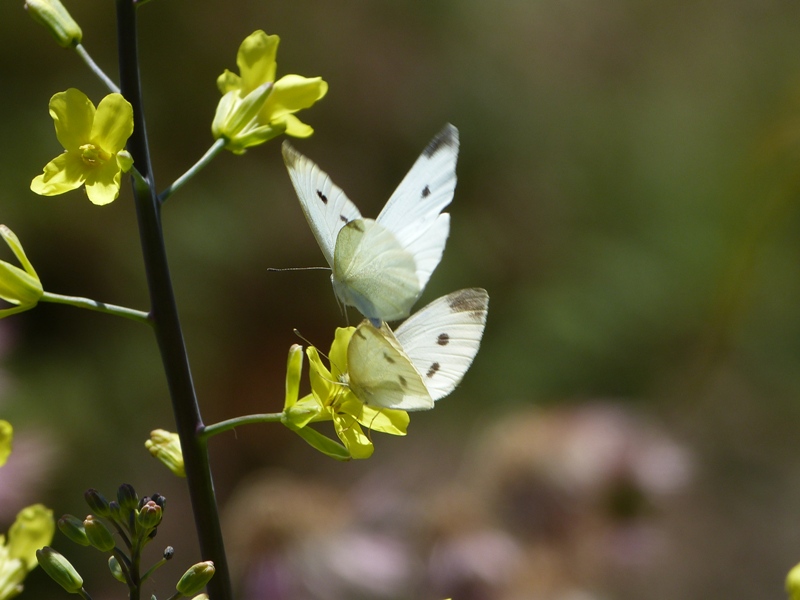
While I was watching it, I disturbed a Bath White, Pontia daplidice, which landed on the ground and once warmed up a bit flew to a flower for a feed.


Although it was frustrating that there was so much cloud, at least the cooler weather meant that the butterflies were easier to photograph.

I had specifically gone to this area, as I have always found African Grass Blues here in the summer, but despite extensive searching I didn’t see any on this visit. However, the sun came out and after a while the place was alive with butterflies. Mostly Small Coppers, which looked beautiful glinting in the sun.


There were also a number of Southern Brown Argus flying with them and by far the most numerous, Clouded Yellows were everywhere I looked. There were the occasional Wall Brown and Meadow Brown, some more Bath Whites, a few small whites and one Southern Blue, Polyommatus celina.


And then, as if they had had too much sun they all appeared to disappear!

The following day I decided to walk up a track above the cemetery. This ran between olive groves and what appeared to be fallow fields.


There were plenty of wild flowers and a number of butterflies flitting from flower to flower. They were all white or yellow, being Small Whites, Large Whites, Clouded Yellows


... and what I assumed were more Bath Whites. However, when I examined my photographs back at the apartment I saw that they were all Western Dappled Whites, Euchloe crameri.


I found it interesting that there were no Bath Whites amongst them. Presumably, just a little change in habitat meant that this area was more favourable to Dappled Whites and the flowers down by the river suited Bath Whites.

I had been keeping an eye on the forecast, which had been pretty accurate. Monday looked like it was going to be sunny in the morning and so I planned to go to a area of limestone mountains about 30 miles north. I will report on what I saw there next. Sadly, however, that was to be the only other day with sufficient sun for me to look for butterflies. Typically, the weather improved considerably from the day we left!

The day before we left I drove past the area near the river where I had seen so many butterflies to discover that it had been completely grazed to the ground by a large herd of goats. Although this was rather frustrating, I was pleased that I had been able to visit the area before this had happened. I did wonder where all of the butterflies would go, though!

Saturday, 8 October 2016

Malaga, Spain - Butterflies - July 2016

From the 1st to 15th July this year we had our annual family holiday in a villa 45 kilometres north west of Malaga. This is the third time we have holidayed there, coincidentally being there for exactly the same dates in 2012 and 2014 previously.

The holiday went off to a really good start, with me seeing a Small White, Pieris rapae, as we were driving out of the airport and then a Plain Tiger, Danaus chrysippus, flew across the road in front of us.

There is an area that I tend to walk to each day to look for butterflies just a little way up the road from the villa we rent. Over the previous two years I have learned that this is the best local spot to find them. Probably the most common butterfly there is the Southern Gatekeeper, Pyronia cecilia, although they weren't as numerous as the first year we visited.


Dusky Heaths, Coenonympha dorus, are beautiful little butterflies with the line of silver scales along the edge or their wings. They always seem to be flying around this area.


The track turns into a feint path that climbs along the ridge of the hills through olive groves. On the exposed parts of the path male Wall Browns, Lasiommata megera, take up territory, chasing after any other butterflies or large insect they see.


Common Blues, Polyommatus celina, were the other butterfly that could be relied upon to be there each day. They seem very much smaller than those that I see back home. I wasn't sure if I was just imagining this, but I also remember when I saw a Small Copper, Lycaena phlaeas, how much bigger it looked than the Common Blue. The two species are more-or-less the same size back home.


I only saw a Small Copper once this year. It seems to be a very widely distributed butterfly, but it's never seen in great numbers.


I was delighted to see a Striped Grayling, Pseudotergumia fidia, on the first day I walked up the path. It was there again in exactly the same place the second day too, but I didn't see it after that. Two years earlier I saw a lot of them in the next valley, but have never seen them at this spot before.


Mallow Skippers, Carcharodus alceae, seemed to have small territories along the road to the villa chasing after anything that flew anywhere near them.


Up the track, on the wild Thyme, Sage Skippers, Syrinthus proto, were doing the same thing.


On a couple of occasions I saw a Mediterranean Skipper, Gegenes nostrodamus. I saw this species very briefly for the first time two years ago.


Other butterflies that I saw occasionally were Clouded Yellow, Colias crocea,
... and Bath White, Pontia daplidice.


The Southern Brown Argus, Aricia cramera, is a beautiful little butterfly, which I regularly saw flying among the wild flowers.


I'll continue with the other butterflies I saw in my next post.

Monday, 21 July 2014

Malaga, Spain - Butterflies - July 2014

For our family holiday this year we spent the first two weeks of July in southern Spain. We returned to the villa that we rented in 2012 near Alora, about 40 kilometres north west of Malaga. When we were there two years ago Spain had been experiencing a particularly dry spring and hot summer and everything was really parched. This year the weather patterns had been more normal and it was a little greener, but strangely, fewer butterflies seemed to be in the air. Not surprisingly most of the species I saw were the same as last time!

As soon as we walked out of the airport I saw a Large White, Pieris brassicae, flying across one of the flower beds. I saw a few more of them during our holiday, but they never seemed to land!

The first morning I took a walk up the hills behind the villa and came across some Wall Browns, Lasiommata megera, in the same location I had seen them before.


On the way back down I saw a few Dusky Heaths, Coenonympha dorus. These were a lot smaller than I had remembered and I thought they were a different species, until I checked in the book! They are beautiful little butterflies with a silver line running along the edge of their wings, although those I saw this time were quite faded.


What was strange was that these were really common two years ago, but I only saw about six or seven of them that morning and no more on my other saunters around the countryside near the village.

Back down to my usual butterfly patch and I saw a blue butterfly which I expected to be a Common Blue. However, it turned out to be a lovely fresh Lang's Short-tailed Blue, Leptotes pirithous.


Over the holiday I would regularly visit the area where I had seen so many butterflies exactly two years earlier, but I was always a little disappointed by how few there were there. I suspect that this little valley with a lot of Thyme, Rosemary and Lavender in it was like an oasis to butterflies two years ago, but this year there was more choice for them to feed in other areas.

I think I only saw two Common Blues, Polyommatus celina, this year, whereas last year I saw several of them each day in this area.


I saw a few more Southern Brown Argus, Aricia cramera, which are really beautiful little things.


The butterfly that was the most common two years ago was the Southern Gatekeeper, Pyronia cecilia. These seem to like any slightly shaded ravine and I remember walking along a dried-up stream last time and hundreds of them flying up in front of me. This year I probably only saw about ten in total!


I think the butterfly below is a Sage Skipper, Syrinthus proto, and it patrolled a short section of the track leading to our villa. Without fail it would be there any time I walked past flying up and down a section about 20 metres long, seeing off any other butterflies that should dare to enter his area!


The other skipper that I saw was new to me. I think this is a Mediterranean Skipper, Gegenes nostrodamus.


One morning I had a brief view of a Clouded Yellow, Colias crocea, and managed one quick photo before it continued on its way.


Most of the other butterflies I saw were ones that flew through the garden of the villa. Many of them didn't give me a chance to grab my camera, including a Holly Blue, Celastrina argiolus, and a Brimstone, Gonepteryx rhamni. We regularly had a Small White, Pieris rapae, visit a Lantana plant near the swimming pool. I not sure if it was the same individual that came back day after day, but it only seemed to be attracted to this one plant.


I saw this Meadow Brown, Maniola jurtina, in the garden and I saw a couple more in the hills close-by.


Geranium Bronze, Cacyreus marshalli, were the only butterfly that I saw more of this year than on my previous visit. Normally, I have only seen them in parks or gardens, but this time I came across them out in the countryside quite regularly. I imagine this must be because there were more flowers available for them to feed on this year. This Geranium Bronze was enjoying the fruits of a Lantana and it stayed in this position for over half an hour one evening.


On our last visit I saw one Bath White, Pontia daplidice, very briefly along a track. This year I also saw one, but this time in the garden and it stayed around a Lantana plant for a while allowing me to take a few pictures!


This Long-tailed Blue, Lampides boeticus, flew manically around the garden all day without stopping. Eventually, one evening it decided to refuel, allowing me to positively identify it and get a picture. A shame it didn't stop in brighter weather to allow me to get a better picture, though!


I went for a walk down to the river in the village, where last time I had seen quite a few butterflies. Unfortunately for me, there was a lot more water in the river this year, so I wasn't able to cross over to the better side. However, the next morning I drove down to another shingle area by the river where I saw some Speckled Woods, Pararge aegeria aegeria, and my target species, African Grass Blues, Zizeeria knysna. No trip to southern Spain is complete for me without me seeing these!!


Having checked through my butterfly book before we left I thought that there were about 90 species of butterflies occurring in this part of Spain at this time of year. By the end of the holiday I had only seen 19 species! I know that many species will have quite specific habitats and thinking of the butterflies that occur back home, you really have to know exactly where to look to find some small colonies of butterflies. When I had climbed to the top of the hill behind the villa I had looked down into the valley on the other side and wondered if there would be different butterflies on the northern slopes of these hill. So, on the last day of our holiday I drove round to the other side of the hills for a short walk.


As soon as I stopped the car I saw a large, dark butterfly land at the side of the road. It flew off before I could spot it, but within a few metres I saw another and it turned out to be a Striped Grayling, Pseudotergumia fidia. Another new butterfly for me. I walked up into the Pine and Eucalyptus forest and saw a Striped Grayling about every 20 metres. They seemed much bigger than the illustration in the book, but I was thrilled to see a new species before we left Spain.


It was great seeing all of these butterflies. Although there weren't as many as I saw during my previous visit, at least I saw almost as many species. However, the butterflies I saw on a visit to the Sierra Nevada mountains more than made up for the lack of butterflies around the villa in Alora. More to follow...

Friday, 16 August 2013

Tenerife - Butterflies - July 2013

Our family holiday this year was spent in Tenerife during the last two weeks in July. I managed to sneak in a few walks while my wife and kids were enjoying the beaches and swimming pool. We were at a resort in Callao Salvaje in the south-west which wasn't a particularly good area for butterflies, however with the island only being about 80 kilometres long, nowhere was more than about an hour and a half's drive away.

Most of the southern side of the island is semi-desert with various succulents and drought-tolerant plants growing. In the spring it must be quite colourful when the plants are in flower, but at this time of year there was nothing much flowering.

The north of the island is greener and a little cooler and much less developed.


On the first morning I was delighted to see African Grass Blues, Zizeeria knysna, on the grass outside
our villa. They seem to occur on almost every irrigated grassy area and many flowerbeds in the towns and resorts. I didn't see them in any natural areas, so I guess that they will be one of the few species to have benefited from the developments there.


Most days we would see one or two Small Whites, Pieris rapae, flying through the resort and later on our holiday my daughter spotted about thirty Small White chrysalises on an abandoned building across the road from our resort. They were probably the most widespread butterfly we saw while we were there.

Each evening, at about 7 o'clock, a Monarch, Danaus plexippus, would cruise amongst the trees opposite our villa. It occasionally landed on a leaf, stayed for a few minutes and then flew around again. There was one tree that it appeared to feed on, but I couldn't figure out why it landed on the other trees, or why it always seemed to arrive at that time in the evening! I never managed to keep track of it, so possibly it came to those trees to roost for the night.


A few days into the holiday, I drove up to the north west corner of the island for a walk in the Laurel forest near a small village called Erjos. Having only seen three species of butterflies in the first three days, this proved to be a good move! I saw ten species of butterfly that day. Sadly, the first one was a road casualty, a Canary Red Admiral, Vanessa vulcania, making its last few flutters at the side of the road. It was a very striking butterfly, noticeably more of a deep red than our Red Admiral, with fewer white markings. Unfortunately, this was to be the only one I saw on our trip.

Once in Erjos, I walked out of the village, through some small fields where there were several Small Whites. I guess that the local cabbage production is severely impacted, as one small field had over 100 Small Whites amongst the Brassicas!


Outside the village, on a shady path, I saw my first Canary Speckled Wood, Pararge xiphioides. It was the first of about 50 I saw in the Laurel forest and they turned out to be the most common butterfly on the tracks through the forest.


A little further up the path, in a sunny spot, there were several Clouded Yellows, Colias croceus, chasing each other without stopping for a picture! This spot also proved attractive for Small Coppers, Lycaena phlaeas, and Southern Brown Argus, Aricia cramera.


Once into the cooler Laurel Forest, I saw my one and only Canary Grayling, Pseudotergumia wyssii, and later I saw a Canary Brimstone, Gonepteryx cleobule, flying towards me. It was rather ragged, but quite a bright yellow. Unfortunately neither of them stopped for a picture.

Further down the track I saw a Canary Large White, Pieris cheiranthi, on a thistle growing in a gorge below the path. There was too much vegetation between it and me for a picture, but later I saw another. After scrambling and sliding down the side of the gorge I did manage to get a few pictures, but not very good ones. They were worth all of the cuts and grazes, though! The Canary Large White is noticeably larger than our Large White and much more strongly marked. When it flies it appears to be yellow, black and white, but when it lands the yellow isn't so obvious.


The other butterfly I saw that day was a Meadow Brown, Maniola jurtina, that was at the side of the path back into Erjos.


Two days later we drove up to the Parque Nacional Del Teide. I was very surprised to see quite a number of flowering plants and shrubs in this high, dry landscape. At the visitor centre, close to 12,000 feet above sea level, there were plenty of Canary Blues, Cyclyrius webbianus, flying among the Shrubby Scabious and White Broom.


I saw what I assume were Bath Whites, Pontia daplidice, flying by. The Tenerife Green-striped White, Euchloe belemia hesperidum, also occurs up there, but I think it was a little too late in the season for it to have been them. There were also a few Clouded Yellows flying among the sparse vegetation.

The following day I dropped my wife and kids off at a water park at Puerto de la Cruz on the north of the island while I visited the botanical gardens. Unfortunately, it was a rather overcast day and the gardens are very leafy and shaded, so I only saw a couple of Small Whites there. So I went for a walk in the Pine forest instead!

Back in Puerto de la Cruz to pick up the family I saw a couple of African Migrants, Catopsilia florella, amongst the Small Whites. The flower beds outside the water park were teaming with Geranium Bronze, Cacyreus marshalli, and African Grass Blue, Zizeeria knysna.


A couple of days later I decided to go for a walk near a village called Masca where I had been told there were good walks. The village is reached down a death-defying road, consisting of nothing but hairpin bends on a steep mountain side. I couldn't find much in the way of paths to walk, but enjoyed walking along the road and among the terraces of vegetables. Amongst the numerous Small Whites there were quite a lot of Clouded Yellows laying eggs. Also Long-tailed Blues, Lampides boeticus, Bath Whites, Southern Brown Argus and Small Coppers. It was lovely watching Monarchs floating on the thermals at the side of the road.


One day we visited Siam Park, which claims to be the biggest water park in Europe. I had plenty of time to look for butterflies while queuing up for the water slides. Strangely, I only saw three butterflies, despite the lush vegetation and flowering plants. Later that week, back at our resort, we received a note through the door to say that they would be fumigating the gardens the following day. This consisted of one person with a knapsack sprayer spraying insecticide and another with what looked like a leaf blower puffing out smoke. This was to keep the cockroaches down, but I am sure this sort of treatment must also repel butterflies. And I think this probably explains the lack of butterflies at Siam Park, too.

On my second last day I drove up to the north east of the island to Anagar. Much of this area is a national park and covered in Laurel forest. I thought that probably the best area to look for butterflies would be around the edge of the forest, and I found an amazing road going down to a collection of houses called Bejia. Many of the houses were built into the rock faces and much of the area was terraced with various fruit and vegetables growing.


I walked down the road and then over a path to the neighbouring village of Los Batanes. This area proved to be very good for butterflies. It was much cooler than the south of the island (21 degrees Celsius as opposed to 28 degrees) and very green and productive. The first butterfly I saw was a Canary Blue, Cyclyrius webbianus, and it was strange seeing it in a completely different habitat to Mount Teide. During my walk I came across and another six or seven.


It was interesting that at the top of the road there were a lot of Canary Speckled Woods, but as I descended they became less common and further down the road the area was also alive with Small Whites and Bath Whites.


I saw one more Canary Large White, several Southern Brown Argus and a number of Clouded Yellows. Sadly, I didn't see any Canary Red Admirals, which was what I was hoping to find that day. I was told that they were quite common on the south of the island over the winter, but that they are rare during the summer due to the lack of flowers. They should still be around on the north of the island during the summer, though.

However, I did manage to see 17 species during our holiday. I was surprised not to see a Painted Lady and I did spend a lot of time checking out areas of grassland for Canary Skippers,  Thymelicus christi, without success. The only other butterfly that I potentially could have seen would have been a Cardinal, Argynnis pandora.

I would love to return to Tenerife, maybe in the spring time, as it is a fantastic destination for walking, once you get away from the developed areas.

Followers