I am no expert photographer, preferring to capture the moment than get a perfectly composed shot. The pictures on my blog are either taken with a compact Canon, a Panasonic Lumix FZ150 or on my phone.


Showing posts with label Iberian Scarce Swallowtail. Show all posts

Tuesday, 1 October 2024

Casarabonela butterflies June 2024

A couple of days before we left Spain I decided to visit Casarabonela, which is a beautiful village about 20 minutes drive from where we were staying. I have visited a couple of times before and always noted how much greener it is there. Even this time during the extreme dry spell there was still water running in a stream there and I could hear water running in a deep ravine in the middle of the village.


Looking at Google Maps I chose a car park on the northern edge of the village, high on the hill. I was a little disappointed when I arrived, as it was a dry dusty area below a Pine woodland. However, I spotted a couple of butterflies in the car park - a very ragged Geranium Bronze and a Southern Brown Argus.


As I set off on a marked trail up the mountain I spotted an area of Thyme growing above the car park, so I scrambled up to it and I was delighted it was covered in butterflies.

These included Southern Marbled Skippers, Sage Skippers, Small Whites, Dusky Heaths and Southern Blues.


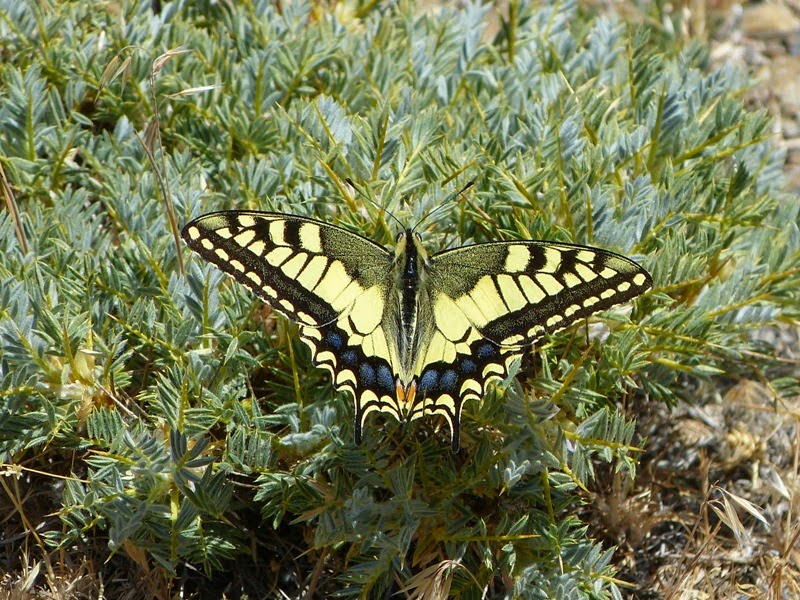
I was also distracted by the arrival of an Iberian Scarce Swallowtail.


I continued up the trail and saw an extremely worn Blue-spot Hairstreak and the odd Dusky Heath on my way.


After a while I came across another area of Thyme. This time there were Small Coppers, Spanish Gatekeepers and Clouded Yellows as well as numerous Dusky Heaths.


Along the path there was the occasional Wall Brown and Speckled Wood.


And then a little further up the path I saw two large Lavender bushes. There were two Cleopatras continually flying around them, briefly stopping for less than a second on a flower before doing another couple of laps.


They were occasionally joined by a Clouded Yellow and more Dusky Heaths!


I noticed that the Thyme close by was covered with butterflies and this area appeared to be a real magnet for them. There was a Striped Grayling, Southern Brown Argus and loads of Dusky Heaths.


There were also some Large Whites, as well as more Wall Browns and Meadow Browns. It really had been worth the climb!


Before I left Casarobonela I decided to check out a ravine in the centre of the village. This had housing and a street above one side with olive and citrus trees growing down the other. In the bottom of the ravine were fig trees and small areas of vegetables. I could only view this area from above, but as on my previous visit I saw a number of Holly Blues flying amongst the fig trees, as well as some Large Whites.


It had been a fantastic two-week holiday to Spain. I now have various favourite spots to visit to look for butterflies when I am there. All together I saw 50 species on this trip, which was primarily a family holiday! It was great to see that butterflies appear to be doing well despite the extremely dry year they have experienced in Spain.


Thursday, 15 August 2024

Sierra Nevada Butterflies - June 2024 Part 2


My next stop was a little further down the mountains at a viewing area about 2,250 metres above sea level. It isn't obvious from the road, but this has proved to be a real hot spot for butterflies and is a must to visit.


As soon as I arrived I saw a fritillary on an enormous thistle. It was a Cardinal Fritillary and was one of six flying there.


Amongst the Small Whites were some Clouded Yellows and a couple more Bath Whites. One of what I thought was a Bath White turned out to be a Western Dappled White.


There were Wall Browns everywhere dashing around chasing other butterflies. They would settle briefly before spotting another butterfly and chasing after it.


As I approached the viewpoint, which overlooks the Canales Reservoir, I could see Swallowtails flying. This is an amazing spot for hill-toping butterflies of all sorts of species.


There were also some Iberian Scarce Swallowtails joining in the fun.


I noticed a really small butterfly, which turned out to be a Panoptes Blue. I think I saw two of them, but at this stage I was joined by a friendly German motorcyclist who was keen to tell me about his exploits! He told me that the Spanish drive very slowly and part of his annual holiday allowance goes towards his inevitable speeding tickets!


I felt a little rude as I slowly moved away from him when I saw in interesting butterfly! Eventually he departed and left me to my strange obsession! There were some Dusky Heaths joining in the chasing about.


By far the most aggressive butterfly was this very worn Spanish Marbled White. It would chase anything that landed within a couple of metres of it!


Amongst the shrubs there were Blue-spot Hairstreaks.


And some Purple-shot Coppers.


It was quite intoxicating watching all of this butterfly activity.

On my way back to the car I saw various Skippers. The only one I could identify was this Southern Marbled Skipper.


Again, I wished I could have stayed there far longer, but I still had my favourite place to visit.


Wednesday, 17 August 2022

Sierra Nevada Butterflies - June 2022

No visit to the villa in Alora would be complete without a visit to the Sierra Nevada. This year I visited on the 3rd of June, almost exactly a month earlier than normal. It is a three-hour drive to get there, but well worth it for the range of butterflies that occur there. There are three different locations that I normally visit, each with its own selection of butterflies.


Initially I drove up to the Hoya de la Mora carpark, which is as high as you can drive. From there I walked down into a valley with a lovely clear stream running through it. Normally, there is quite a variety of butterflies down there, but I started to worry after a few hundred metres and I had seen no butterflies.

Eventually, as I reached the stream I saw a Small Tortoiseshell. A little further along I saw a Small Copper. I was starting to get a bit fed up, as I had traveled all this way to see two butterflies, both of which I had seen in my garden before I left Scotland!


However, I soon cheered up when a Provence Orange Tip flew past me. Frustratingly, I saw at least two of them, but neither settled at all. Eventually, I just fired off my camera in their general direction and managed to get a picture of a little yellow and orange dot, a few pixels wide, just to prove I had seen them!

At least it now seemed worthwhile struggling down into the valley. On the way back up towards the carpark I saw a couple of Clouded Yellows and Queen of Spain Fritillaries.


So, just five species. Usually, in July I will see about 15 species on this same walk.

I then walked up to the small area where Zullich’s Blues are found. I anticipated I would be too early to see any, but thought it worth checking as I was there. I have sat on a rock up there in the past, eating my lunch, watching Zullich’s Blues sparing with Spanish Argus with the occasional enormous Apollo gliding past. Sadly this year, none of those species were flying yet.


On my way back down to the carpark I did see some Painted Ladies and quite a few Small Tortoiseshells. Also some Wall Browns and a Bath White.


Driving back down the mountain road, I stopped at the viewpoint I have visited in the past. This is a very reliable site and as usual, there were Swallowtails and Iberian Scarce Swallowtails hill-topping there. Also a lot of Wall Browns amongst the scrub. This year there were also quite a few whites flying. Those that stopped allowed me to identify them as Small Whites and Western Dappled Whites.


I was really excited to see a little Panoptes Blue flying there along with two Purple-shot Coppers.


There was also a mystery Skipper that didn’t land for long enough for me to photograph it and a large orange Fritillary whizzing around, which I had no chance to identify! Next I drove down to my favourite spot - a scrubby meadow. 

I will continue this in my next post.

Friday, 1 August 2014

Sierra Nevada, Spain - Butterflies - July 2014 (2) "Hilltopping"


On my way back down the mountain road I noticed a viewpoint, but it was impossible to drive the car into the parking area as there was a foot drop off the tarmac! I managed to find somewhere to park the car a little further down the road and walked back towards the viewpoint.

Initially, I was surprised not to see any butterflies, but as I walked up to the viewpoint I was amazed to see five Swallowtails, Papilio machaon hispanicus, flying backwards and forwards. I presume this is the "hill topping" activity that I have heard so much about.

The Swallowtails were being bombarded by Wall Browns, Lasiommata megera, every time they flew anywhere near them. It was a great sight to see!

Among them were some Large Wall Browns, Lasiommata maera.

I was delighted to see this Blue-spot Hairstreak, Satyrium spini. I had read about them before I went and I was disappointed to see that they occur in May and June in the Sierra Nevada. However, this one looked quite fresh. Later I saw some much more faded individuals.

As I crouched down to take a picture of the Blue-spot Hairstreak I noticed another butterfly out of the corner of my eye landing on the same plant. It was a Iberian Scarce Swallowtail, Iphiclides feisthamelii. What a dilemma - which to take a picture of?!! I ended up alternating between the two!

The Dusky Heaths, Coenonympha dorus, here were a lot fresher-looking than those back in Alora. There were quite a number here at about 2,100 metres, yet I had seen none 500 metres further up in the mountains.

There were also plenty of Purple-shot Coppers, Lycaena alciphron, in this area.

The Common Blues here were all rather faded, but this Idas Blue, Plebejus idas, was particularly nice. I had thought that this was another Silver-studded Blue, but after help from the UK Butterfly Forum and checking with the "Mariposas Diurnas de Sierra Nevada" book I now know it is an Idas Blue. These have a slightly darker background colour on the underside of their wings and more extensive blue spots.

I was amazed by how many butterflies there were in this small area. If you look carefully at the picture below you can see a dot above the left-hand interpretation board. It is one of the Swallowtails!


Followers