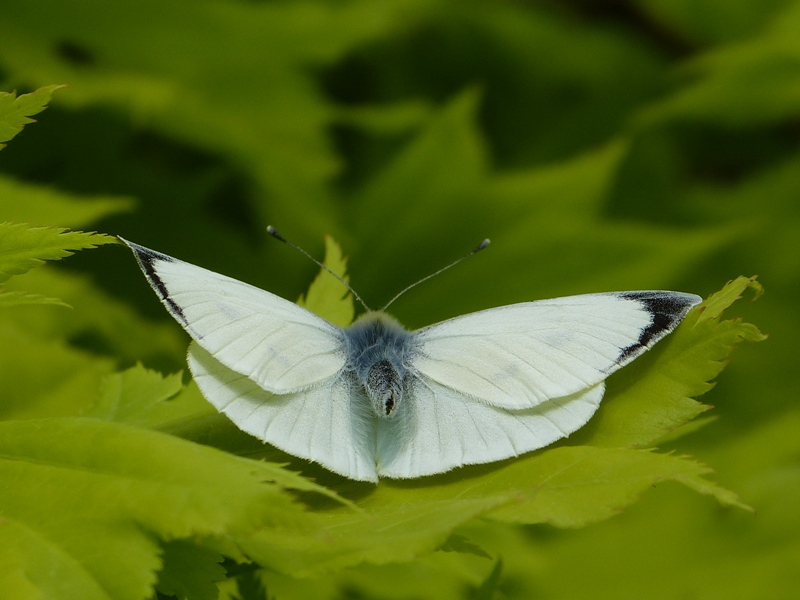
I am no expert photographer, preferring to capture the moment than get a perfectly composed shot. The pictures on my blog are either taken with a compact Canon, a Panasonic Lumix FZ150 or on my phone.


Showing posts with label Large White. Show all posts

Friday, 23 January 2026

East Lothian Butterflies 2025 part 1

I collect the butterfly records from the East Lothian Countryside Rangers and about 40 volunteers. At the end of the season I put together an annual round-up that I send to the volunteers to let them see how their records fit into the big picture. Below is an edited version.

2025 was pretty dry and sunny in East Lothian, but there was often an easterly wind keeping the temperatures down. The general lack of rain and the wind caused the vegetation to dry up, particularly in coastal areas.

We had a couple of very early records. Firstly, a Speckled Wood that was seen on 15th January in Butterdean Wood. I can only assume that it had crawled into a nearby greenhouse as a caterpillar last autumn and was tricked into thinking that spring had arrived.

The next butterfly was a Small Tortoiseshell, which was seen on 28th February. Maybe this wasn't such a surprise as they spend the winter hibernating as adult butterflies, so can make an appearance on a mild day.

There was then a flurry of Small Tortoiseshells and Peacocks on 6th March. Both species had a fairly average year, but at least Small Tortoiseshells bounced back from last year's low numbers.

There were a few Red Admirals seen in March, indicating that they may have survived the winter here. They went on to have an amazing year, with us recording about three times the average number.

The first Comma was seen on 15th March. They went on to have a great year, particularly later in the season, and I received the highest number of records since I started collating them in 2008.

A few days later a Painted Lady was spotted in North Berwick. They also had a good year, with 220 records - a big improvement on last year's 14! Their numbers can be really variable. I would suggest the normal annual average is under 100 records, but the figures are skewed by the 2019 invasion when I received 5395 records!

All four white species had an amazing year. For Orange Tips, Green-veined Whites and Large Whites it was by far the best year since I started recording the butterflies. 


Small Whites also had a fantastic year, way above average, but not quite as high a number as was seen in 2018.

Speckled Wood numbers picked up in April and they also had a very good year. I received records of 1608 of them, which is the second highest number since they reappeared in East Lothian in 2009.

Small Coppers had a fairly average year.

The same could be said for Wall Brown. Their numbers look fairly average, but when you look at when they were seen, they were almost exactly two weeks early and there was a small third generation towards the end of September, with the last one being seen on 7th November.

I will continue this on my next post.


Tuesday, 30 September 2025

Of Caterpillars and Chrysalises Part 2

Continued from my previous post.

I can’t believe the number of eggs I have found this year of Large Whites, Small Whites and Green-veined Whites. There have been a lot of adults flying around and my Nasturtiums have been covered in eggs. 


The Large White lays its eggs in batches on the underside of the leaves.


The other two species lay their eggs individually anywhere on the plant. They have also been laying eggs on a Rocket plant growing in our patio and on Bittercress and Garlic Mustard.


I tried to photograph some Large White eggs and various stages of their development as caterpillars, but there were so many different batches of eggs I couldn’t keep track of which were which.


There were so many caterpillars that some of the Nasturtiums were completely stripped of leaves. I tried to pick leaves from other plants, but discovered that most of them had new batches of eggs on them. So, I resorted to buying bags of Curly Kale to try to keep the caterpillars alive! I have never seen so many caterpillars!


Once they were ready to form chrysalises they crawled up the wall of the house to find a sheltered spot.


Unfortunately, a few were parasitized by Braconid wasps. Presumably the adults had laid eggs inside the caterpillars at some point and the larvae burst out of the chrysalises to pupate.


And the Bluetits learned where to look for the caterpillars, flying up to the wall and picking off the chrysalises. Even the chrysalises that I had thought were safe were picked off by wasps, biting into the chrysalis and managing to prize them off the wall! I was feeling a bit despondent, seeing so many chrysalises perish after I had put the effort in to save the caterpillars. 

However, I needn't have worried. One day I noticed a Small White butterfly emerging from under the Alpine trough. I had a look underneath the trough and there were several more Small White chrysalises under there.


During the late summer/early autumn there have been loads of Large Whites, Small Whites and Green-veined Whites flying around.

On 12th July I noticed a hutchisonii form of Comma laying eggs on the nettles behind my garage. I wasn’t able to look for the eggs for fear of being stung, but on the 7th August, I was walking past the garage when I spied a little face peeking out from below a nettle leaf. It was a Comma caterpillar.


I watched it for a few days and on the 10th August it formed a chrysalis.


Unfortunately, it is now the end of September and nothing has emerged from the chrysalis, so I fear it may have failed.


I was down in my meadow one day in August, when I noticed a nettle bouncing around. I couldn't understand why it was moving like that on a still day. On closer inspection I noticed that the top leaves were stitched together and on top of the leaves was a parasitic Ichneumonid wasp.


I chased the wasp away and investigated further and found a Red Admiral chrysalis inside the nettle leaves. A little later when I walked back the nettle was bouncing around again and the wasp was back. So I decided to pick the nettle and put it in a mesh cage. I thought that in a few weeks I would either have a Red Admiral or a number of wasps! Luckily it was a Red Admiral that emerged from the chrysalis about three weeks later.


I don't think I have ever known such a good year for finding caterpillars and chrysalises!


Monday, 18 August 2025

Large White, Pieris brassicae

Towards the end of last summer I was pleased to find some Large White, Pieris brassicae, caterpillars on some Nasturtiums in our garden. It had been quite a wet year and I had been a little worried because I hadn’t seen any caterpillars up until then. I kept an eye on them and towards the end of September they were still slowly growing.


On 25th September I was concerned to see that it had been frosty and there was actually ice on the leaves next to the caterpillars. I wasn’t sure if they would be able to survive such temperatures, so I put six caterpillars into a mesh cage under the shelter of an overhang in our roof.


Within a few days they had formed chrysalises on the side of the cage where they spent the winter.


This spring I kept an eye on them and between the 2nd and 9th May they all emerged. What I found interesting was that they were all males. 


I also noticed that all of the Large Whites I spotted flying here were males and it wasn’t until the 7th June that I spotted my first female.


However, I needn’t have worried, because this year the Nasturtiums are covered in Large White eggs and caterpillars and I don’t think I have ever seen so many Large Whites flying here!


Thursday, 29 February 2024

Scottish Borders Garden Butterflies 2023

We moved to this house in the Scottish Borders at the start of 2020 and since then I have been mostly working from home. During my lunch hours I tend to take the dogs for a walk around more or less the same route and I keep a note of the butterflies I see. I then keep a record of the highest number of each species I see each week. So, I now have four years' worth of butterfly records to compare.

Each year the weather has been quite different and that has had an impact on butterfly numbers. The weather was not great in 2023 with a lot of easterly winds. Spring started quite late but dry, but  from July onwards it was cloudy and wet.

Also, I have been spending a lot of time trying to improve habitats and plant different plants to attract butterflies. I would like to think that the effort is seeing rewards.


The main areas where I see butterflies is in the meadow I have been developing, on some Buddleia plants and, this year, in an area where I had some Spruce trees cut down, where I have replanted with native trees. The area is now quite grassy, with various other plants such a Fox Gloves and wild Raspberries.

The four species of white butterflies were interesting. Orange Tips generally had a good year. The first sighting was a week later than normal, but they were about in good numbers.


I saw more Small Whites than I have in previous years, but they were never seen in high numbers. I had found a number of chrysalises last year, which I kept in a cage over winter. 29 of them emerged over a period of a month in April and May. However, I never saw them in big numbers and, strangely, I didn't find any caterpillars on the Nasturtiums this year.


Conversely, Green-veined Whites didn't have such a good year for some reason.  I always associate Green-veined Whites with damper areas, so possibly last year's dry summer didn't agree with them.


Large Whites had a fairly average year. I had been expecting to see a lot of them, because there were a lot of caterpillars last year and there were several chrysalises on the house.  Again, this year, I didn't find any caterpillars on the Nasturtiums, which is unusual.


Last year was a really good year for Ringlets and this year wasn't quite as good. Overall, their numbers have gone up here over the last six years. I would like to think this is in part the result of some of the habitat work I have done.


2023 was a really great year for Meadow Browns here. I recorded 103 individuals, way up from the previous high of 21. As with the Ringlets, I would like to think that the Meadow Browns are enjoying the way I am managing the meadow. The high numbers of these two species may be a result of the weather the previous year, when eggs would have been laid and the caterpillars emerged. 2022 was a very dry summer. It will be interesting to see how they do this coming year after last year's wet summer.


I only saw 2 Small Coppers  here last year.  They had done really well the previous year, so I don't know why there were so few in 2023. There are plenty of food plants for them here, so I can only assume that it was the weather that didn't suit them.


I will continue this on the next post ...

Tuesday, 3 November 2020

Casarabonela Butterflies - September 2019

Last September my wife and I decided to go and explore some nearby villages and we randomly picked Casarabonela, which is about thirteen kilometres west of Alora, where we were renting a flat.

It is amazing what a difference those 13 kilometres make, though, and we noticed how green the countryside was on the drive up the hills towards Casarabonela. It is an amazing little village, perched on a steep hillside, with narrow little streets, only wide enough to walk up. As with many Spanish villages, it wasn’t always apparent which streets were suitable for vehicles as many of them started off wide, but narrowed, or had really tight corners, or steps!

Luckily, we decided to park the car near the bottom of the village and walk through the streets to the main village plaza where we found a café that served cold beer, with amazing views over the valley.

This trip wasn’t meant to be a butterfly trip, but I was amazed at how many butterflies there were flying around the village. This butterfly had me puzzled and I still don’t know exactly what it is! When I first saw it, I assumed it was going to be a Southern Brown Argus, but the pattern on the underside of the wings suggest it is most likely a Southern Blue, Polyommatus celina. However, it was very much larger than others I have seen elsewhere in Spain. Possibly the lush vegetation allows then to grow a little larger here than in more arid areas where I am always surprised that they are so much smaller than Common Blues that we get back home.

There were quite a few Geranium Bronzes, Cacyreus marshalli, flying in the village, presumably taking advantage of the lovely geraniums growing in all of the window boxes around the village.

I stopped in my tracks when we were walking next to a small formal shrub garden and I was astounded to see a Spanish Festoon, Zerynthia rumina. I had always assumed these were a springtime species, but when checking the books I see that they are double brooded in some locations. This picture was taken on my phone, so it is a little fuzzy.

This turned out to be one of five we saw there and to my wife’s frustration I would chase off after others trying to get a picture, but they were very active and wouldn’t let me get close.

There was a steep ravine running into the village with terraced orchards and vegetable gardens. From the pavement above I could see a number of Holly Blues, Celastrina argiolus, flying around some ivy-clad buildings, all too far away to photograph!

As we walked along a road with an orchard below I was delighted to see a Two-tailed Pasha, Charaxes jasius, drift past us and down amongst the fruit trees. All along this road there were Small Whites, Pieris rapae, and what looked to be freshly emerged Large Whites, Pieris brassicae.

I spotted a house with an amazing garden full of flowering bushes. I really wished I could have gone and had a look inside the garden, but on the hedge outside was a Long-tailed Blue, Lambides boeticus.

Higher up in the village we found the municipal swimming pool, but sadly despite us really feeling the heat, it is considered too cold for it to remain open in September. The lovely cool water looked so tempting through the bars! As we walked along this road, with scrubland on one side, we saw a few Swallowtails, Papilio machaon, a worn out Meadow Brown, Maniola jurtina, a Painted Lady, Vanessa cardui

and two striped Graylings, Hipparchia fidia, also looking a little worse for wear.

This is a beautiful little village and I really hope we can return there next summer when there may be more butterflies around and hopefully the swimming pool will be open!

Followers