I am no expert photographer, preferring to capture the moment than get a perfectly composed shot. The pictures on my blog are either taken with a compact Canon, a Panasonic Lumix FZ150 or on my phone.


Monday, 24 August 2015

Mavrokolympos Dam - Butterflies

A couple of days into our holiday to Cyprus I walked up the road towards Mavrokolympos Dam. I had been told that this road was a great place to see butterflies, but I had also been told that July was not a good time of year for butterflies in Cyprus.

I walked for about two kilometres, but there were no butterflies along the side of the road, or along some small tracks leading to the dried up river. So, I decided to drive up to the reservoir and walked along its west side to the small river that feeds into it.


I was surprised that there were still very few butterflies, but in a small gully I found 11 Common Blues, Polyommatus icarus, all but one were males.


In the same area I saw a single Small White, Pieris rapae.


During the course of my walk I also saw a Wall Brown, Lasiommata megera, a Cyprus Meadow Brown, Maniola cypricola, a Mallow SkipperCarcharodus alceae and another Pigmy Skipper, Gegenes pumilio.


I was surprised to see water running down the river into the reservoir. There were several species of fish swimming in the water including some that looked just like goldfish!

I searched the grass around the river for some time, thinking that it would be a good place for Dark Grass Blues, Zizeeria karsandra, which at that time I hadn't yet seen. Unfortunately, there were none there, but a Swallowtail, Papilio machaon, spent a long time feeding on the flowers of a shrub there.


There were also many different varieties of dragonflies and damselflies there, which I spent some time watching. By this time I realised that I had spent longer than planned here and I was due to buy some bread on my way back for lunch. I rushed back to the car and started driving down the road, only to discover that it had been closed to traffic! Three large boulders had been pushed across the road. I drove back up to the dam where there were two men surveying the dam wall. We all drove back to have a look at the road block and after many very animated phone calls the men told me that the road authority wanted money to open the road again!


One benefit of waiting there was that a Hermit, Chazara briseis larnacana, landed at the side of the road


The underside was a lovely pattern of beige and brown and the upper side was mostly dark grey with white markings. The butterfly tended to land and immediately close its wings, then a few seconds later flash its wings open very briefly. I was lucky to snap this fuzzy picture of it with its wings open.  


We spent some time looking at the boulders and at a fence next to the road to see if we could make a way past. Eventually the men suggested that we should try to drive along a dirt track. They said their truck could make it, but it could be a problem for my hire car! Eventually, after much wheel-spinning, bumping and sliding we made it through to a tarmac road. All along I was thinking of the contract that I had signed with the car hire company stating that I wasn't to take the car off-road! Luckily no damage was done and they were none-the-wiser!


Friday, 14 August 2015

Cyprus Butterflies - July 2015

We have just returned from this year's family holiday to Cyprus. We were based in a villa on the outskirts of Pegia, about five miles from the coast at Coral Bay.

Normally, before we go anywhere on holiday I spend ages researching what butterflies I may see, but this year my life was made so much easier by Eddie John's fantastic web site. This has all of the information anyone would need about the butterflies of Cyprus. Eddie runs the butterfly recording scheme for Cyprus and he was kind enough to send me the grid squares they use to record butterflies along with some tips on good places to look for them.

I also bought a copy of The Butterflies of Cyprus by Christodoulos Makris. This is a large book with details of every species of butterfly that has been seen on Cyprus along with distribution maps.


I was advised that July isn't a particularly good month for butterflies in Cyprus because much of the vegetation is dried out at that time of year. However, as I discovered, if you pick your spots then there were plenty of opportunities to see butterflies.

53 species of butterflies have been recorded on Cyprus, but five of those are very rare migrants, so it is probably more realistic to say that 48 species occur on Cyprus. 38 of those species occur in July.

Near the villa was an area of waste ground where there were two large Thyme plants growing. Every time I visited them there were about ten butterflies in that small area. The most common was the Cyprus Meadow Brown, Maniola cypricola.


The upper side of the females has lovely orange markings.


The males are less boldly marked and I noticed that both males and females can be quite variable.

There were also a number of Large Wall Browns, Lasiommata maera, in the area. Superficially these looked quite similar to the Cyprus Meadow Browns and I would have to wait for them to land before I could positively identify them!


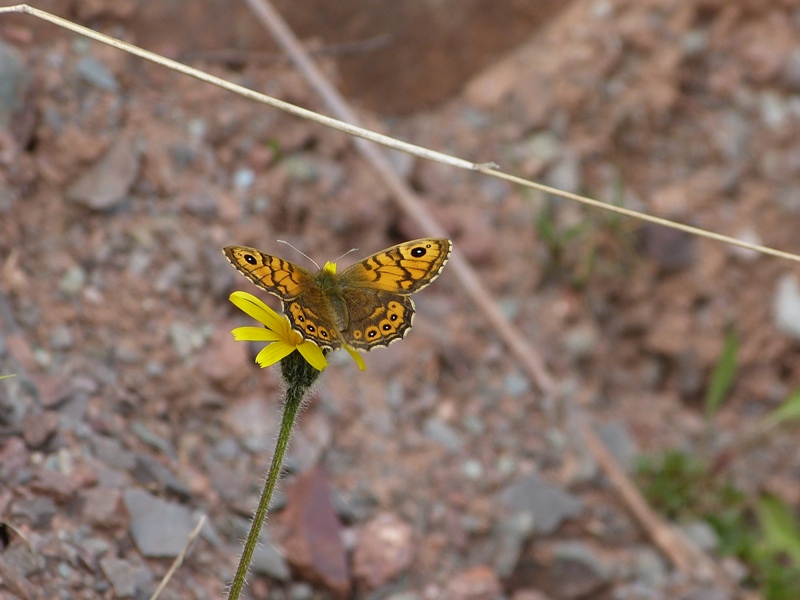
And in amongst these two were the occasional Wall Brown, Lasiomata megera.


As well as seeing these butterflies in this area, these three species would also regularly drift through the garden of the villa we were staying in. Several times a day we would also have a Swallowtail, Papilio machaon, fly into the garden and spend several minutes flying around the orange trees. It seemed to be attracted to the trees, but never landed on them.

Long-tailed Blues, Lampides boeticus, were very regularly seen in the garden, but again they never landed or fed on any of the plants.


On our first day a Cleopatra, Gonepteryx cleopatra, flew into the garden and landed on a Hibiscus plant. They are so well camouflaged that I couldn't find it until I disturbed it and it flew off. I realised that I had been staring at it all along thinking it was a leaf! That was the only one I saw in the area.

Meanwhile, back at the patch of Thyme I regularly saw Holly Blues, Celastrina argiolus, and Lang's Short-tailed Blue, Leptotes pirithous. These are becoming much more common on Cyprus than they once were.


Further down the track there was a dried-up stream where I was lucky enough to see a Millet Skipper, Pelopidas thrax. This was the only one I saw on my holiday.


I also saw two or three Pigmy Skippers, Gegenes pumilio, there.


I saw the occasional Bath White, Pontia daplidice, here. It used to be thought that it was the Eastern Bath White, Pontia edusa, that occurred in Cyprus, but recent genetic research has proved that it is P. daplidice that occurs there. The Small Bath White, Pontia chloridice, also occurs there, but I don't think I saw that!


Later on our holiday I was surprised that I hadn't seen any Dark Grass Blues, Zizeeria karsandra. Up until recently these were considered to be a sub-species of Zizeeria knysna, which I regularly see in Spain and the Canary Islands. There they are commonly found on irrigated grass, road sides and by water courses, but for some reason I didn't find them in similar habitats on Cyprus. Eventually I spotted some flying next to a bin in Coral Bay when I had driven in to buy my morning croissants!


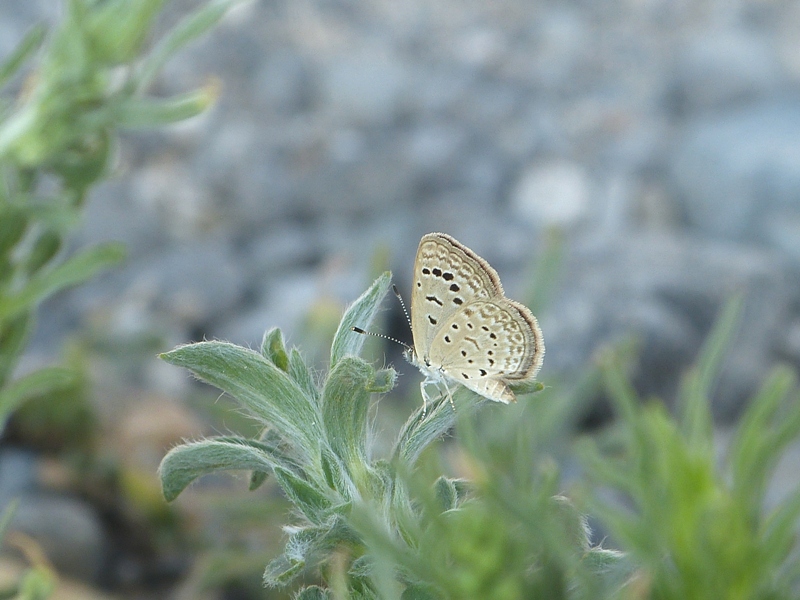
There was a thunder storm on our last night and the next morning it was still cloudy. So, I decided to pay a quick visit to the Thyme bushes to see if there were any different butterflies flying in the overcast conditions. The usual species were still flying as usual, but on the track I spotted a Grass Jewel, Chilades trochylus, on a plant in the middle of the track. These are Europe’s smallest butterflies and they are almost impossible to follow when in flight.
 
I had seen a Grass Jewel earlier in my holiday on a trip up to the Troodos Hills. I will try to write posts about what I saw in Troodos, Larnaca Salt Lake and the Movrokolympos Dam over the next few days.

Friday, 17 July 2015

Common Blue, Polyommatus icarus

I have been lucky to see quite a few Common Blue butterflies, Polyommatus icarus, this year. They have all been beautiful fresh butterflies in lovely condition.


The males are a fantastic blue colour on the upper side of their wings, but the underside patterning is quite different.


Many books describe the upper side of the wings of the female as being brown with a row of orange spots around the edge and a dusting of blue scales towards the body. They are also described as being highly variable, with specimens in Ireland and Scotland having more blue markings. We are lucky that the females in this area are beautifully marked.


Although the males are undoubtedly beautiful, I think I prefer the contrast of the blue with the orange markings of the female Common Blues.


Normally I see about ten or twenty times as many male Common Blues as I do females. I guess that the males are more active, seeking out females and defending teritories. However, for some reason this year I have noticed almost as many females as males.


I am always so please to see Common Blue butterflies. They are the only blue butterfly that occurs here (apart from the odd Holly Blue that has been seen). Next year I think I will make more of an effort to search out the females!


Monday, 6 July 2015

Red Admiral Invasion

Red Admirals, Vanessa atalanta, are regularly seen here most summers. They can't survive the winters in the UK, although there are some sightings early in the year suggesting that in some circumstances they do make it though the winter. In central Europe they hibernate as adult butterflies reappearing when the weather warms up in spring. During the summer they migrate northwards ariving in East Lothian over the summer.


It is thought that Red Admiral butterflies may be able to withstand the cold of our winters, but they tend to wake up too early if there is a warm day early in the year. At that time there are no flowers for them to feed on, so they can't replenish their energy reserves and sadly therefore perish.


This year I had only received three reports of Red Admirals in East Lothian up until the end of June.
Then, on 1st July I was walking our coastal path on a cloudy and windy day and I saw my first Red Admiral of the year. As I walked a little further another Red Admiral flew in from the sea and over the path. In the short distance that I walked a further five Red Admirals blew in from the coast. I thought this rather unusual and wondered if it had been the same butterfly that had been flying in circles!


When I arrived home I received an e-mail from a recorder who had seen seven Red Admirals flying or blowing in from the sea a little further up the coast and over the last few days I have received various similar reports suggesting that thousands of them have arrived.
Last night I drove along a local farm track and eleven Red Admirals flew up in front of the car. So, this evening I returned at the same time with my camera. There did not appear to be any on the track, but as I walked into a slight dip a Red Admiral flew up next to me.


It flew up into the trees and was joined by a second butterfly. Then, as I watched, two other Red Admirals flew out of the tree and spiraled up into the air together. There turned out to be at least eight Red Admirals in those trees.


Occasionally one would fly down and land on the road, or on a plant next to the road, but as soon as another flew past they would spiral up into the tree again!


They were so brightly coloured when their wings were open, but the underside of the wings is incredibly well camouflaged.


It was fantastic watching so many butterflies in such a small area. There were also four Speckled Woods, Pararge aegeria, in those trees and they would join in the aerobatics each time the Red Admirals flew close to them!


It wasn't until I enlarged this photo that I noticed how many flies there were amongst the branches of the trees!


I have never seen so many Red Admirals in one place. It was a delight to see them and they were unusually approachable. As usual I am left asking more questions. Firstly, I wonder where they have all flown in from? The wind was blowing in from the south-east, so I wonder if there had been a westerly wind further south pushing them out to sea. Their instinct to fly north could have brought them into line with our south-easterlies. Imagine if the wind had been blowing the other way!
I am also intrigued as to what was so attractive about this particular spot on the farm track? And was this spiraling flight a form of courtship?
There are always more questions than answers!!

Sunday, 21 June 2015

Borders Butterflies

Last week a friend and I went down to the Scottish Borders to have a look for butterflies. There were three sites that we intended to visit. Unfortunately the first area where we were hoping to see Large Skippers drew a blank. I think we were just a little too early in the season.
Next we drove down to the coast, just north of the English Border. Here there is a rocky scree where there is a colony of Small Blues, Cupido minimus. These are the UK's smallest butterfly and they are a real pleasure to see. Despite them being rare, if you know where to look they are easy to find.

Almost as soon as we arrived we spotted our first Small Blue and while we were there we estimate we saw about 40 individuals.


There were also a lot of Small Heaths, Coenonympha pamphilus, flying in the area.

There were also one or two Wall Browns, Lasiommata megera, flying, although they wouldn't let me get very close!

We noted that the number of other butterflies was down on previous visits. This has been the case all over this part of Scotland after a cold spring.
Next we headed only a mile or so up the coast where there is a good colony of Northern Brown Argus, Aricia artaxerxes, on a steep slope above some cottages.

I hadn't been to this site before, but I was delighted to see so many Northern Brown Argus at the side of a steep track on some Valarian plants. The hillside above here was covered in their caterpillar foodplant, Rockrose, Helianthemum nummularium.


We also saw my first Common Blue, Polyommatus icarus, of the year.

Despite the poor weather and low numbers of butterflies I have been very lucky so far with the butterflies I have seen.

Friday, 29 May 2015

Green Hairstreak - Callophrys rubi

One advantage of having lousy weather is that when it is nice we really appreciate it! Yesterday we had sunshine forecast and I was able to visit the site where we had found Green Hairstreaks, Callophrys rubi, last year.
A friend and I have already visited this site twice this month without seeing any Hairstreaks. Although it was sunny, up in the hills the temperature wasn't high enough for the butterflies to emerge. My friend noticed that when she felt the clumps of vegetation where the chrysalis would have been it was very much colder than the air temperature.
Last Friday she sent me an e-mail to say that she had seen some Green Hairstreaks there. The weather was great this weekend, but I was working, so yesterday lunchtime we met up to go and have a look for them.
As soon as we arrived we saw a small butterfly flying close to the ground. Even though the wind was quite strong the Green Hairstreaks were flying in sheltered spots close to some pine trees.
I had noticed last year that the Hairstreaks always occurred close to pine plantations. I had assumed that this was because they offered shelter from the wind. However, as we watched them this time two Hairstreaks briefly chased each other and then spiraled up onto a pine tree where they proceeded to mate.
The pine trees appeared to be attractive to the Green Hairstreaks and we noticed that they often landed on the fresh shoots. Presumably there is resin on the shoots that the butterflies feed on.
The male butterflies seem to have special perches where they wait for other insects to fly past. They would fly up and chase away any flies that flew too close to them and pursue any females that flew nearby.
These are such beautiful little butterflies. The metallic green colour looks so exotic. Some of them have a row of white dots, while others are completely green. The intensity of the green varied depending on how the light was hitting the wings. The top side of their wings is brown.
It was a real treat being able to spend time watching these butterflies.

Tuesday, 5 May 2015

Favourite butterfly

It is time for my annual indulgence. After a week of miserable weather we actually had some sunshine yesterday. I was able to complete my butterfly transect and on the way back I stopped to take some pictures of Orange Tips. They are my favourite butterfly and represent the start of the butterfly season for me.


I was amused that within seconds of the sun going behind a cloud the Orange Tips would stop flying and close up their wings. They are very difficult to spot when they are roosting like this.


When the sun came back out they would open up their wings and start feeding again!


So far this year I have only seen one female Orange Tip, but I was delighted to spot an egg in this picture behind the butterfly's left antennae. Sadly the weather has turned windy and rainy again, so it may be a few days before they are out and about again.

Followers