I am no expert photographer, preferring to capture the moment than get a perfectly composed shot. The pictures on my blog are either taken with a compact Canon, a Panasonic Lumix FZ150 or on my phone.


Monday, 14 January 2013

St Lucia Birds and other Wildlife

Sitting here with a cold and a sore back, watching the snow come down outside, I thought I would add some pictures of birds that I saw in St Lucia. It seems amazing that I was there in the warmth only 9 days ago!! I am not an expert birder, so some of my identifications could be wrong.

I thought this was a female Carrib Grackle, but I have since been corrected and told it is a Tropical Mocking Bird. I took loads of pictures of male Carrib Grackles, but deleted them from my camera, thinking I would get a better one later on our holiday. Now I find I don't have any! The male is completely black with bright yellow eyes. Grackles seemed to be the St Lucian equivalent to starlings and a large flock of them constantly checked out the dining area at the resort, taking the opportunity to steal a bit of dropped food or sachet of sugar! They were the most common bird on the resort and made quite a bit of noise.

The other black bird I saw was the Shiny Cowbird. This was a little smaller than the Grackle and had an amazing iridescence to its feathers varying from blue to purple depending on how the light hit it. Unfortunately, my picture hasn't captured this.

I was very surprised to see that Cattle Egrets wandered around the grounds of the resort, quite unconcerned about the people there. They were to be seen all over the island on any open ground.

I was surprised to see a Black-crowned Night Heron at the resort when I crossed a bridge. At first I was concerned as I thought it had a bit of plastic around its neck, but later discovered that it was its long feathery crest!

I was surprised when this flew across the path in front of me and landed in a tree. I had never seen a bird with a badger's head before! Turns out to be a Yellow-crowned Night Heron.

It was fantastic to see Humming Birds all around the island. There are three species occurring on St Lucia, the Purple-throated Carib, the Green-throated Carib and the Antillian Crested Hummingbird. They were very tame, very rapid and often had me fooled while I was searching for butterflies! I didn't notice any Purple-throated Caribs, but I saw plenty of the other two. I took hundreds of pictures but most of them turned out to be just green blurs!

Here is another one taking an early morning shower in the spray of a leaking pipe! There was also a large brown butterfly at the same spot, but it flew off before I saw what it was.


Another of my favourites was the Lesser Antillian Bullfinch. The male is black with a red chin, while the female is various shades of brown and grey. They seemed to occur all over the island, but not in great numbers. They would make quick assaults on the dining area searching for crumbs. These two were photographed at a feeding area in a rain forest visitor centre.


Here is one scavenging in the dining area.


There are several species of doves and pigeons on St Lucia, although I only noticed three. The most common at the resort was the Zenaida Dove. They had a lovely patches of purple iridescence on the sides of their necks.

There were a number of Collared Doves at the resort. They don't appear in the book I have, and I guess that they are the same species as we have here in Scotland and they have been introduced.

My favourite dove was the Common Ground Dove. These lovely little birds are only a little larger than a sparrow and they tended to go around in pairs!

The Bananaquit was a noisy little bird. It seemed to compete with the Gracles to see who could make the most noise and it was just as inquisitive.

Another bird that I regularly saw out to sea was the Magnificent Frigatebird. Unfortunately I didn't think to try and take a picture of one! Surprisingly, for and island, I didn't see any gulls and only one wader which I was told was a Yellowlegs! There were a lot more birds that I saw, but I have no idea what they were!

It was amazing how tame the birds seemed to be there and considering that I didn't specifically look for them I was surprised how many I saw.


A few other bits and pieces of wildlife from St Lucia. Everywhere I went I saw lizards sunbathing or scurrying off into the undergrowth. I thought that I recognised two distinct species, but now I think they were both the St Lucian Anole. Apparently this is very variable, and it occurs as a brown lizard in dryer areas and green in wetter areas. This is one I saw at the resort.

And this is one I saw on a building in the rain forest.

This is a little gecko that lived in our bathroom. It was only three or four centimetres long!

There are a few other species of lizards including whiptails and an iguana, which lives in the dryer north west of the island. Apparently the iguana can grow up to six feet in length. It would have been interesting to have encountered one of those! Frogs were also abundant and were the noisiest thing about after dark, making regular peeping noises. There are also introduced giant Cane Toads there, which grow up to about six inches long. Cane Toads seem to be regular victims on the roads. The only wild mammal I saw was also sadly squashed. It was an opossum that we found at the side of the road during an early morning walk.

Just about everywhere you looked there were holes and piles of soil. These were created by land crabs. I think they are the St Lucian equivalent of moles!

They seemed quite variable in colour.

I spotted these caterpillars on the first day of our holiday at the resort. I was amazed at their size - about 9 centimetres long. Each day they grew bigger until they were about 20 centimetres long and then they disappeared. I don't know if they had gone off to pupate or if a gardener had decided that they had eaten enough of the plant and had dispatched them. Checking the internet since we returned home it appears that they are Frangipani Hawkmoth caterpillars. The moth is disappointingly dull compared to the caterpillar!

All of these pictures apart from the bullfinches were taken at Smugglers Cove Resort. It was amazing how much wildlife there was around when you looked for it. I would love to return to St Lucia and spend more time exploring the rest of the island and seeing the amazing plants, animals, beautiful scenery and friendly people again.

Sunday, 6 January 2013

St Lucia - Butterflies - December 2012


We spent just under two weeks on St Lucia in the Caribbean from 22 December 2012 to 3 January 2013.
Although this was a family holiday to a resort I still managed to see a number of butterflies. My ageing father took me, my wife and kids there, which was very generous of him. His need for constant attention limited our exploration of the island a bit, but I can't really complain!!!

Before heading off I did my usual research into what butterflies I might see on my holiday, but I was amazed at how difficult it was to find much information. I managed to buy a used copy of Norman Riley's "Field Guide to Butterflies of the West Indies", but this was published in 1975, so much could have changed since then. Further internet research revealed that "Butterflies of the Caribbean" was written by David Spencer Smith in 1994, but the only copy I could find for sale was almost £2,000!! My local library eventually managed to get a loan of a copy from Cambridge University Library, which I was able to read at my library, with strict instructions not to take it out of the building!! I spent several lunch hours writing copious notes from this book during the two weeks it was available to me.

The best web site I could find about butterflies in the area was Focus on Nature Tours' web site http://www.focusonnature.com/CaribbeanButterfliesList.htm. This lists all of the butterflies that occur in the Caribbean and beside each there is a code for which islands they occur on.

I also spent a long time e-mailing various individuals and organisations in St Lucia, but amazingly no one was able to give me any information about butterflies there. The only person who was able to help me was a professor in Canada who had studied beetles in St Lucia and he sent me a list of the butterflies he had seen.

Using the above sources, and also searching Flickr and other web sites for pictures of butterflies taken in St Lucia, I put together a list of butterflies that could occur in St Lucia. There were a total of 67 species on the list, but further research showed that one of them was a single record from 1913 and various others were rare vagrants. I think that there are probably about 50 species of butterflies regularly occurring on the island, which is amazing given that it is only 27 miles long by 14 miles wide!

Of course, I had no idea if December/January was a good time of year for butterflies, or how localised any populations may be.


The temperature varied between 25 and 30 degrees Celsius while we were there and it was very humid. There was a constant breeze making it very pleasant. There were regular heavy downpours, usually in the early hours of the morning or in the late afternoon. None of the showers lasted very long and the ground quickly dried up again. Most of the time it was sunny, with the occasional cloud.
I was delighted that when the sun shone there was usually at least one butterfly to be seen flying past. The problem was that they did tend to just fly past and rarely settled! It seemed that the larger the butterfly the less likely it was to land and many butterflies seemed to hop from flower to flower only settling for a second at a time, which was not long enough for me to take a picture!

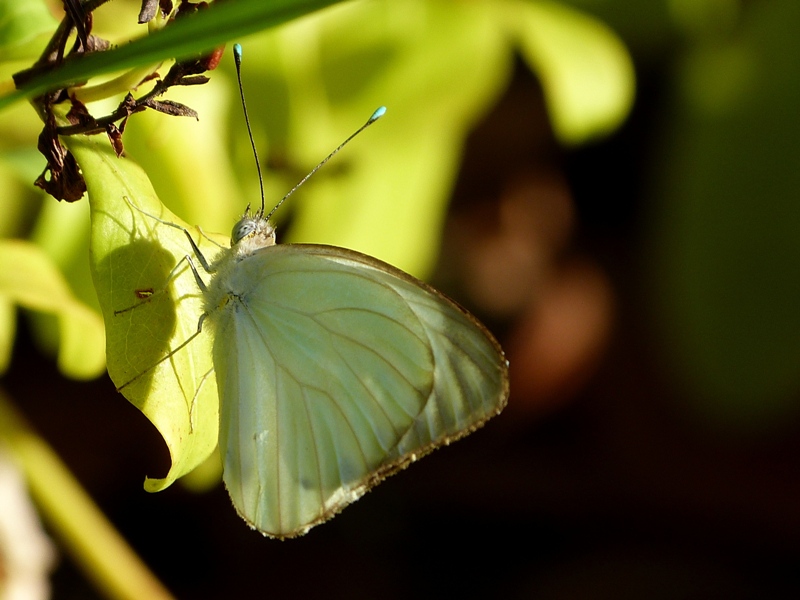
The most common butterfly that I saw was the Great Southern White, Ascia monuste eubotea

They had amazing bright turquoise clubs on their antennae.

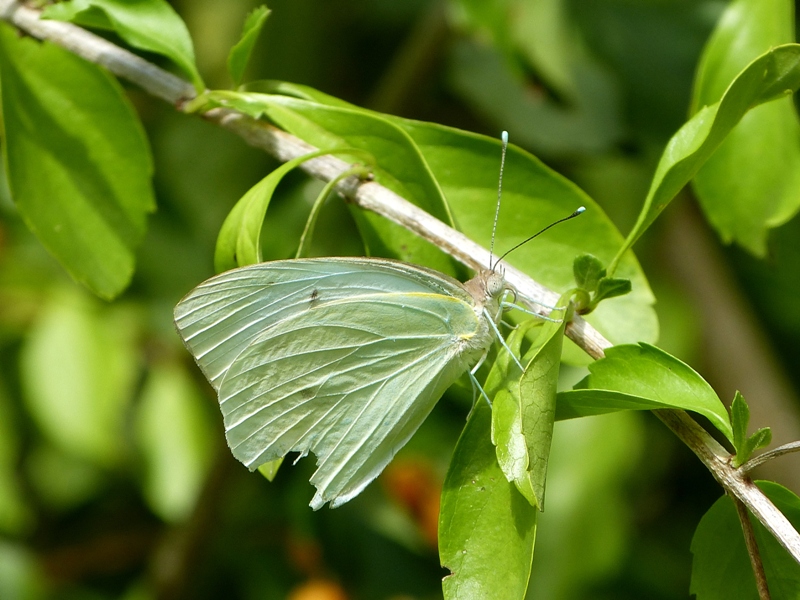
The Great Southern White was easily confused with the Tropical White, Appias drusilla comstocki. To make matters worse, the Tropical White occurs as a wet season or dry season form and the males and females differ. So the upper side of the wings can be anything from completely white, to yellowish, with either a very narrow grey margin or a lot of grey! They also have some turquoise on the antennae, but not as pronounced as the Great Southern White.

There are also five larger Sulphurs occurring on St Lucia. They vary from bright orange/yellow to pale greenish/white. For me it was impossible to identify anything until it landed, which didn't happen often. Even when they did land, I found it difficult to know what they were without taking a picture and then studying it against my old book.

The most common yellow butterfly seemed to be the Apricot Sulphur, Phoebis argante argante. Along with the Great Southern White, there would rarely be a sunny moment when there wasn't one flying in view.


I learned that the only way to get a picture of these was to watch them when the sun was about to go behind a cloud and wait for them to settle. They usually disappeared into the vegetation, but occasionally they remained in view.

The Large Orange Sulphur, Phoebis agarithe antillia, was incredibly similar to the Apricot Sulphur. They are very slightly larger, but the main difference is the extent of the kink in the line of brown markings leading from the apex of the fore wing. The Large Orange Sulphur was also inclined to settle high in the trees, rather than in lower vegetation.

The Cloudless Sulphur, Phoebis sennae sennae, was a bit easier to identify. It was quite large and bright yellow. It would flit from flower to flower, rarely settling for longer than a second, managing to frustrate anyone trying to take a picture!! I did manage the odd shot, but it never settled at a good angle! To add to my confusion, the female Cloudless Sulphur is more heavily marked, making it quite similar to the two species above!

It seems that there are six different species of Eurema occurring on St Lucia. Eurema are amongst my favourite butterflies. They are mostly bright yellow with black markings on the upper side of their wings and I find their diminutive size very endearing. The Pale Yellow, Eurema venusta emanona, seemed to be the most common one I saw.
I really love these! The forewing of the Pale Yellow is only 17mm long and we have nothing like them back home in Scotland. As they fly along, close to the ground, it is possible to make out the upper side of the wings, the forewing being a brighter yellow than the hind wing with a narrow black border.

I was surprised to see this one behaving a bit strangely on a flower one evening, but then noticed that it had become the victim of a little Orb Spider. Later I found its discarded and shrivelled body on the ground below the flower.
  
This poor picture is of a False Barred Sulphur, Eurema elathea. They are very similar to the Pale Yellow, but they have a black bar along the bottom of the upper forewing. It can just be made out through the hind wing on this picture . I had expected these to be more common, but this is the only one I am aware of seeing.

I also saw some Little Yellows, Eurema lisa euterpe, but didn't manage to photograph one. They have more brown markings on the underside of the wings.

The picture below intrigues me! I think that the black mark at the top of the wing is because a bit of wing is missing, showing the black from the upper side of the other wing. Even so, there appear to be no markings at all on the underside of the wings, so I can't be sure what it is. Unfortunately, I couldn't get close so this very cropped picture is the best I could manage. I will have to do a little more research to see if I can identify it.

There are 13 different species of whites and yellows, and very often I saw one flying past that looked as though it was a slightly different shade of yellow or cream. I think that to seriously try to identify them it would be necessary to take a net and catch them, although there are very few places where this could be done without permission.

(I'll continue this on a separate post.)

St Lucia - Butterflies - December 2012 (2)

The first butterfly I was able to photograph on our holiday was a White Peacock, Anartia jatrophae jatrophae. I was surprised how small this was (about the size of a Green-veined White back in Scotland) as I had expected it to be about the same size as our own Peacock. This one was being harassed by a Great Southern White, but it was one of the few butterflies that I managed to take a picture of with its wings open.

It is missing a bit of its rear wings, but it turned out to be the only one I saw during our holiday. In fact it gave me a bit of a false impression of what I was going to see on my holiday. This was on my first walk around the resort to specifically look for butterflies and here was a White Peacock, a Great Southern White and a Hanno's Blue all within a couple of feet of each other.

There seem to be two different blues and six different hairstreaks occurring on St Lucia. I didn't manage to spot any hairstreaks, but there were a few Hanno's Blues, Hemiargus hanno watsoni, flying around the resort we were staying on. These were really small and difficult to spot, but at least they allowed you to approach them fairly easily.

These are so small - the forewing is only 10mm long. This one is feeding on Coatbuttons, Tridax procumbens (as is the White Peacock above), which seems to be a favoured nectar source for butterflies there.


The other blue I saw was the Cassius Blue, Leptotes cassius chadwicki. When they were flying they actually looked like a white butterfly as much of the upper wing on the female is white. I had expected these to be really common from what I had read on the internet, but I only saw two individuals. There was a lot of Plumbago growing at the resort and in the towns, which I thought would have been covered in Cassius Blue, but that wasn't the case. (In Europe, and Africa when I see Plumbago it very often has a close relative of this butterfly - Leptotes pirithous - feeding and laying eggs on it.) Maybe it would be different at a different time of the year.
  
On a few occasions I saw a Buckeye. Both the Caribbean Buckeye, Junonia evarete michaelesi and the Mangrove Buckeye, Junonia genoveva occur on St Lucia. I think it was the Mangrove Buckeye that I saw each time, but I find it very difficult to tell the difference between the two species. It seems that until recently they were thought to be two sub-species of Junonia evarete. It was interesting that the one I saw at our resort didn't settle for long at all, but later during our holiday we did a Segway trip near Rodney Bay, where I saw several of them just sitting in the grass sunning themselves. It makes me wonder if the plants in the resort were treated with insecticide or something to make them less attractive to insects.


There could be up to 21 different Skippers occurring on St Lucia. I only managed to identify three, although I saw a lot more that just didn't stop to let me identify them!

This one is a Southern Broken Dash, Wallengrenia otho ophites and it seemed to be the most common Skipper I saw. 
Again, they rarely settled at our resort, but this one was happily sitting on a flower on our Rodney Bay trip. The guide was starting to get a little tired of my jumping off the Segway to photograph butterflies by this stage, so this one was quickly snapped!!

The other Skipper I managed to photograph was the Canna Skipper, Calpodes ethlius. This was on some Bougainvillea at the resort in an area they say was planted to attract butterflies.
  
The other Skipper I identified was the Common Long-tailed Skipper, Urbanus proteus domingo, but sadly I didn't manage to photograph it.

It seemed that the more spectacular butterflies were less inclined to stop for a picture. Amongst those I saw were the Gold Rim, Battus polydamas lucianus, a dark, tailless swallowtail, the Painted Lady, Vanessa cardui (it gets everywhere!!), and the Julia Heliconian, Dryas iulia lucia. This is a beautiful bright orange long wing. They would fly around tantalizingly close to me, one time circling my feet, but just never seemed to stop! Another common orange butterfly was the Gulf Fritillary, Agraulis vanillae vanillae. Again, these are really beautiful, but I didn't see one land at all. On more than one occasion I also saw a Monarch, Danaus plexippus megalippe. This is a sedentary sub species that occurs in much of the Caribbean. It is slightly different in appearance from the migratory Monarch, but of course, I didn't see it for long enough to notice!!

During a trip into the rain forest I only saw two butterflies - a Cloudless Sulphur and a Great Southern White. Not surprising really, I suppose, as there were not as many flowering plants as there were in the more inhabited and coastal areas of the island. However, I had thought that I may have seen a Leaf Wing or St Lucia Mestra in the shade of the trees. Certainly the best area I explored was along the tracks above Rodney Bay. It would have been good to have had more time to explore such areas. Still, I'm not complaining. I identified 20 species during my visit with 18 of them being new to me.


St Lucia comes highly recommended. I have never been to such a lush vegetated place. There are plenty of areas to explore, although you have to have permission before entering any of the trails in the rain forests. Looking at the excursions that were offered from our resort, it is possible to visit the botanical gardens and a few large estates where cocoa beans are grown or where you can explore the native flora and try out native fruits and plants. I am sure if I had been to any of those places I would have seen more butterflies.

I'm certainly not complaining, though. It was lovely being there. Such a beautiful island, with much of it completely unspoilt. The people there are so friendly, too. Don't expect anything to be done in a hurry, but it will be done with a smile!

Another time I would love to hire a car (which would be an adventure in itself!) and explore more of the island. The Segways were great fun, but my 14 year old son demonstrated how it is possible to run yourself over with one! I am sure the scars will eventually fade!

I would certainly love to go back to St Lucia. Maybe at a different time of year and maybe to a different part of the island. For me, it is just about the perfect destination.

Thursday, 25 October 2012

East Lothian Butterflies 2012


The weather in East Lothian in 2012 was terrible. It started off quite well and we had two glorious weeks in March when butterflies started to appear, but from April onwards we had a ridiculous amount of rain. There were barely two days without rain right through to August. September was a little better, much to the relief of the farmers, who were able to harvest their crops, but we also had some periods of very heavy rain. We twice suffered fairly serious flooding in July and September, with rivers bursting their banks and fields being flooded.
The weather certainly had an impact on butterfly numbers earlier in the year, but species that appear later in the season didn’t suffer so badly. We had a few sightings of Red Admirals, Peacocks and Small Tortoiseshells in late February/early March, but things really took off on 21 March. For the next ten days I had records of various butterflies coming in and it looked like we were going to have an amazing year. April, however, was a complete wash out and I received very few records of butterflies that month! After that numbers picked up a bit, but were generally very disappointing.

Red Admiral, Vanessa atalanta
The first record I received this year was a Red Admiral on the 15th March. We had a really good year for them in 2011, but it is not considered that they survive the winter in Scotland. There was another record on 21st February, but then no more were seen until June. Possibly Red Admirals can survive the cold of a Scottish winter, but they wake up in a period when there are no flowering plants for them to feed on.
The Red Admirals that turn up later in the year have most likely worked their way up here from southern England or the continent. A few individuals were seen in the early summer, but like last year, numbers really picked up in September when they were commonly seen furiously feeding on buddleia. Hopefully, many of them will have flown south where they will be able to make it through to next spring.

Peacock, Aglais io
Peacocks have become a butterfly that you can rely on here, whilst numbers of other species tend to fluctuate. The first record I have this year was from 21st March and they made regular appearances through to June. As is normal they were not about in July, but the next generation started to appear at the end of August and they were seen in good numbers until the end of September.

Small Tortoiseshell, Aglais urticae
Small Tortoiseshells seem to be doing better here than they are further south. Over the last few years there has been concern that the number of Small Tortoiseshells has been declining and it is thought this may be due to a parasitic fly, Sturmia bella, becoming more common in the UK. If it is true that this fly is spreading up from Europe then hopefully it won’t make it up to Scotland!
Despite the poor weather Small Tortoiseshells were frequently recorded here. The first record was on 1st March and they were seen throughout the year until early October.

Comma, Polygonia c-album

The Comma is a butterfly that I am always excited to see. I saw my first one in East Lothian in 2004 and since then the numbers have gradually picked up. Certainly this seems to be a butterfly that is extending its range northwards. Unfortunately, this year it hasn’t done so well. I spotted my first one this year on 21st March, and on the same day the Countryside Ranger at John Muir Country Park saw one. I received one other record in May, but then nothing at all until September. I was beginning to worry that the wet weather had wiped them out, but having now had four reports of them I hope that they will be able to bounce back next year.

Small White, Pieris rapae
I saw my first Small White on 22 March in the middle of the exceptionally nice weather. Given the right weather conditions they can start to appear at that time, but normally they are a couple of weeks later. For the remainder of the spring the numbers were lower than normal due to the cloudy, wet conditions. The second generation in July and August was a little better, but Small Whites are never as numerous as Green-veined Whites here.

Green-veined White, Pieris napi
The first Green-veined White was reported on 25th March. The spring population was hit quite hard by the weather (both last summer and this spring), but they struggled on. Luckily they obviously managed to lay eggs between the showers and the second generation that appeared at the end of July was a lot more numerous. They continued in good numbers until the middle of September. There was a very definite gap between the two generations this year, which isn’t always the case.

Orange Tip, Anthocharis cardamines
The first Orange Tip I saw this year was a female on 27th March. This was exceptionally early and sadly for her just before the weather turned really bad. I saw the odd one in April, but the poor weather really seemed to impact on numbers.  The numbers I recorded on my transect were about a third of last year’s record, although they did continue later in the year than normal. Strangely I didn’t find any eggs on the common food plant here – Garlic Mustard, Alliaria petiolata, but I later found them laying eggs on Dame’s Violet, Hesperis matronalis, which was new to me. Unfortunately, shortly after finding the eggs the area was flooded. I fear that this could have an impact on numbers next year, but it will be interesting to see.

Large White, Pieris brassicae
The Large White is a butterfly that for some reason doesn’t occur in great numbers here. Normally, I only see them occasionally, so this year didn’t seem much different from the norm. The first record was on 27th March and I received a few more record later in the year. The numbers were higher for the second generation, with more being reported in August.

Small Copper, Lycaena phlaeas
Earlier in the year it was noted all over the UK that the number of Small Coppers being recorded was lower than normal. The first record I received for East Lothian was on 12th May, and very few more were reported until the next generation started to appear in July. Numbers really seemed to pick up then, so it seems that the few that were spotted earlier in the year managed to breed successfully.

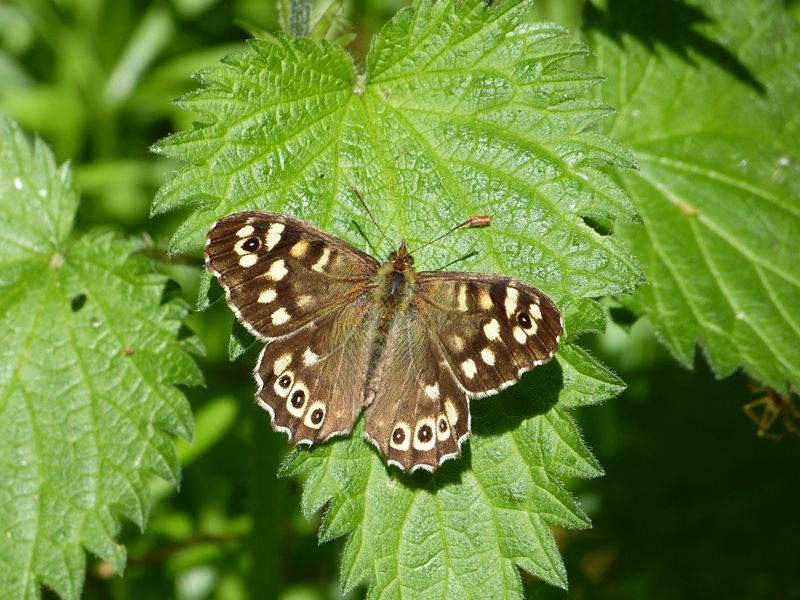
Speckled Wood, Pararge aegeria tircis
In 2009 I received a couple of records of Speckled Woods in East Lothian, making me hopeful that they may move up here from the Scottish Borders. I received one more record in 2010 and last year I found a small colony at John Muir Country Park. Later in the year more were found elsewhere in the Park. This year they seem to have extended their range further along the coast. I saw my first one this year at exactly the same spot in John Muir Country Park on 16th May. They were subsequently seen in various sites up to 20 kilometres further west, right through until September. Not having any previous data it is difficult to say how the weather may have impacted on them, but it is exciting to see them doing well and extending their range.

Wednesday, 24 October 2012

East Lothian Butterflies 2012 (2)


Small Heath, Coenonympha pamphilus
The Small Heath is a common butterfly along the coast in East Lothian and it is also found in the Lammermuir Hills. This year they appeared to do as well as ever and I saw over 50 of them during a visit to John Muir Country Park in June.

Holly Blue, Celastrina argiolus
Holly Blues have been recorded right on the western fringes of East Lothian for some years now, but last year I was excited to hear that a new colony of Holly Blues had been found in the coastal village of Aberlady, about 15 kilometres east of the original colony. When I checked this out I found three individuals, so it wasn’t a big colony! This year, despite several visits, I didn’t see any there. However, on 23rd May one was spotted a short distance away in Gullane and two days later I received a record of one five kilometres further along the coast. I live in hope that there is a colony somewhere around that area and that if we have a better summer next year I will manage to see them again.
Sadly, I heard no Holly Blues were recorded at the original site near Musselburgh this year and it is feared that they may have perished due to the poor weather. I really hope for better news next year.

Wall Brown, Lasiommata megera
Wall Browns were first recorded in East Lothian two years ago, having worked their way up the east coast of Scotland. Last year they extended their range only a few metres, but this year they seem to have moved even further up the coast. The first one I saw this year was on 25th May near the boundary with the Scottish Borders, but later in the year I received several reports of them along the next five kilometres of coast. I am hopeful that they will continue to expand their range over the next few years as there is a lot of good habitat further along the coast.

Painted Lady, Vanessa cardui
2012 was not a good year for Painted Ladies in the UK. I received one record on 1st June and two in August. I was beginning to think that I wouldn’t see one myself, but on a warm day in September I found one in amongst some Red Admirals and Small Tortoiseshells feasting on some buddleia. This was to be the only Painted Lady I saw in 2012.

Common Blue, Polyommatus icarus
The Common Blue seemed reasonably unaffected by the weather. It is a butterfly that can be locally common at some coastal sites and disused quarries. This year I specifically went to look for them where I knew I had a good chance of finding them, so I may have a false impression of how many there were. The first ones I saw were on 14th June at an area within John Muir Country Park in an area that is the first place I look for them each year.

Grayling, Hypparchia semele
The Grayling is a butterfly that may have quietly been living unnoticed in East Lothian for a few years. After hearing rumours that there were some living on an old railway siding in an ex-opencast coal mine, I checked the area out last summer and immediately spotted one. Later in the year some were reported on a re-landscaped mining spoil heap less than a kilometre away. This year I checked out the railway siding on 29th June and despite the wind I saw one Grayling. In July I checked out the spoil heap and saw over 40 of them, so they now seem to be well established in the area. There were also two records of individuals at two sites on the coast.

Ringlet, Aphantpopus hyperantus
Ringlets tend to occur in damp grassy areas, and normally start to appear in late June. This year I didn’t see any until 3rd July when I counted 16 on my transect. Luckily for them, this was after the worst of the wet weather, and just after the first floods, so their numbers weren’t that much lower than normal. They tend to be quite a short-lived butterfly, and their numbers tend to drop off by early August, but this year they were still being noted in the third week of August. So, it seems that they delayed their whole adult life by two weeks.

Meadow Brown, Maniola jurtina
The emergence of Meadow Browns was also two or three weeks later than normal, and although their numbers were low to start with they picked up later in the season. I recorded my first one this year on 17th July. If anything, I think this season was better than average.

Dark Green Fritillary, Argynnis laodice
Along with the other two butterflies above this butterfly was about three weeks later than normal. The first record I have for this year is the 27th July, but normally they would be seen at the end of June or early July. Once they did appear their numbers seemed about normal.

Northern Brown Argus, Aricia artaxerxes
Northern Brown Argus tend to live in small colonies based around their food plant – the Rockrose, Helianthemum nummularium. The adults tend not to fly any distance from the areas where Rockrose grows. I am only aware of three sites where there are colonies of Northern Brown Argus in East Lothian, although I am sure there must be others still to be discovered. Adults normally start to appear in mid-June, but I didn’t get to a site just inside East Lothian until 26th July when I saw a good number of them.

That was 20 species of butterflies recorded in East Lothian this year. Not bad considering the appalling weather. I was constantly amazed that butterflies appeared after fairly long periods of cold wet weather. Numbers of most species seemed to be down on normal, but hopefully they will bounce back if we have a summer next year!

The two species that seem to have suffered were the two that are probably the rarest. Holly Blue numbers were down and we didn't record any Small Skippers. Last year was the first year that Small Skippers were recorded in East Lothian. I hope we see them again soon.

Followers