I am no expert photographer, preferring to capture the moment than get a perfectly composed shot. The pictures on my blog are either taken with a compact Canon, a Panasonic Lumix FZ150 or on my phone.


Saturday, 4 June 2016

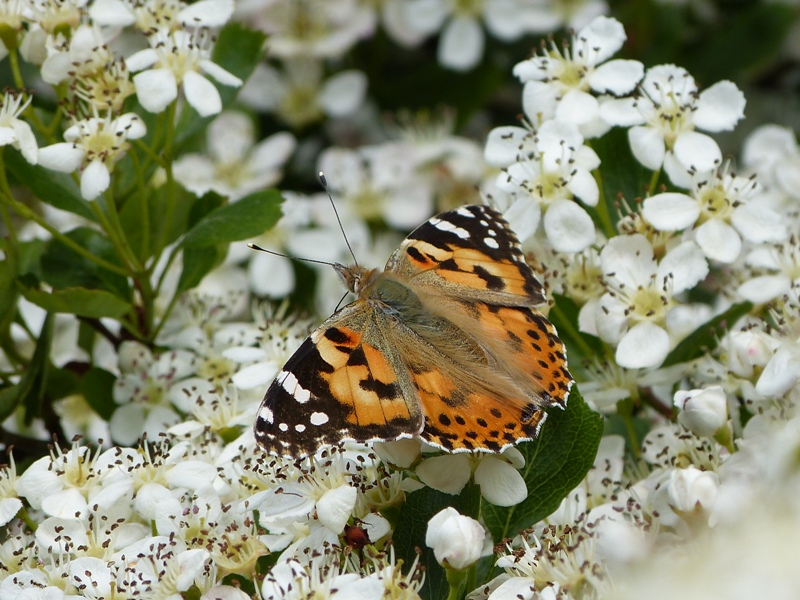
Painted Lady - Vanessa cardui

When I was out for a walk with my dog after lunch today I was delighted to see a Painted Lady, Vanessa cardui, fly up from the track in front of us. At the same time I met a friend with his dog and I lost sight of the butterfly. I returned a few minutes later with my camera just in case the Painted Lady had decided to stick around.
At first I couldn't find it anywhere, but then my eye was drawn to a beautiful Hawthorn bush which was completely covered in flowers. To my delight there was the Painted Lady feeding on the blossom and it turned out that there were two!


The Painted Lady is found here in East Lothian most years. Sometimes it is seen in great numbers, but more often than not we only see a few individuals.

The Painted Lady can't survive our cold winters, so those that we see have migrated here. Their parents may have started their journey in North Africa or southern Europe. I wonder where those I saw today started out? Hopefully this one will lay some eggs here, or maybe it will continue to travel further north.


It used to be thought that the butterflies that reached the UK perished when the first frosts arrived. However, it has recently been discovered that Painted Ladies return to Africa at the end of the season. They fly at over 500 metres high and return to the same area that their predecessors left earlier in the year. The remarkable thing is that the butterflies that return to Africa are the great-great-grandchildren of those that started the journey northwards. How is that knowledge passed on?

Occasionally we experience what is sometimes referred to as a "Painted Lady Year", in which tens of thousands arrive on our shores. Two weeks ago the first Painted Lady of the year in East Lothian was reported to me and last week I saw one in the Scottish Borders. This evening I received two more records of Painted Ladies being seen today. So, I am hoping that 2016 will turn out to be a great Painted Lady year.

Wednesday, 18 May 2016

Green Hairstreak - Callophrys rubi

It has been a bit of a frustrating season so far. The last few days of March were mild and promising, but then most of April it was too cold for butterflies. The last ten days have been sunny and reasonably mild, bringing out a few butterflies. We are currently up to 13 species for the season.

A few days ago I heard that Green Hairstreaks, Callophrys rubi, had been found in a local wood. They were first recorded there last year, but have most likely lived there unnoticed for many years. A friend and I went to look for them and were delighted to find at least eight.


My friend returned the following day and explored further into the wood and found a colony of about 25 and today she let me know that she had managed to find Green Hairstreaks in another wood where they have never been recorded before.


They are very small and so well camouflaged that I am not surprised they haven't previously been noticed here.


Green Hairstreaks lay their eggs on Blaeberry here. We have also noticed that they only seem to occur close to conifer plantations. Maybe that is a coincidence, but apparently identical areas of Blaeberry without conifers near by don't seem to have any Green Hairstreaks living on them.


It is great to know that there are at least three areas of East Lothian where Green Hairstreaks occur. I am sure there are probably many more. Over the winter I found a site that looks perfect for them, but it is a three hour walk to get there, so I doubt I am going to have time to check it out this spring. At least I now know what sorts of habitats to check out.


Tuesday, 29 March 2016

East Lothian Butterflies 2015 (2)

Continuing on from my previous post ...

Green Hairstreak, Callophrys rubi
We only discovered Green Hairstreaks for the first time in East Lothian in 2014, although I am sure they were probably hiding away in their remote locations for several years before that. This year the first record was on 20th May and they were recorded until 7th June. They were mostly recorded in the Lammermuir Hills, but also in an area of lowland woodland.


Wall Brown, Lasiommata megera
There were two distinct generations of Wall Browns between 30th May - 2nd July and 16th August - 19th September. They seemed to be quite abundant this year and I have been told that they were particularly abundant on the coast in the Scottish Borders. This is good news as they are struggling in southern England, possibly as a result of climate change.


Painted Lady, Vanessa cardui
I had thought that 2015 was a poor year for Painted Ladies, as I only saw one all year! However, I received quite a few records from other enthusiasts. Considering the number of Red Admirals that arrived here in July, I was surprised there weren't more Painted Ladies, though. The first record I received was on 11th June and the last one seen was on 26th October.

Common Blue, Polyommatus icarus
The first Common Blue recorded in 2015 was on 11th June and they were recorded through to 29th September in good numbers. There was no clear division between the two generations. For some reason there was a much higher proportion than normal of females reported than in previous years.

Northern Brown Argus, Aricia artaxeres
I am only aware of four sites in East Lothian where Northern Brown Argus occur. Three of these sites are smaller than the average sitting room. This year I only received records from two sites with the earliest being 20th June and the latest was on 7th August.

Ringlet, Aphantpopus hyperantus
Ringlets were seen in their usual good numbers between 24th June and 16th August. They seemed to have a longer season than in previous years, possibly because the weather was so poor.


Meadow Brown, Maniola jurtina
As usual Meadow Browns were very numerous in 2015. The first record was on 27th June and they were seen through to 3rd September, with a peak in numbers in early August.

Dark Green Fritillary, Argynnis aglaja
The Dark Green Fritillary is mostly found on the coast of East Lothian, but there are a few inland sites where they are also found. The first record in 2015 was on 27th June and they were seen until the 15th August.

Small Skipper, Thymelicus sylvestris
The Small Skipper was first recorded in East Lothian in 2011 at Aberlady Local Nature Reserve. It has since done incredibly well and spread along the coast and is also found at a couple of inland sites. In 2015 it was recorded between 28th June and 29 August.

Grayling, Hypparchia semele
I am only aware of three sites where Grayling occur in East Lothian. One of those sites is in an area that is due to have houses built on it and we are currently unable to access it. All of the records I received in 2015 were from a nearby site, which is an old mining spoil heap. The first Grayling was recorded on 3rd July and they were seen till 6th August.

Small Pearl Bordered Fritillary, Clossiana selene

The only record of a Small Pearl Border Fritillary this year was on 3rd July when I briefly saw one at a site in the Lammermuir Hills. This is the only place I am aware of them occurring in East Lothian, so I hope they are able to hang on there.

The only butterfly that I was hoping to see in East Lothian that we didn't record in 2015 was the Large Skipper. They had been seen just inside the East Lothian boundary in 2014 and we had high hopes that they would increase in number or progress along the coast as so many other species have done. They may have been there, but due to the lousy weather no one was there to spot them!  With a bit of luck we will find them again in 2016.

It is fantastic having so many people contributing to the butterfly records in East Lothian. We are building up a really good picture of what is going on during a very interesting period in the distribution of butterflies here. I wonder if we will have any new butterflies in 2016?


Thursday, 18 February 2016

East Lothian Butterflies 2015

I will remember 2015 as being rather grey and cool. After a mild winter with only one dusting of snow, spring arrived in mid March with butterflies regularly being recorded from the 18th March.
Much of the summer was cloudy with only short spells of sunshine. While areas north and south of East Lothian enjoyed longer sunny periods, we seemed to miss any good weather. In fact when I was checking the Butterfly Transect results, I didn't come across one record sheet showing the temperature being above 20 degrees Celsius!
However, the weather in September and October was lovely and later in the year we avoided the heavy rain, which caused flooding elsewhere in the UK. The weather didn't really turn cold until 4th December.
Despite the weather I received a bumper number of records this year, which gave a really good picture of how the butterflies fared over the year.

Peacock, Aglais io
The first butterfly recorded in 2015 was a Peacock on 4th March. They were regularly seen with the last record of a worn specimen being seen on 30th June. On 16th July the first of the new generation was spotted and again they were seen in good numbers until 1 November.

Small Tortoiseshell, Aglais urticae
Small Tortoiseshells also did well this year with the first record being on 19th March. There was no clear division between the generations and they were recorded through to 8 December. That was our last butterfly record of the year.

Comma, Polygonia c-album
I think 2015 was the best year we have had for Commas here in East Lothian. The first record was on 23rd March and they were regularly spotted through April. I only received one record each month in May, June and July and then from the beginning of August they were seen in good numbers through to 26th October.

Small White, Pieris rapae
The number of Small Whites recorded in the spring was down on previous years, probably reflecting the poor weather we had late in the summer of 2014. The first record in 2015 was on 9th April and they were seen through to the 7th July. From 6th August the second generation appeared and they were seen in better numbers until 1 October.

Orange Tip, Anthocharis cardamines
Orange Tips did well this year. The first record was on 9th April and they were recorded through to 27 June. This was quite a prolonged flight period, maybe as a result of the cool weather.

Green-veined White, Pieris napi
Green-veined Whites always do well here. The first record for 2015 was on 9th April and they were seen in smaller than normal numbers until 16th July. On 6th August the second generation emerged and they were seen in good numbers until 14th October.

Red Admiral, Vanessa atalanta
The first Red Admiral record was on 10th April and I only received three more records until July when we were literally invaded by hundreds of them. On 1st July I saw six Red Admirals flying or blowing in from the sea on a cold grey day. Six other people reported similar sightings that day and I received several records of Red Admirals over the next few days. These butterflies went on to produce a further generation and high numbers of Red Admirals were seen until 11 November.

Large White, Pieris brassicae
Like the Small White, numbers of the spring population of Large Whites were quite low. They were first recorded on 15th April until 7th July. The second generation was seen between August 6th and October 26th in far greater numbers.

Speckled Wood, Pararge aegeria
The first Speckled Wood was recorded on 18 April. Their numbers seemed a little disappointing compared with last year, but they picked up later in the season. The last record was on 26th October. They didn't extend their range as they have in previous years, but considering the weather they continued to do well.

Small Copper, Lycaena phlaeas
Small Coppers did very well here in 2015. Because I received so many records there was a nice clear division between the two generations with the first generation being between 20th April and 8th July and the second generation being between the 12th August and 1st October.

Holly Blue, Celastrina argiolus
I only received one record of a Holly Blue in 2015 on 21st April. Whilst it is sad to only receive one, it gives me hope that there may be a hidden colony of Holly Blues somewhere in East Lothian. Records in recent years have all come from three neighbouring villages, so I intend to have a thorough search of the area this year!

Small Heath, Coenonympha pamphilus
Small Heaths were recorded from 4th May until 25th September. This is a longer season than I have seen here before, which is possibly a result of the cool summer we had.


I'll continue with the remaining species in my next post.
Wednesday, 6 January 2016

Butterflies through time (3)

In my previous two posts I talked about eight of the species of butterflies that have recently been recorded in East Lothian. I would call these new species, but as I have discovered many of these species occurred here many years earlier.

The three species below have been recorded in the last couple of years.

Small Pearl-bordered Fritillary, Bolora selene
There is a record in "The Butterflies of Scotland" of Small Pearl-bordered Fritillary from East Lothian in 1845, but by 1900 it was not recorded from East Lothian any longer. There are various scattered records from around Scotland, and it seems that it occurs in small isolated colonies. It was discovered again in East Lothian in 2013 in a small valley in the Lammermuir Hills.

Green Hairstreak, Callophrys rubi
There are scattered records from all over Scotland in "The Butterflies of Scotland", but it doesn't show any Green Hairstreaks occurring in the Lothians. The "Provisional Atlas of the Insects of the British Isles" confirms that the only records were further west and north of here. However, I have been told of two sites in East Lothian where they are said to have been found about 30 years ago. I have checked both of those sites with no success, but last year Green Hairstreaks were found in the Lammermuir Hills, just inside East Lothian. This year another colony was found a few miles further into East Lothian.

Large Skipper, Ochlodes sylvanus
"The Butterflies of Scotland" shows records for the Large Skipper occurring in south west Scotland in the early 20th Century. There are a couple of records of it occurring in the Scottish Borders in the late 19th Century, but there is some dubiety about these records. The 1970 "Provisional Atlas of the Insects of the British Isles" shows no records in Scotland. In 2014, having spread further north in the Scottish Borders a couple were found just inside East Lothian, on the coast.

So, there are 24 species of butterflies occurring in East Lothian. The eleven species mentioned in these last three posts were not recorded here in 1970 and have all apparently appeared here since then. However, as I have now found out, seven of those species did once occur here, as early as the 1800s, but they apparently died out after that.

This of course leaves the big question, why? I certainly can't imagine that the habitat has improved in that time. In fact, the amount of undisturbed space has diminished in that time. I did wonder if it was something to do with the industrial revolution or the use of pesticides, but that wouldn't have made the butterflies head south to more populated areas of the country. Then my wife's cousin cracked it. "What about the Little Ice Age?" she asked. This was something that I hadn't hear of previously.

She sent me some information about the Little Ice Age, and although it isn't unanimously agreed when it began or ended I found some interesting information on Wikipedia. Apparently the NASA Earth Observatory has detected three cold periods starting in 1650, 1770 and 1850. The period of cooling starting around 1850 matches very well with the disappearance of some of these species of butterflies.

That same Wikipedia page also shows a graph of estimated average temperatures, which shows a considerable increase in the last 20 years. This could be a possible reason for the other species extending their range northwards into East Lothian.

I think there are more people recording butterflies these days, but I don't think that is the reason these butterflies have been recorded. Many of the people who send in records have noted new species where they have not seen them before. Possibly some species such as Green Hairstreak and Graylings, which are quite difficult to spot, have been here, undetected for many years.

Of course these are just some initial thoughts and I recognise that there could be some flaws in my theories. I would be very interested to hear other people's opinions about this.

References:
Thomson, G (1980). The Butterflies of Scotland. London: Croon Helm Ltd.
Heath, J (1979). Provisional Atlas of the Insects of the British Isles. Biological Records Centre.

Wednesday, 30 December 2015

Butterflies through time (2)

Following on from my previous post I have been continuing to read up about the butterflies that have recently been recorded in East Lothian. It would seem that many of the "new species" found in East Lothian in recent years did once occur here in the past.

Grayling, Hipparchia semele
I can find very little information about the distribution of the Grayling in East Lothian. "The Butterflies of Scotland" shows some records on the east coast of East Lothian between 1900 and 1980, but it says that the Grayling has been lost from many of its inland sites. The 1970 "Provisional Atlas of the Insects of the British Isles" showed it to no longer occur here. I found a stray Grayling in East Lothian in 2001, but the first recent records of it breeding here are from 2005 at the western side of East Lothian. I have also received records of it occurring in a remote valley or "cleugh" in the Lammermuir Hills. However, I wouldn't be surprised to learn that it has been around for a lot longer, unnoticed in some remote location. Certainly it has become more numerous in the few sites it is now found in the last five years.

Speckled Wood, Pararge aegeria
Recorded around Edinburgh in 1811, but another species that disappeared from Edinburgh and the Lothians in the mid 1800s. By 1970 it no longer occurred in the North of England. It was first recorded back in East Lothian in 2009 having spread north up the east coast from the Scottish Borders. Since then it has continued to extended its range, now being commonly found right around the coast and in many wooded areas inland in East Lothian.

Wall Brown, Lasiommata megera
Again, it seems that this butterfly was found in much of Scotland in the early Nineteenth Century. It appears that it was reasonably common until it was wiped out after a series of cold summers from 1860. Thereafter only occurring in the south west of Scotland. It was first recorded in East Lothian again in 2010 arriving on the east coast and it has since worked its way around much of the coast.

Small Skipper, Thymelicus sylvestris
There are a couple of dubious records of the Small Skipper occurring in Scotland, but it is thought these could be mis-identification. The first records of the Small Skipper in East Lothian were from the Aberlady area in 2011. Since then it has slowly spread westwards along the coast as far as Levenhall and in 2014 it was also found at a couple of inland sites. There seems to be no obvious pattern to where they have been found here. It could be that, unlike many other species, they have come around the western side of the Lammermuir Hills.

There are three more species of butterflies that have recently been found in East Lothian. I will put details of them in my next post.

Saturday, 19 December 2015

Butterflies through time (1)

We only have 25 different species of butterflies here in East Lothian. However, thirty years ago there were only about half that number. I have always been interested in why we have recorded so many new species here in recent years. Is it because we are putting more effort into searching for the butterflies, or are these genuine increases in the range of these species?

Recently I was lucky enough to find a second-hand copy of "The Butterflies of Scotland" by George Thomson.  This was writen in 1980 and I was keen to see the distribution maps and compare them with those in the 1970 "Provisional Atlas of the Insects of the British Isles" and with the current distribution maps produced by Butterfly Conservation. However, I was delighted to discover that the author has also included the history of records for each species going back to the early 1800s.

I have been spending hours reading this book and learning about how the distribution of many species of butterflies has changed over the years. Some of what I have read confirms what people have told me but there were a few surprised in there too!


I will start with some now common butterflies. The Orange Tip, Anthocharis cardamines, is said to have been widespread throughout southern and east Scotland in the early 1800s and it remained so until the 1880s, but after that its range contracted to south west Scotland. In about 1950 it was considered to be advancing back towards the Lothians. The map in Butterflies of Scotland shows it occurring in South-west Scotland and the Highlands, with one or two records in between. My boss, who was a countryside ranger in the 1970s says he remembered them only being along the River Esk in the west of East Lothian. Since then they have spread and they are now commonly seen in the spring across much of East Lothian and Scotland.


The Peacock, Aglais io, was recorded in south west Scotland in the 1700s and it continued to be recorded there through the 1800s with sporadic records across Scotland. However, by the start of the 1900s it was becoming rarer. It is thought that small colonies persisted on the west coast of Scotland, but that other records from around Scotland were migrants. Records started to pick up again in the 1950s and since then it has continued to spread across Scotland. It wasn't until the 1980s that it was found in East Lothian.

Ringlets, Aphantopus hyperantus, were said to be abundant in East Lothian in 1852, but by the end of that century they were becoming scarce. The last record from East Lothian around that time was in 1928. It was recorded again in 1984 in the east of East Lothian and has since spread across the whole county, now being common and numerous.


There are records of the Comma, Polygonia c-album, occurring in Southern Scotland, and up to Fife in the 1850s, but after that its range contracted until in 1920s it was only regularly occurring in the southern half of England. From around the 1980s it underwent a rapid expansion and reached the Scottish Borders in the 1990s and was first recorded again in East Lothian in 2001. Since 2006 it has become established here and has slowly become more numerous.

So, three of these species were certainly in East Lothian in the early 1800s, and most likely the Peacock was also occasionally found here then, too. Now the question is not so much why they occur here now, but why they moved away and then returned. I will have a look at the other more recent arrivals in East Lothian and see if I can find information about the weather during this period. More to follow...

Followers