I am no expert photographer, preferring to capture the moment than get a perfectly composed shot. The pictures on my blog are either taken with a compact Canon, a Panasonic Lumix FZ150 or on my phone.


Sunday, 26 April 2015

Trials and Tribulations of being a Caterpillar

Many of the plants in our small garden have been specifically planted to provide nectar for bumble bees and butterflies. Others have been planted hoping that butterflies will lay their eggs on them. Last year I planted Nasturtium seeds in any bare areas of the flower beds. These not only provide a nice splash of colour, but the flowers attract bumble bees and various species of white butterflies lay their eggs on the leaves.

I was delighted to find some Small White, Pieris rapae, eggs dotted around the Nasturtiums. They lay their eggs singly.

One day I noticed a Large White, Pieris brassicae, laying eggs on a Nasturtium leaf. They tend to lay their eggs in batches of about 30 or 40 eggs. It took the female butterfly about fifteen minutes to lay this lot on 27th July.

I hoped to keep a diary of the progress of these eggs, but sadly August turned out to be much colder than normal. On 5th August the eggs hatched.

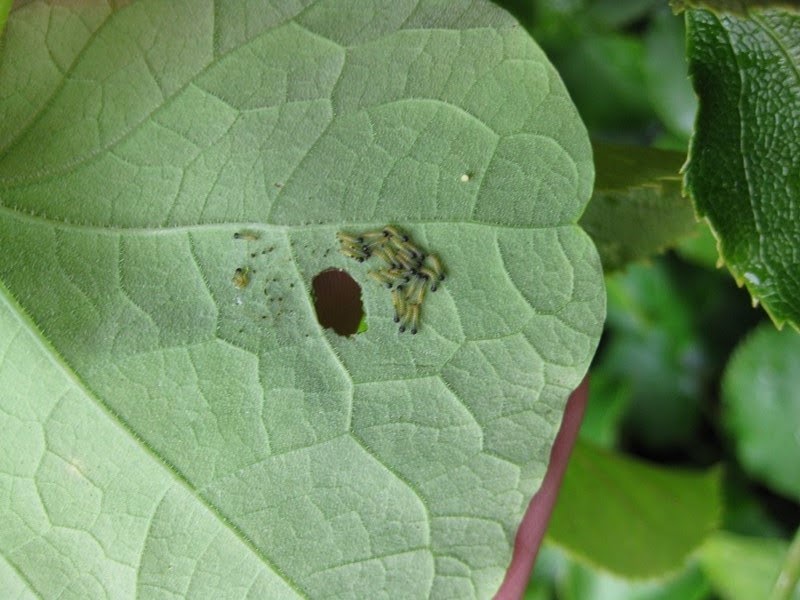
Within a couple of days the caterpillars had chewed a hole in the leaf and they all mad their way to the underside.

There they stayed for several days, not growing at all. This picture was taken on 23rd August.

Then a few days later they were all gone. I watched several batches of eggs and they all went through the same process and sadly the caterpillars all appeared to die. Similarly, the Small White eggs hatched, but the caterpillars didn't grow. I can only assume that the weather was just too cold for them to develop.

Earlier in the year I noticed that a Garlic Mustard plant I had planted in a pot had some Large White caterpillars on it. I had planted this in the hope that a passing Orange Tip, Anthocharis cardamines, would lay an egg on it, but I was happy enough to have these caterpillars instead.

The caterpillars grew quickly, but one day I thought they were behaving a little strangely. They had all climbed to the top of the seed heads. I wondered if they were looking for food, so moved a couple of them onto fresh leaves, but they just crawled back up to the seed heads.

The following day when I returned home from work I was horrified to find that the caterpillars had all been parasitised. The next picture is a little gory. It shows the pupae of a parasitic wasp. The adult must have laid eggs in the caterpillars when they were much smaller and the wasp larvae had been living inside the caterpillars all of the time I had been watching them. They appeared to be quite healthy up until the day before the wasp larvae appeared.


I was concerned that the number of Large White butterflies may be low this year due to the lack of success of the caterpillars that I had seen. Happily I have already seen a couple of Large Whites this year, so hopefully they did better elsewhere.

What perils these caterpillars go though in their short lives. Hopefully they will have more success this year. I will keep my eyes on the plants in the garden and report any good news stories!

Monday, 6 April 2015

More Winter Butterflies

Three weeks ago the manager of a large local estate kindly lent me the keys for an old abandoned castle, after I had told him about the hibernating butterflies I had found around East Lothian. This is a magnificent building, now derelict, with parts of it dating from the 1400s.
I had a quick look in one of the outbuildings and found one Small Tortoiseshell, Aglais urticae, on the ceiling and, sadly, a lot of wings on the floor.
I had a little difficulty opening the door into the castle due to a build-up of debris from the local pigeons. I ended up climbing up through a window and clearing the ground behind the door to allow my friend to get in. Inside we were a little disappointed to find that there were very few rooms with roofs.
However, we noticed a room with a vaulted ceiling that looked very promising, but it was about ten feet above ground level.
I managed to borrow a ladder from a local business and climbed up into the room. 
At the far end, in a little nook, I found two Peacock butterflies, Aglais io, sheltering. Again, they were away from any direct light and sheltered from the wind. I found another behind some old lime mortar that was pealing away from the wall.
We were left a little intrigued, as there is a garden centre close by where there are hundreds of butterflies seen in the summer. Then I had a look up a tall chimney and saw eight or ten Peacock butterflies in the section I could see. There were probably more further up, out of sight.
We then found the perfect place, but unfortunately we couldn't get into the room to have a look. It was a basement directly below the room with the vaulted ceiling. There was a small window opening with a shaft down into the room. I could see another room off the main room, which would be the ideal place for butterflies to hibernate. The door into this basement also had debris built up behind it and I didn't want to risk breaking the door, trying to open it. At least I think I know where the butterflies were all hibernating!

We have had two beautiful days in a row now, so all of the butterflies are wide awake. I walked my transect for the first time today and I was delighted to see two Commas, Polygonia c-album, six Peacocks and six Small Tortoiseshells. Those are the three species that over-winter as adults here. I didn't manage to find any hibernating Commas, so that will be next winters mission!

In a coupe of weeks I should be seeing the first white butterflies and that is when I consider the season has really started!


Tuesday, 10 March 2015

Hibernating Butterflies

Inspired by my visit to Inchkeith island to look for over-wintering butterflies last November, I have been occupying myself this winter looking for hibernating butterflies here in East Lothian.

I started by looking in a local ruined castle. It has an underground chamber, which I thought could be perfect for butterflies to shelter in for the winter. I didn't find any in the main chamber, but the tunnel leading into it had two Peacock butterflies, Aglais io, in it, just behind this arch:

I think there was too much light in the main chamber, but the tunnel was very dark.

After that a friend and I were given permission to have a look around the buildings on a large estate near the coast. We checked out some of the buildings, including the boathouse and curling house, but they were both too light. Unfortunately, the most likely buildings, including an ice house were locked up. However, we found an old stone shed in the walled garden and sneaked a look around the door. There in the rafters we spotted several Peacock butterflies. Unfortunately, my camera couldn't focus on them in the dark. We think there were at least 18 in this group and there were two other smaller clusters.

On another occasion I checked out the old bread oven in another castle.

Initially, I thought there was nothing there, but then I noticed a Small Tortoiseshell, Aglais urticae, in the crack between two stones.

It wasn't until I was looking at my pictures that I noticed that what I thought was one butterfly turned out to be two roosting next to each other. These two are perilously close to a spider's nest.

There were 16 butterflies bin total scattered around the oven. I found it interesting that the first two locations had only Peacock butterflies and this castle had only Small Tortoiseshells.

At work, I met an archaeologist and I mentioned to him what I had found and asked him if there were any other old buildings he could recommend. He suggested a ruined house on the coast that had an old bread oven in the cellar.

Sure enough when we looked inside the bread oven there were some Peacock butterflies.

Some of them were rather worn, showing the colour of the upper side of their wings. We found eleven Peacocks there. At each of these locations I also spotted Herald moths and mosquitoes sharing the winter accommodation.

I rent an old barn on a nearby farm where I keep a couple of old cars and our log supply. Last weekend I was collecting some logs when I noticed some butterfly wings on the floor. The more I looked the more I found. I counted over 100 individual wings, which would mean at least 25 butterflies. Most of the wings were from Small Tortoiseshells, but there were about ten Peacock wings, too.

A couple of years ago we stapled some thick polythene sheeting across the rafters to stop pigeons roosting there. This must have created a nice dark space for butterflies to hibernate. Unfortunately, I guess it is also home to several spiders, which have been enjoying a good feed. I hope that a good number of butterflies have managed to make it through the winter and will soon be flying around the farm.

Last week I received my first 2015 record of a butterfly flying in East Lothian. I am excited to think that I will soon be seeing butterflies again. But, strangely, I am looking forward to next winter now that I know the sorts of places to look for hibernating butterflies!

Tuesday, 17 February 2015

Speckled Wood, Pararge aegeria, in East Lothian 2009 - 2014


I have mentioned in previous posts the remarkable expansion in the range of the Speckled Wood butterfly, Pararge aegeria. I have recently been going through the records and mapping where they have been recorded in East Lothian in the last few years.

Up until 2009 we had no records of them occurring here, but a colleague spotted one right at the eastern boundary of East Lothian in May 2009 and two months later another was seen about 12 kilometres away at John Muir Country Park.

In 2010 I only received one record of Speckled Wood at Tyninghame Bridge in August.

In May 2011 I found a pair of Speckled Woods in John Muir Country Park and subsequent visits in June and September found them at exactly the same spot. They were also seen in various other locations within the park. That year we also received records from Innerwick and at Yellowcraig about another 12 kilometres west.

Despite the poor summer of 2012 I still received a number of records of Speckled Woods. They continued to be seen at JMCP and one was seen on two occasions in a small woodland close to Traprain Law. Most exciting were a number of records received from the Aberlady area, another large leap away.

2013 was a fantastic year for butterflies and Speckled Woods seemed to do as well, if not better than most species. They spread for six or seven kilometres up the River Tyne from JMCP and continued to do very well in the woodland around Aberlady, spreading westwards along the coast to Port Seton. They also seemed to be spreading along the woodland on the Longniddry to Haddington Railway Walk towards Haddington. Late in the season, records were received from Skateraw and Thorntonloch, nicely filling in a gap on the east coast and in November a record was received from the coast on the west of the county, showing that they had spread the length of the East Lothian coast in five years!

In 2014 Speckled Woods continued to expand their range, following the River Tyne up to Haddington and moving inland towards Gifford and Saltoun Woods. In late summer they became the most numerous butterfly seen in many parts of East Lothian, and on 10th September I saw over 400 in a wood near Aberlady.

The increase in Speckled Wood records again last year must have been partly attributable to more people looking for them and sending records in, but I think we have still built up a pretty good indication of how the species has spread over this time. The rate of spread of the species seems quite remarkable and it is difficult to understand why Speckled Woods are extending their range at such a rate. It is easy to label this as another consequence of climate change, but since 2009 we have experienced two of the coldest winters in recent history and the wettest summer on record!
I am really looking forward to seeing if Speckled Woods spread to the remaining areas of East Lothian this year.

Friday, 2 January 2015

East Lothian Butterflies 2014

The winter of 2013/14 was the mildest I can remember. For the first time in my lifetime we didn't have any snow here and the Geraniums in our window boxes survived the winter because of the lack of a serious frost. Whether this was beneficial to the butterflies is difficult to determine.
We had a reasonably good spring and the early months of summer were warm and sunny. However, August and September were much cooler than normal and rather grey. This, I think, did have an impact on the butterflies.
Our first frost was at the beginning of October, but winter didn't really arrive until the beginning of December.
2014 was the best year I can remember for butterflies in East Lothian. Many species were seen in much higher numbers than normal. Two new species were recorded here and other species expanded their range.

Small Tortoiseshell, Aglais urticae
The first butterfly recorded in East Lothian in 2014 was a Small Tortoiseshell that I found on the pavement near where I work on 28th February. I picked it up and put it on a flower in the sun! Small Tortoiseshells continued to be recorded in good numbers through to 10th November.
Small Tortoiseshell


Peacock, Aglais io
The first East Lothian Peacock was seen on 6th March. They did very well this year with the adults being recorded through to early June. Then in the third week in July the new generation emerged and an enormous number of Peacocks were recorded throughout East Lothian. Their number reduced quite rapidly, probably not helped by the cool weather in the second half of the summer. The last records of butterflies I received in 2014 were both Peacocks flying on 30th November.
Peacock


Comma, Polygonia c-album
The first Comma was recorded here on 11th March and they went on to do very well this year. They were first recorded in East Lothian in 2004, but normally only one or two are seen at a time. In 2014 they were seen regularly and in July when the second generation appeared they did particularly well. On one occasion I saw six on the Buddleia in my garden.
Comma


Small White, Pieris rapae
The first record of a Small White this year was on 5th April. The great thing about having so many people contributing sightings is that we could see a clear division between the spring generation and the summer generation. The spring Small Whites were seen until the middle of June. The summer generation started to appear in the middle of July and continued through to 26th September.

Green-veined White, Pieris napi
The first record of a Green-veined White was on my transect on 11th April. Green-veined Whites are very common here and this year was particularly good for them. The two generations follow a very similar pattern to the Small White.
Green-veined White


Orange Tip, Anthocharis cardamines
The first Orange Tip seen this year was on 14th May. Thereafter they were seen in good numbers until the end of May. I was pleased to see that they had recovered after a poor year in 2013, which was a knock-on from the flooding we had in 2012.
Orange Tip


Large White, Pieris brassicae
The first Large White was seen on 18th April. Generally we don’t see Large Whites in great numbers here, however in 2014 they were seen in good numbers. The summer 2013 generation was higher than normal and I remember seeing a lot of caterpillars later in the year. However, the caterpillars that hatched in 2014 may not have done so well. Those that hatched in August on the Nasturtiums in our garden perished in the cooler than normal weather. It will be interesting to see how many Large White butterflies emerge in 2015.
Large White


Speckled Wood, Pararge aegeria
Speckled Woods were first recorded in East Lothian in 2009. Since then they have spread across much of East Lothian. 2014 saw them continue to expand their range along the River Tyne to Haddington, right along the coast and further inland. If they continue like this they will be found all over East Lothian in 2015. The first record of a Speckled Wood this year was on 20th April and they were seen through to 18th October. In one small woodland near Aberlady they were seen in their hundreds, quite unlike anything I have seen before anywhere.
Speckled Wood


Painted Lady, Vanessa cardui
The first Painted Lady was recorded on 4th May. There were a few more records throughout the year, but they didn't reach East Lothian in any great quantity. I imagine the wet summer in Europe didn't help, as these butterflies migrate, through a few generations, from north Africa.

Small Copper, Lyceana phlaeas
The first Small Copper this year was recorded on 6th May. They continued to do well, being seen in good numbers through to the 2nd October.
Small Copper


Red Admiral, Vanessa atalanta
The first Red Admiral we saw this year was on May 8th. This was a particularly good year for them, particularly once the second generation started to appear in August. They were seen until the 29th November.

Wall Brown, Lamiommata megera
Wall Browns were first recorded in East Lothian in 2010. They have continued to spread slowly along the coast and to a couple of inland sites. The first Wall Brown this year was recorded on 9th May and they were seen through to 5th September. On 21st May I saw a male Wall Brown near Haddington, a long way from any other colonies. Despite checking the area regularly for the next few weeks I didn't see any more in that area.

Small Heath, Coenonympha pamphilus
The first Small Heath was recorded on 21st May. It is a common butterfly along the coast in East Lothian and it is also found in the Lammermuir Hills. This year they appeared to do exceptionally well.
Small Heath


Green Hairstreak, Callophrys rubi
On 30th May a Green Hairstreak was reported to me just outside East Lothian. The following day I found some, again within feet of the East Lothian border. However, as butterfly records still use the old Vice County areas both of these records turned out to be East Lothian records. There are old records of Green Hairstreak in other areas in East Lothian, but despite looking for them, I have never seen them there. Now I know what habitats they like I will need to spend some time looking for them this year.
Green Hairstreak


Common Blue, Polyommatus icarus
The first Common Blue was recorded on 1st June. They did really well this year and were seen in good numbers. They were seen through to 19th August.
Common Blue


Northern Brown Argus, Aricia artaxerxes
There are only four colonies of Northern Brown Argus in East Lothian that I am aware of. Three of them are very small, only a few feet across. The first record of a Northern Brown Argus was on 11th June. They did really well this year, with good numbers being seen at the main site. The other sites are perilously clinging on, but work is being done to try to ensure their future survival.
Northern Brown Argus


Ringlet, Aphantopus hyperantus
Ringlets bounced back in 2014 after a poor previous year. They were first recorded on 14th June and continued in very good numbers until 9th August, which is very late here.

Grayling, Hipparchia semele
Graylings appear to only occur at three sites in East Lothian. Unfortunately one of these sites is earmarked for development, so may soon be lost. 2014 was a good year for Grayling. The first record was on 16th June and they were seen through to 24th July.

Meadow Brown, Maniola jurtina
The first Meadow Brown was seen on 16th June. Again, they did really well, being seen in good numbers right through to the end of August. I also saw a very ragged individual on 5th September.

Dark Green Fritillary, Argynnis aglaja
Dark Green Fritillaries are never seen in great numbers here. They mainly occur along the coast and in the Lammermuir Hills. The first record for 2014 was on 16th June. Numbers on the coast were about average, but they seemed to do well in the Lammermuirs.

Large Skipper, Ochlodes sylvanus
The most exciting news this year was the arrival of Large Skippers into East Lothian. They have been expanding their range in the Scottish Borders for a number of years and in June they were found just over the border within sight of East Lothian. Despite searching suitable sites on our side of the border we weren't able to find any here. However, on 19th June I received a report that one had been found a couple of miles inside East Lothian. Six days later I was walking along a road verge and spotted one right in front of me. This is the same area that Wall Browns and Speckled Woods first entered East Lothian, so I am looking forward to hearing about Large Skippers working their way along the coast.
Large Skipper


Small Skipper, Thymelicus sylvestris
Small Skippers were first seen in East Lothian in 2011 at Aberlady. A couple more were seen in 2012 and in 2013 they had increased considerably. In 2014 they not only increased in numbers again, but they were also seen at a number of sites, quite far apart. They seem to have spread right along the coast to Levenhall and were found at a couple of inland sites. They were seen between 30th June and 5th August.
Small Skipper


Small Pearl-bordered Fritillary, Boloria selene
I found Small Pearl-bordered Fritillaries for the first time in East Lothian last year. As far as I am aware they only occur at one site. They were seen there again this year on 11th July and again a few days later.

So, 2014 was another great year for butterflies in East Lothian. Two more new species were recorded and I wonder how long we can continue to find new species here! The sad news was that I didn't receive any reports of Holly Blue this year. It would be sad if they have died out here, having been seen at a few sites in 2012.

Now that I am receiving records from the Ranger Service and about 15 volunteers, we are beginning to build up a really good picture of how butterflies are doing here. There is a lot to look forward to in 2015. It will be interesting to see if Large Skippers increase in numbers or extend further into East Lothian. Now that I know what sort of habitat Green Hairstreaks like I am going to check out some of the areas where they used to occur. I wonder if there will be any more new species this year!

Tuesday, 16 December 2014

Northern Brown Argus - Aricia artaxerxes

I have just been sorting through some pictures from earlier in the year. It seems appropriate, when we are only a few days away from the shortest day, to put up some pictures I took a couple of days before the longest day this summer. These are some lovely little Northern Brown Argus - Aricia artaxerxes which I saw in the Lammermuir Hills in June. It is great to think that in five days time the days will gradually start getting longer again!


Tuesday, 4 November 2014

November Butterflies

I had a very interesting day on Saturday, when I was invited to join a group counting Grey Seal pups on the islands of Inchkeith and Inchmickery in the Firth of Forth. The reason I was there was to identify butterflies that they had seen hibernating in old underground military buildings in previous years. Both islands have a long history of military defense, but I hadn't realised that they are almost entirely covered in old military buildings of various ages.


Last year the group had noticed large "clumps" of butterflies on the walls and ceilings of some of the rooms. This year they were very disappointed that we only saw one or two butterflies at a time. However, I found it all very interesting.

We found a total of 77 Small Tortoiseshells, Aglais urticae, and 7 Peacocks, Aglais io,  on Inchkeith and two more Small Tortoiseshells flew past us while we were looking at the seals.
Small Tortoiseshell
Peacock
These were the two species that I thought we would find, but I also wondered if we would have found a Comma, as they have done so well this year. I also wondered if any Red Admirals or Painted Ladies would have tried to tough it out here, rather than migrating south for the winter.
There are seven Small Tortoiseshells in this picture along with a Herald moth.
The butterflies seemed to be quite specific about their requirements, only being found in the underground buildings. There were none in the tunnels or rooms with direct access to the outdoors. They were all in rooms that had just the slightest hint of daylight and no perceivable movement of air. When we searched rooms that were further underground we found nothing. So it seems that they had found locations with a nice steady temperature, but where they would be able to perceive the arrival of spring. I wondered how the butterflies had found these locations. Had they flown over to the island specifically to hibernate, or were they already resident there?

 
Mother Grey Seal keeping an eye on us.
The pups were pretty sweet!
Relaxed!
The buildings on Inchmickery were all above ground and didn't appear to have any butterflies at all.
Inchmickery
I would love to return another year and see if there are more butterflies. This year we had a cooler than normal August and September and a milder than usual October. This may have upset the normal behaviour of the butterflies. Had August and September been nearer their normal temperatures and the weather then quickly cooled in October, possibly more butterflies would have found their way into these buildings.
We were honored with a flypast of Pink-footed Geese.
I now need to find similar locations on the mainland to see if butterflies are hibernating there. The islands will remain a little warmer over the winter than further in land, but the butterflies will have to hibernate somewhere.
It seems that the more I learn about butterflies, the more questions I have!

Followers