I am no expert photographer, preferring to capture the moment than get a perfectly composed shot. The pictures on my blog are either taken with a compact Canon, a Panasonic Lumix FZ150 or on my phone.


Monday, 16 June 2014

Garden Moth Trap

I have been having fun with the moth trap that I have been lent to help determine what moths occur in this part of Scotland.

I have set it running six times in the last two months and it is interesting to see the different species that seem to occur each time.

The first time I tried it was on the 5th April and I only caught three moths, all the same species, the Hebrew Character, Orthosia gothica.
Hebrew Character

Three weeks later we had appropriate weather to use the trap again. This time I caught three species, a Hebrew Character, and two new species, a Common Quaker, Orthosia cerasi, and a very similar-looking Small Quaker, Orthosia cruda. 
Common Quaker
After another three weeks, I tried again on 19th May and I caught nine species. All of them brown, but at least slightly different browns!
Lunar Thorn, Selenia lunularia

Small Phoenix, Ecliptopera silaceata

Now I was starting to get more excited!

The next time I put the trap out was on 27th April and this time I caught 11 species, and seven of them were new. There were also some really exciting species among them. I had put the trap down by the house, which is painted white, and I think the reflected light helped to attract more moths. Some of them were on the wall of the house in the morning.

I love these White Ermines, Spilosoma lubricipeda

These Poplar Hawkmoths, Laothoe populi, are enormous. They are at least three inches across. I have never seen one of these flying around or attracted to a light, so I was surprised to find two in the trap.

As well as these, I saw a lovely Brimstone Moth. These are a lovely yellow, but sadly it flew away before I could take a photograph.

On the 9th of June I only caught eight species, but there were some interesting moths among them.
I love the mottled pattern on this little Foxglove Pug, Eupithecia pulchellata.

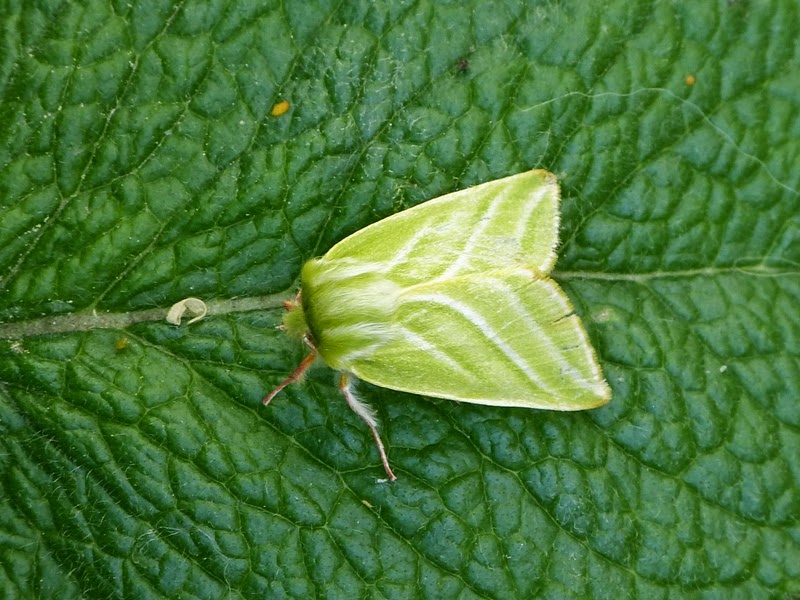
Green Silver-lines, Pseudoips prasinana.
The moth trap runs off mains electricity, but I was also given a battery and adapter, so that I can take it out into the countryside to see what I can catch there. Last week I thought I should try it out in the garden running off the battery to make sure it worked. This time I caught seven different species. I am not sure if this was because the light wasn't quite so bright, or if it was because there was quite a lot of rain in the night. However, there were five new species for me among them.
Bordered White, Bapalus piniaria.

Elephant Hawkmoth, Deilephila elpenor.
Once I have photographed each moth and noted them down I put them somewhere safe, so that the next evening they can fly off and live their lives unscathed. I have noticed that some of the garden birds have been taking an interest in what I am up to, so I am taking extra care to make sure the moths are hidden away from them!

Each time I put the trap out I have caught some new species and so far it has been quite a gentle learning curve. I can't take credit for being able to identify them all, and I regularly send pictures to Mark, who lent me the trap, for him to help me with the identification.

On Saturday evening I took the moth trap to a local farm where the farmer has a great interest in wildlife. He has planted hedges, dug ponds, improved woodlands, put up bird boxes and left a grassy margin around each field, all to benefit the local birds and other wildlife. I will have to leave what I caught until my next post.


Thursday, 12 June 2014

Vice County Maps

I learnt something new last week after I had found the Green Hairstreak butterflies that I mentioned in my previous post. Given that I have been co-ordinating the butterfly records in East Lothian for a few years now, it is something that I really should have known!
I have always used the current boundary of East Lothian to differentiate between East Lothian records and records from outwith East Lothian.
However, I was informed that biological records use the Vice County areas. This was a system that was devised in the 1870s by a botanist, dividing Britain into 113 roughly equal sized areas based on the old counties. These areas remain the same, despite more recent changes in county boundaries, so biological records are measured consistently.

Vice County 82 - East Lothian

The current boundary for East Lothian
If you compare the maps above you will see that using the Vice County area we lose Musselburgh on the west, but we gain a little spur to the south west and we also gain the bite that is missing on the current south east border.
Linn Dean Nature Reserve, where I saw the Green Hairstreak butterflies, is in the spur to the south west. I can't believe my good luck!!

Sunday, 1 June 2014

Green Hairstreak - Callophrys rubi

I am not really sure how I feel about wind farms. I don't like the look of them, particularly as the few that were built are expanding and starting to merge together. On the other hand, it must be good to generate electricity without releasing carbon or producing toxic byproducts.

Actually, it is the large tracks that are cut into the landscape that worry me more than the turbines. Much of the area I was walking in today is very wet, but where the tracks have been created, there is a large ditch either side, allowing the water to drain off the hills. The hills used to act like a large reservoir of water, but now no sooner than it rains, the water runs off sometimes causing flooding downstream.

Today I went in search of Green Hairstreaks, Callophrys rubi, close to a large wind farm in the Lammermuir Hills.


I had been told of the location of some recent sightings of this butterfly, and many of them were tantalizingly close to the East Lothian border. I plotted the locations onto a map and there was a row of dots just a few metres outside East Lothian's boundary looking as though they were just about to mount an attack!

Up here the Green Hairstreak caterpillar food plant is Blaeberry, or Bilberry, Vaccinium myrtillus. I had been advised to look for boggy areas with tussocks of Blaeberry and the sightings that I had plotted all appeared to be close to Spruce plantations.

It was difficult to get through the boggy ground from the wind farm tracks to the areas I wanted to check out. I ended up taking quite a detour, and as I was getting close to a Spruce woodland I thought I would check the blaeberries growing close by. To my delight I saw a small green butterfly flying into the air in front of me. It was soon being chased by another. These were the first Green Hairstreaks I had seen in Britain!


I walked along a small valley to where I had been told that other Green Hairstreaks had been seen and I was delighted to see several more.


The reason that no Green Hairstreaks had been seen in East Lothian became apparent when I looked over the fence and saw that the farmer on the other side had improved his grazing, and instead of bog there was rough grassland. I searched all around the woodlands, but there was no sign of any Blaeberry and consequently no sign of any Green Hairstreaks on the East Lothian side of the boundary.

I then followed a stream all the way to a local nature reserve to see if there was any suitable habitat there. On my way down the stream, I was stopped in my tracks when I saw a Green Hairstreak on a leaf in front of me. I was very excited, as I thought this was my first East Lothian record, but then realised that I had jumped over the stream to get past some rocks and I was actually back on the other side of the border!


The butterfly was just below the centre of the picture above. On the right hand side of the stream is East Lothian, and on the left is Midlothian. You can see how close this was to being an East Lothian record!!

Although this didn't seem to be the right sort of habitat for a Green Hairstreak, I climbed up the slope and found Blaeberries growing.

I spent some time searching the slopes on the East Lothian side and found a few patches of Blaeberry growing, but sadly no Green Hairstreaks. At least I know the sort of habitat that I need to be looking for, so the search will go on!


Tuesday, 6 May 2014

Orange Tips

Sorry to be a bit repetitive, but I have been having fun photographing my favourite butterfly! The weather has been cool and cloudy with occasional sunny spells, which is makes photographing Orange Tips so much easier!


The pattern on the underside of their wings blends in beautifully with the flowers of one of their favourite food plants - Garlic Mustard.


I have shown pictures of eggs, caterpillars and a chrysalis of the Orange Tip in a previous post.


Friday, 25 April 2014

The start of the butterfly season


I chose a good week to take off work last week! The weather was sunny and although not particularly warm, it was enough to tempt a few butterflies out of hibernation and cause a few others to venture out of their chrysalises! I made the most of the weather and took the dogs out for walks several times each day as an excuse to look for butterflies!
Quite a number of the hedges around the fields here are Blackthorn, Prunus spinosa. They have white flowers at this time of year, but I have never seen them flower so profusely.
The black berries are used to flavour Sloe Gin, so it looks like we should have a good crop later in the year!
The Cherry trees are also flowering well this year.
Spring wouldn't be spring without Primroses, Primula vulgaris. They have been flowering for a few weeks now, so are a little past their best.
I came across a fair bit of wildlife while I was out and about. Brown Hares are not as common as they were a few years ago, but I bumped into quite a few last week. Luckily they spotted us before the dogs spotted them and they slipped off safely. I was very surprised to come almost face to face with a Fox on a local shooting estate. This was the first Fox I have seen around here, as they have been almost eradicated to protect the Pheasants. This Roe Deer was one of a group of four I spotted while looking for butterflies. They didn't see me for quite some time, but I think this one heard my camera and they ran off shortly after I took the picture!

The flowers are alive with insects.  This lovely Carder Bumblebee, Bombus pascuorum, was on a Cuckoo Flower, Cardamine pratensis, in a meadow near where we live.
The three usual butterflies were all out in force. The Peacock, Aglais io, the Small Tortoiseshell, Aglais urticae, and the Comma, Polygonia c-album, all over-winter as adults, hibernating in wood piles, hollow trees and in sheds. They start to appear in March on warm days and by April they are regularly seen.
Peacock
Small Tortoiseshell


Comma

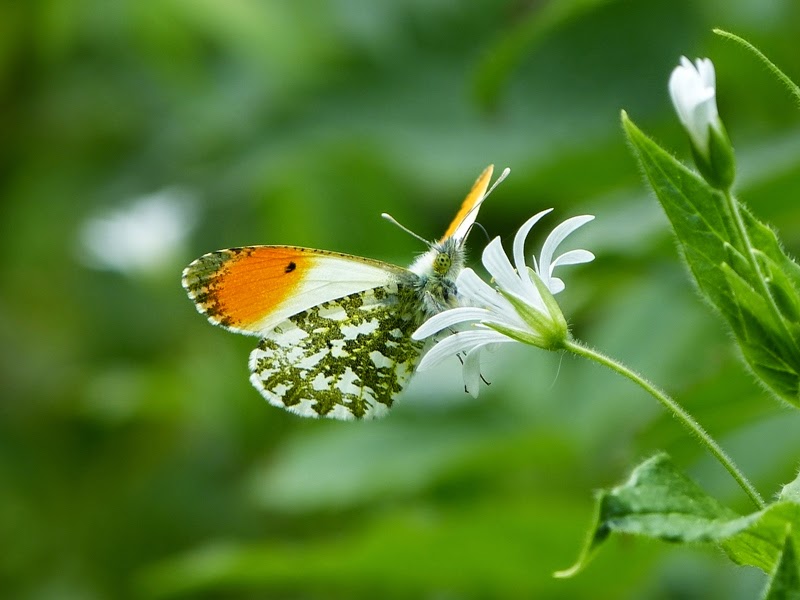
My favourite local butterfly is the Orange Tip, Anthocharis cardamines. Not only do I love their colours, but for me they signify the start of the butterfly season. As with the other three white species found here, they spend the winter as a chrysalis. However, unlike the other three species of whites, they only have one generation a year, so are only seen for about six weeks.
I have real problems getting good pictures of them, and I am never satisfied. They are very fickle and will only fly or open their wings when the sun is shining. The white areas on their wings reflect the sunlight causing quite a glare. Almost as soon as the sun goes behind a cloud, they will close their wings. I have found that the best option is to find one feeding and wait for the sun to go behind a cloud, and quickly get a picture before they close their wings! This isn't easy as the males tend to fly up and down paths and river banks looking for females.
When their wings are closed they are very well camouflaged.
The female Orange Tip lacks the orange tips!


I am sorry to have put on so many pictures, but I can't resist these butterflies! 
This week the weather has returned to grey and cloudy, so unusually I took my leave on the right week!

Saturday, 12 April 2014

All the right signs

The weather here has been a little disappointing recently. Nothing unusual, but I am always impatient at this time of year, because as soon as it warms up I know we will see more butterflies.
The Butterfly Transect Surveys are meant to start the first week of April, but we haven't had good enough weather here yet to make a start. Today I walked my transect route, just in case there were any butterflies there, but I didn't hold out any hope as it was quite cloudy and there was a cold wind at lunch time when I could get out of the office to do it.
Things started off reasonably well with bumble bees feeding in the willow trees. I think this one is a Buff-tailed Bumblebee.

A little later I saw my first Red-tailed Bumblebee of the year.

The clouds kept breaking, revealing large blue patches of sky. As I reached the river I saw a flash of blue as a Kingfisher flew past me. A little further upstream a Heron was looking splendid with its plumage blowing in the wind.

Ladybirds seem to have survived the mild winter in great numbers. The foliage next to the river was littered in them.

As I climbed the fence into a meadow a Peacock butterfly, Aglais io, flew up in front of me. These butterflies over-winter as adults, hibernating in sheds or log piles.  This one seems to have come through the winter in lovely condition.

I noticed some Sand Martins flying over the river. They have spent the winter in Africa, but they spend the summer over here, breeding in sandy river banks. Their arrival is always a sign that the weather is about to improve. As I watched them flying low over the river, catching flies, I noticed that there was a Swallow amongst them. It briefly stopped on a dead tree for a rest.

While I was watching them I heard the squawk of a buzzard and I looked up to see it flying overhead.

Shortly afterwards some grey clouds blew over and I thought that I had no chance of seeing any more butterflies. However, all the signs are there that the weather is about to improve and I shouldn't have too long to wait.

As it turned out, I only had to wait about ten minutes! On my way back to the office I saw a white butterfly flying along the edge of the meadow. I followed it for a while until it stopped, allowing me to identify it. It was a Green-veined White, Pieris napi. The first one I have seen this year. It would have spent the winter as a chrysalis and probably only emerged today.


There were plenty of signs that the weather may be about to improve, so I hope it won't be long until I see several more new species of butterflies for the year.

Saturday, 5 April 2014

Moth Trap

I was recently contacted by a moth enthusiast who told me that Butterfly Conservation is undertaking a project to produce an Atlas of moth distribution. They have produced an excellent Butterfly Atlas, which incorporates records from enthusiasts around the UK, and this will follow a similar format. I have therefore been lent this moth trap so that I can help with records from this area.


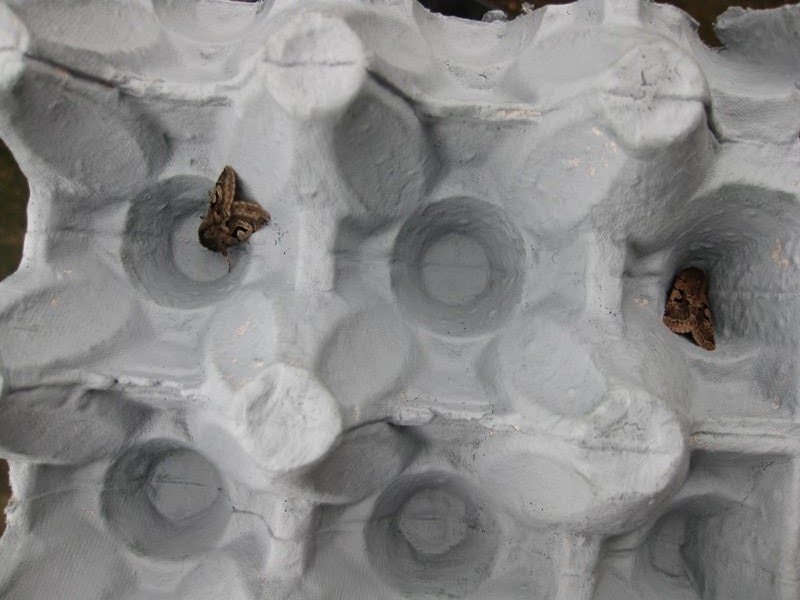
It is an ingenious home-made device. It is left out over-night. The light attracts the moths and then bounce off it and fall through the funnel-shaped lid. Inside the trap are sections of egg crate and the moths settle down for the night amongst them. In the morning it is just a case of lifting off the lid and checking for moths in the egg crates.

I set the trap up last night for the first time. I wasn't very hopeful, as it was only 5.8 degrees, but this morning I could see one moth through the lid. As I checked through the sections of egg crate I found that I had caught nine moths. They were all Hebrew Characters, Orthosia gothica.


Once identified, I put the moths in a shed, where they would be safe from the garden birds that were showing an interest in what I was doing! 

They may not be as colourful as a butterfly, but I can see that I could get quite hooked on trapping moths. At least it will keep me occupied until the weather warms up enough for the butterflies to start appearing.

Followers