I am no expert photographer, preferring to capture the moment than get a perfectly composed shot. The pictures on my blog are either taken with a compact Canon, a Panasonic Lumix FZ150 or on my phone.


Thursday, 28 March 2013

Small Tortoiseshell - Aglais urticae

Almost every year the first butterfly I see is a Small Tortoiseshell, Aglais urticae. This year I saw one on the 2nd March, and I thought that it was going to be a good start to the butterfly season, but the weather turned for the worst the next day. Temperatures haven't been much above freezing since, and we have had snow showers for the last 12 days in a row! The forecast doesn't look as though things are going to change for the foreseeable future. At least the weather has given me a chance to sort through some of my old photographs.


The Small Tortoiseshell was once one of the most commonly seen butterflies in the UK. It can be seen almost anywhere in the British Isles at almost any time of the year. Typically there are two broods. The butterflies that we see at this time of year emerged around about September the previous summer. After the adult butterflies emerge they feed up before finding themselves a dry spot, such as a shed or log pile to hibernate. During mild, sunny days over the winter the butterfly may be seen flying around. This can be a little risky, as there is unlikely to be a nectar source available and the butterfly will needlessly be using up energy.

It is more normal for the adults to start appearing in late March, when there are spring flowers available for them to feed on. These butterflies will go on to lay eggs in May, which will turn into the next generation of butterflies around about July. The July adults pair up very quickly and go on to produce the generation that overwinters. So, the summer brood has a lifespan of about three months while the winter brood has a lifespan of about nine months.


Two summers ago, I was walking our dog along a local farm track and I noticed this female Small Tortoiseshell behaving a little strangely. I watched for a while and realised that she was laying eggs on some nettles alongside the track.


It took her over half an hour to lay this batch of eggs.


I kept an eye on the eggs for the next few days. The weather turned cool and wet and it took the eggs eighteen days before they hatched. I am sure that they would not take as long in warmer weather.


The day after they hatched I went away for a few days and on my return there was no sign of the caterpillars. Sadly, I think they must have perished due to the poor weather.

I regularly see Small Tortoiseshell caterpillars on the nettles along that track. They aren't difficult to spot, as after they hatch they build a communal web towards the top of the nettle plant. The butterflies remain as a mass as they move around the nettles leaving a trail of eaten leaves and droppings.
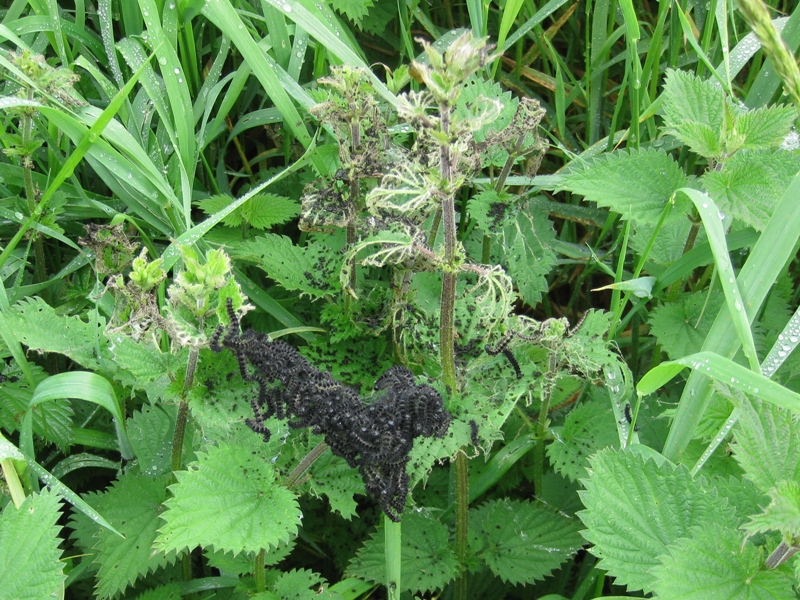

The caterpillars are black with yellow stripes and covered in spines.


When they reach the final instar the caterpillars have more obvious yellow stripes and they become solitary.

I found the following three prints today and scanned them. They were taken in 2001 when I was working as a Countryside Ranger at John Muir Country Park, near Dunbar, Scotland. I have checked my notes and notice that I spotted the freshly hatched caterpillars and 21 days later they turned into chrysalises. It was interesting that most of the chrysalises were a beautiful shimmering gold, but there were a few dark brown ones, too. Most of them were attached to the stems and leaves of the nettles close to where they had been feeding, but others had climbed a close by shed and formed chrysalises under the eaves of the roof.


I noted that after 18 days the adult butterflies eclosed.

I said at the beginning that the Small Tortoiseshell was once a very familiar butterfly here in the UK. Unfortunately its numbers have been declining in recent years. It isn't known for sure what is causing this, but the best theory is that climate change has allowed the parasitic fly, Sturmia bella, to expand its range into the UK. This fly lays its eggs on the nettle leaves that the butterflies are feeding on. The eggs are ingested by the caterpillars and the larva of the flies slowly consume their hosts. It seems that the biggest impact on Small Tortoiseshell numbers has been in southern England and here in Scotland the population is remaining stable.


Hopefully this cold weather will soon come to an end and I'll be seeing Small Tortoiseshells and other butterflies out and about.

Friday, 1 March 2013

Butterfly World Chrysalises

Of great interest to me on our recent visit to Butterfly and Insect World was an area where they had rows of chrysalises on canes waiting to eclose or emerge. Unfortunately, there were no names on the canes, but there were a couple of freshly eclosed butterflies and there were a couple that I managed to identify afterwards from the internet. However, there are still a few I can't identify. If anyone can, I would be grateful to hear from them!


There was such an amazing array of shapes and colours.

These are the chrysalises of the Tree Nymph, Idea leuconoe.

I had thought that these were the chrysalises of the Monarch, Danaus plexippus, but I am grateful to Kirsten from the Museum of Science and Industry in Tampa, Florida, for correcting me. (If you haven't seen their blog, I would highly recommend that you take a look - http://lepcurious.blogspot.co.uk/) Kirsten informs me that these are in fact the chrysalises of Queens, Danaus gilippus. These were about 20mm long. I love the row of golden dots around the top, just like a golden zipper! I had been concerned that out of 20, or so, chrysalises only two were green, with the others being a buff colour, but Kirsten assures me that this is normal for Queen chrysalises.

This Owl butterfly, Caligo memnon, had kindly just emerged, allowing me to identify the chrysalis!

Similarly this Cattleheart, Parides lysander, was still pumping up it wings.

Judging by the chrysalises above I thought that this was also a Cattleheart. Kirsten has suggested that this looks more like a Polydamas Swallowtail, but it is very difficult to be more specific than that as the chrysalises of that group of Swallowtails are so similar. I am sure that she is right, as this chrysalis was on a different stick from the Cattlehearts and looking again, I can see that it isn't the same.

And now for some chrysalises I can't identify. I have no idea what these are!

Or these! Kirsten has suggested the Giant Swallowtail, Papilio cresphontes.

This is a fantastic chrysalis, looking like a variegated leaf. I would love to know what butterfly it will turn into.

Here is a Blue Morpho, Morpho menelaus, eclosing, being closely watched by a Glasswing, Greta oto.

Here is a Goldrim, Battus polydamus, illustrating a bit of a concern that I have. The bamboo canes that the chrysalises are attached to are very smooth and difficult for any butterflies to grip onto. My son and I were looking at a Blue Morpho that had dropped to the ground while its wings were still soft. Luckily it found a rock to climb up to allow its wings to harden. While we watched it climb the rock this Goldrim dropped to the ground and its wings flopped over as it walked along the ground. I bent this fern leaf over and it immediately climbed up it, allowing its wings to straighten and dry out. I think that it would be good if they were to roughen up the canes with some sand paper before they stick the chrysalises on to give the butterflies something to grip onto.

I was also slightly concerned that the chrysalises were within easy reach and it would be easy for kids to poke them or any newly eclosed butterflies. I suppose this can't be a problem, or they would have changed how they display the chrysalises. Actually, the last time we visited Butterfly World the chrysalises were all behind glass, so it is a big improvement to be able to get a close look at them.

I find the whole process of caterpillars turning into chrysalises, then turning into butterflies really fascinating. For me, the range of chrysalises at Butterfly World was just as interesting as the butterflies themselves.

Sunday, 24 February 2013

Butterfly and Insect World, Edinburgh

SADLY BUTTERFLY WORLD EDINBURGH IS NOW CLOSED.

On Saturday my son and I visited Butterfly and Insect World, just outside Edinburgh. It is the perfect antidote to a cold February day after several months of butterfly-less-ness!!
The place isn't enormous, but there is plenty to see for the enthusiast or casual observer. As well as a large greenhouse, full of plants and ponds where the butterflies fly, there is also an area with reptiles, tarantulas and other insects.
You can buy a small Guide to Tropical Butterflies, but it doesn't cover all of the butterflies that can be seen there. I suppose the species that can be seen depend on the chrysalis available.
I have managed to identify most of those that I saw, but there are a few that remain a mystery to me. If anyone knows their names, or if I have made any identifications mistakes I would be pleased to hear from you.

A pair of Blue Morpho butterflies, Morpho menelaus. The upper side of their wings are an amazing blue colour, but of course you can only see that when they fly. One of these was roosting high in a palm tree and another was flying around it. I switched my camera to take a video and almost immediately the male landed and they started to mate.

This is a Banded Purplewing, Myscelia cyaniris, from Central America. Its wings had an amazing purple sheen, depending on how the light hit them. It would land, flick its wings open a couple of times and then close them to roost. The underside of the wings are a dull brown pattern.

This is a Cattleheart, Parides lysander, which is found in much of South America.

A Clipper, Parthenos sylvia, from South-east Asia.

I think this is a Doris Longwing, Laparus doris, from Central America.

This is the upper side of the Doris Longwing.

One of my favourite butterflies there was the Glasswing, Greta oto, which occurs from Mexico to Panama. There were quite a lot of them flying around the display.

This is a Goldrim, Battus polydamus, one of the butterflies I saw in St Lucia.

Thank you to Stiletto for identifying this butterfly for me. It is Hypolimnas bolina. I have a picture of the upper side further down this post, which looks completely different.

This is Hecale's Longwing, Heliconius hecale, from Central America.

This, I have discovered is a Jazzy Leafwing, Hypna clytemnestra. The upper side of the wings is mostly black, with a white band.

This is a female Low's Swallowtail, Papilio lowi, from the Philippines...

... and this is a male Low's Swallowtail.


One of my favourite of all butterflies is the Malachite, Siproeta stelenes, which occurs in Central and northern South America. I only saw one of these at the display and it seemed to like perching high in the vegetation.

Just before we left we saw a Monarch, Danaus plexippus. Whenever I have seen these in the wild I have always thought they were large butterflies, but in the company of the other butterflies here it seemed quite small!

A Postman, Heliconius erato, from northern South America.

A Purple Mort Bleu, Erphanis polyxena, from South America. These had lovely purple upper wings.

A Tiger Leafwing, Consul fabius, from South America.

The Tree Nymph, Idea leuconoe, from South East Asia. There were plenty of these drifting around Butterfly World.

This is the Variable Cracker, Hamadryas feronia, which occurs in the southern USA and northern South America. This one came down to feed on some bananas, but it normally rests flat against tree trunks.

Here are a few pictures from a previous visit.

This is a Common Mormon, Papilio polytes, from Asia.

And this is a Giant Orange Tip, Hebornia glaucippe, also from Asia.

This is a Palm Fly, Elymnias hypermenstra, from India.

This is a Pink Rose, Pachliopta kotzebuea, from the Philippines.

This is a Scarlet Swallowtail, Papilio rumanzovia, also from the Philippines.

This is a male Mimic, Hypolimnas bolina, which occurs in Africa, Asia and Australia.

I struggled to get sharp pictures of some of these exotic butterflies in the Scottish gloom! I was impressed with the number of different species on display. Initially when we arrived, I thought there were only ten or so species flying around, but the longer we stayed the more we spotted. There were other species that I didn't manage to photograph. I only saw one example of many species, but I am not sure if there were more hiding amongst the vegetation.

There were also a number of chrysalis on display waiting for future butterflies to emerge. I'll put some pictures in a separate post.

More information about Butterfly and Insect World can be found on their web site:
http://www.edinburgh-butterfly-world.co.uk/

Monday, 11 February 2013

Small Copper - Lycaena phlaeas

The Small Copper, Lycaena phlaeas, is a bright little butterfly that occurs over most of the UK and much of Europe. It also seems to occur in Asia, North Africa and North America where it is know as the American Copper. Here there are two generations a year, with the first butterflies being seen in May. This generation is seen until late June and then there is a bit of a lull until the second generation appears in late July/early August. The second generation seems to be far more numerous and Small Copper butterflies are still seen flying through until early October. 


Small Coppers aren't seen here in great numbers. The males are very territorial and will fly up and chase off any other insect that dares to fly too close. They usually then return to their favoured sunny spot, making they quite easy to photograph! 


Quite a large proportion of the Small Coppers seen in East Lothian have a number of blue scales on their hind wings. This is referred to as the aberration caeruleopunctata. However, sometimes there can be as few as one blue scale on each wing and other times there can be five distinct blue spots. I am not convinced that this is so much an aberration as just a slight variation!


The two main food plants for Small Copper caterpillars here are Docken, Rumex obtusifolius, and Sorrel, Rumex acetosa. Here is a female I saw laying eggs on Docken a couple of years ago. 

Two years ago, at the end of August, I saw a female laying eggs on some Sorrel at a restored open-cast coal mine. I noticed that a number of the Sorrel plants had Small Copper eggs on them, so I dug one of them up and planted it in a pot in my garden. 

The egg was less than a millimetre across. A few days later the egg had clearly hatched, but it was a few days before I managed to find the caterpillar, which was larger than I expected (about 4mm long). Over the next few weeks, I was surprised to see that it appeared to be larger on some days than others. It was a while before it dawned on me that there were actually two caterpillars in the pot!!


I kept an eye on them for the next few weeks, but when the cold weather arrived in December they completely disappeared. Despite searching the plant thoroughly I couldn't find them and I thought that they may have become a snack for the garden birds.
However, in March I was pleased to find two large caterpillars and a smaller one in the pot!! They must have over-wintered just under the surface of the soil.


They munched their way through the sorrel until they reached about 10 or 12mm and then they disappeared again at the end of April. I presume that they formed chrysalises in the crown of the plant or in the soil, but I wasn't able to find them. Possibly they had wandered off to pupate in another part of the garden.

Followers