A couple of days into our holiday to Cyprus I walked up the road towards Mavrokolympos Dam. I had been told that this road was a great place to see butterflies, but I had also been told that July was not a good time of year for butterflies in Cyprus.
I walked for about two kilometres, but there were
no butterflies along the side of the road, or along some small tracks leading
to the dried up river. So, I decided to drive up to the reservoir and walked along
its west side to the small river that feeds into it.

I was surprised that there were still very few butterflies, but in a small gully I found 11
Common Blues, Polyommatus icarus, all but one were males.

In the same area I saw a single Small White, Pieris rapae.

During the course of my walk I also saw a Wall Brown, Lasiommata megera, a Cyprus Meadow Brown, Maniola cypricola, a Mallow Skipper, Carcharodus alceae and another Pigmy Skipper, Gegenes pumilio.

I was surprised to see water running down the river into the reservoir. There were several species of fish swimming in the water including some that looked just like goldfish!
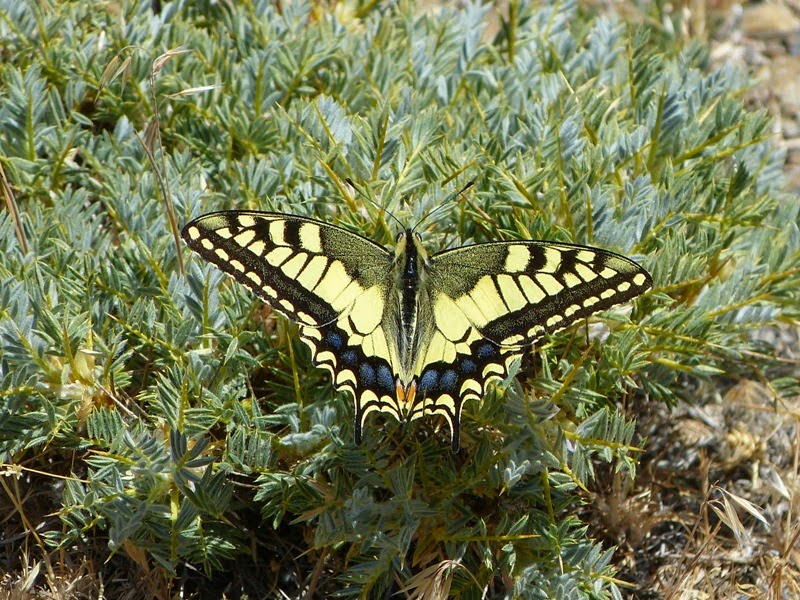
I searched the grass around the river for some time, thinking that it would be a good place for Dark Grass Blues, Zizeeria karsandra, which at that time I hadn't yet seen. Unfortunately, there were none there, but a Swallowtail, Papilio machaon, spent a long time feeding on the flowers of a shrub there.

There were also many different varieties of dragonflies and damselflies there, which I spent some time watching. By this time I realised that I had spent longer than planned here and I was due to buy some bread on my way back for lunch. I rushed back to the car and started driving down the road, only to discover that it had been closed to traffic! Three large boulders had been pushed across the road. I drove back up to the dam where there were two men surveying the dam wall. We all drove back to have a look at the road block and after many very animated phone calls the men told me that the road authority wanted money to open the road again!

One benefit of waiting there was that a Hermit, Chazara briseis larnacana, landed at the side of the road.

The underside was a lovely pattern of beige and brown and the upper side was mostly dark grey with white markings. The butterfly tended to land and immediately close its wings, then a few seconds later flash its wings open very briefly. I was lucky to snap this fuzzy picture of it with its wings open.

We spent some time looking at the boulders and at a fence next to the road to see if we could make a way past. Eventually the men suggested that we should try to drive along a dirt track. They said their truck could make it, but it could be a problem for my hire car! Eventually, after much wheel-spinning, bumping and sliding we made it through to a tarmac road. All along I was thinking of the contract that I had signed with the car hire company stating that I wasn't to take the car off-road! Luckily no damage was done and they were none-the-wiser!

During the course of my walk I also saw a Wall Brown, Lasiommata megera, a Cyprus Meadow Brown, Maniola cypricola, a Mallow Skipper, Carcharodus alceae and another Pigmy Skipper, Gegenes pumilio.

I was surprised to see water running down the river into the reservoir. There were several species of fish swimming in the water including some that looked just like goldfish!
I searched the grass around the river for some time, thinking that it would be a good place for Dark Grass Blues, Zizeeria karsandra, which at that time I hadn't yet seen. Unfortunately, there were none there, but a Swallowtail, Papilio machaon, spent a long time feeding on the flowers of a shrub there.

There were also many different varieties of dragonflies and damselflies there, which I spent some time watching. By this time I realised that I had spent longer than planned here and I was due to buy some bread on my way back for lunch. I rushed back to the car and started driving down the road, only to discover that it had been closed to traffic! Three large boulders had been pushed across the road. I drove back up to the dam where there were two men surveying the dam wall. We all drove back to have a look at the road block and after many very animated phone calls the men told me that the road authority wanted money to open the road again!

One benefit of waiting there was that a Hermit, Chazara briseis larnacana, landed at the side of the road.

The underside was a lovely pattern of beige and brown and the upper side was mostly dark grey with white markings. The butterfly tended to land and immediately close its wings, then a few seconds later flash its wings open very briefly. I was lucky to snap this fuzzy picture of it with its wings open.

We spent some time looking at the boulders and at a fence next to the road to see if we could make a way past. Eventually the men suggested that we should try to drive along a dirt track. They said their truck could make it, but it could be a problem for my hire car! Eventually, after much wheel-spinning, bumping and sliding we made it through to a tarmac road. All along I was thinking of the contract that I had signed with the car hire company stating that I wasn't to take the car off-road! Luckily no damage was done and they were none-the-wiser!